
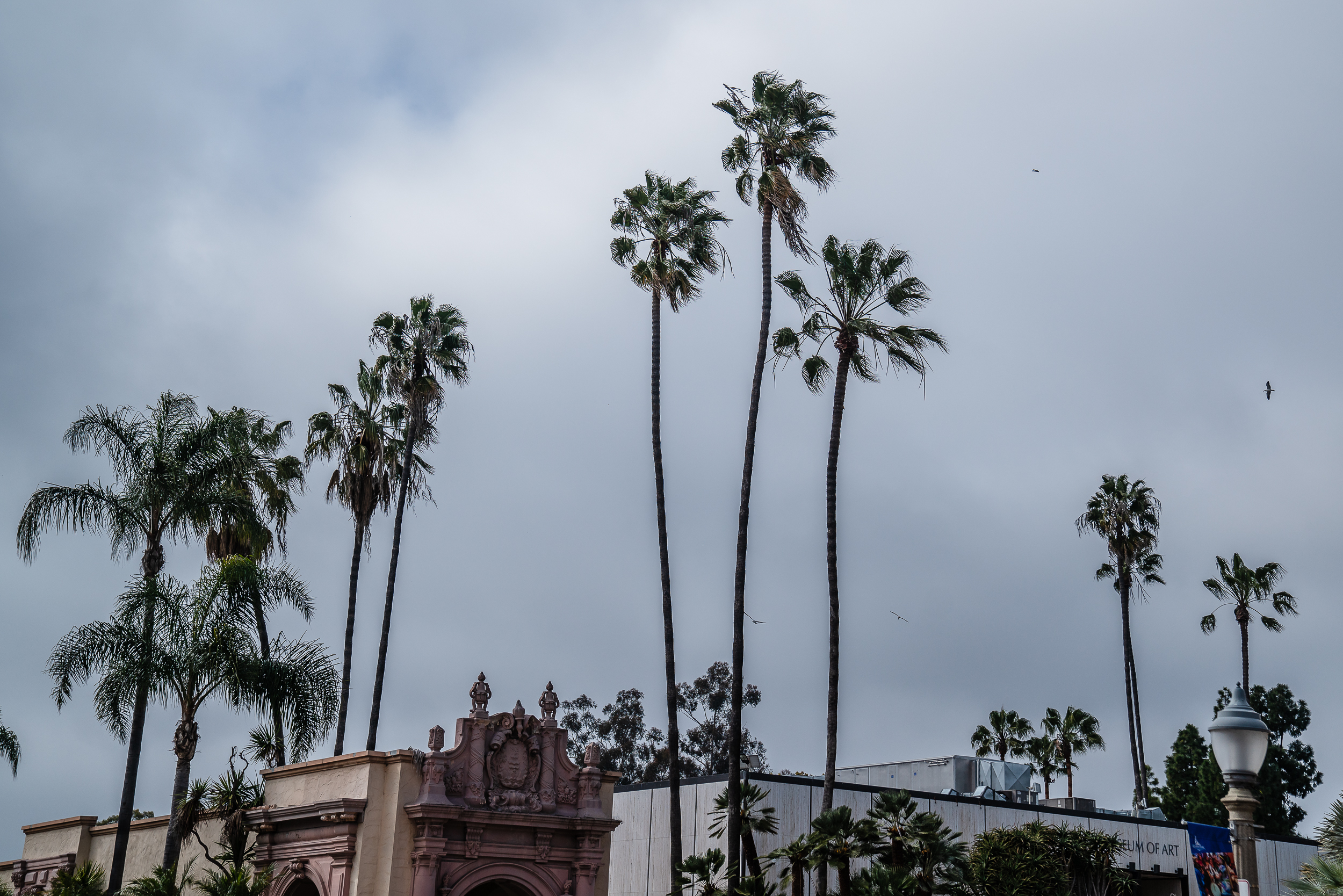
Free parking in Balboa Park may soon become a thing of the past; something we reminiscently tell our out-of-town family members about when we take them to visit the historic landmark.
“You know, parking used to be free here,” we’ll say.
Discussions about potentially charging for parking at Balboa Park are ongoing, but our Bella Ross dug into one of the big questions she’s been hearing about the proposal: Does the city charter allow San Diego to charge for parking in Balboa Park?
California statutes from the 1840s declared Balboa Park a “free and public park” when San Diego was entrusted with its lands. This has led some people to believe the park has to remain free, according to those statutes.
But Ross discovered that the city’s charter, adopted in 1889, and other state laws override that previous declaration about Balboa Park.
Still, this isn’t the first time the issue has come up, and it may not be the last. Ross writes that this question has spurred legal challenges in the past that stalled a major project.
It’s on … San Diego vs. LAFCO
The fight between the city of San Diego and the region’s boundary refs is officially on.
On Monday, the City Council voted 6-0 during closed session to initiate litigation against the San Diego County Local Agency Formation Commission, or LAFCO, and Executive Officer Keene Simonds.
But why? LAFCO is letting La Jolla proceed with its efforts to separate from the city of San Diego. Earlier this month, we reported how Mayor Todd Gloria was outraged by LAFCO’s decision to accept signatures the Registrar of Voters had ruled out.
He hinted the city would seek legal action.
“The decision by LAFCO to overrule the Registrar undermines public confidence in the integrity of this signature-verification process and sets a troubling precedent,” Gloria said in a statement Monday.
He said the action taken today by the Council will hold LAFCO accountable for “its arbitrary and capricious decisions.”
Related and interesting: The city is also fighting a lawsuit on almost the exact same issue. A few years ago, the foundations that support parks and libraries in San Diego joined with the largest union of city employees, the Municipal Employees Association, or MEA, to support a ballot initiative that would raise a parcel tax to support parks and libraries. The registrar of voters determined, just as it did with La Jolla, that it had insufficient signatures. The city clerk agreed.
The foundations and MEA sued saying, just as the La Jollans did, the signatures were thrown out for insignificant discrepancies between the signatures and official voter rolls. But unlike LAFCO, the city clerk agreed with the registrar of voters and rejected the ballot initiative. The case is now in the Court of Appeal and a ruling could come in just a couple weeks and it could set precedent for the case the city is now filing against LAFCO.
Border Report: There’s a Shortage of Lawyers for Children in Immigration Court

Children going through U.S. immigration courts are sometimes going through it alone as obtaining a lawyer becomes increasingly difficult in the Trump administration.
Judges in immigration court hear cases involving children every day. These are children of all ages and from different parts of the world, like Haiti, Mexico and Guatemala.
In these cases, children only have representation if their families can pay for a lawyer or can find one to represent their child for free. Otherwise, some children, even as young as toddlers, have to represent themselves.
Voice contributor Kate Morrissey writes that the federal government used to pay contracted lawyers to represent children facing court alone, but the Trump administration stopped those payments in March.
A federal judge has ordered those payments to resume, but those lawyers still haven’t received any money. The impact could be an increasing number of children having to navigate a complex system without legal representation.
Newsom Urges Cities to Clear Encampments
Gov. Gavin Newsom is again nudging cities to clear homeless encampments.
Newsom’s office drafted a policy that cities and counties can adopt or modify that bans “persistent camping” in one area, bans encampments that block sidewalks and requires local officials to try to offer and connect homeless people to a shelter before clearing an encampment.
Worth noting: As the Union-Tribune reports, all 18 cities in San Diego County already have camping bans. It’s unclear how much of an impact Newsom’s announcement will have here.
One take: San Francisco Chronicle columnist Emily Hoeven wrote that headlines about it made it seem like more of a big deal than it was.
“It was mostly a regurgitation of guidance he’d given local governments about a year ago after a U.S. Supreme Court ruling that gave cities broad power to clear homeless encampments and confiscate property from individuals living in them,” Hoeven wrote.
The bigger deal that got less attention: Newsom’s office announced $3.3 billion in state behavioral health bond funding for shovel-ready mental health and substance use treatment facilities from voter-approved Proposition 1. San Diego County and five providers learned they’ll receive funding to support seven local projects expected to supply more than 350 new beds. Projects that got good news on Monday include a county-backed 72-bed treatment center with detox beds and post-hospital care in National City and McAlister Institute’s planned El Cerrito recovery campus with at least 50 new treatment beds and outpatient services.
County Supervisor Terra Lawson-Remer cheered the Proposition 1 announcement Monday and called on local governments to help fast-track the projects.
“We brought this money home — now we need every city and every partner to help get shovels in the ground,” Lawson-Remer wrote in a statement. “Let’s not let bureaucracy delay care that’s ready to be built.”
In Other News
- San Diego County is facing hundreds of new lawsuits from now-adult victims who say they were sexually abused as children by social workers at county facilities like the Polinsky Children’s Center. (Union-Tribune)
- Leaders of San Diego County’s healthcare systems have been making trips to Washington D.C. to lobby elected officials into reconsidering planned cuts to MediCaid and MediCal. (Union-Tribune)
- Elizabeth Holmes’ husband – whose wife is currently in prison for defrauding investors of her failed blood-testing company Theranos – is raising money for a new blood-testing startup. (New York Times)
- Several Chula Vista City Councilmembers announced they would be bringing a resolution forward at today’s meeting denouncing federal tariffs. (KPBS)
- San Diego County has named Dr. Sayone Thihalolipavan as its new public health officer. (KPBS)
- Correction: We updated yesterday’s Morning Report section on bonfires to correct that illegal wood fires would be easier to spot not harder. A previous version mistakenly misquoted a city spokesperson.
The Morning Report was written by Tigist Layne, Andrea Lopez-Villafaña and Lisa Halverstadt. It was edited by Andrea Lopez-Villafaña.
Shouldn’t Voice of SAN DIEGO also mention that “Elizabeth Holmes’ husband” is also the son of local hotel magnate Bill Evans?
La Jolla is already ticked off at San Diego. Telling them their petition is no good because a couple of people didn’t cross their T’s right isn’t going to make it better. Just let them spend their money to find out how much it will cost and how long it will take. They’ll probably win a vote to leave, because all the other neighborhoods would like a template of how to be rid of Gloria.