

It seemed an implausible scenario for a case of mistaken identity: a college student on a road trip arrested for human smuggling.
On June 9, 2024, Ziming Wang, a 23-year-old Los Angeles college student with 20,000 followers on TikTok, excitedly packed his car for a road trip with his girlfriend and their three hamsters. Their destination? A cross-country adventure that would take them from San Diego to New York City, with stops in Los Angeles and Las Vegas. Just as he hit the highway, however, Wang’s trip became a nightmare that would force him to spend nearly 30 days in immigration detention.
This story is based on Wang’s recollections and court documents obtained through the Freedom of Information Act. (Editor’s note: Ziming Wang is not related to Yiqing Wang.)
At his TikTok fans’ request, Wang drove to the border to give his followers a look at the divide between the two nations. Rather than going to San Ysidro or Tijuana, Wang chose to drive east along State Route 94, seeking to film a more authentic border landscape and capture footage of immigrants crossing, he said.
Among the rugged hills and dusty trails in Dulzura, he stumbled upon a tense scene – three dozen dehydrated and wounded Chinese migrants were hiding out, refusing to come down as a group of U.S. Border Patrol agents attempted to intervene. An agent asked Wang why he was there, and when he explained his intentions, he said he was unexpectedly enlisted as a translator. From the afternoon until the evening, Wang said he raced up and down the hillside, translating the agent’s request and bringing water and bandages to those in need.
Further down the road, hidden in the brush, Wang and his girlfriend came across a couple who were voluntarily assisting a group of Chinese migrants – seven or eight in total. Among them, two elderly women and a younger woman stepped forward, seeking help.
Wang agreed to drive the three women to a nearby shelter, but with no cell service, he decided to start driving first and search for a specific shelter later. However, as soon as he started his car, Border Patrol agents surrounded them.
Within moments, agents arrested Wang and his girlfriend.
…
A Border Patrol agent told a different story.
Agent Guy Davis reported that he received an alert about a black Tesla driving on Otay Lakes Road suspected of picking up people who crossed the border illegally earlier that day, according to a report.
The agent wrote he spotted the Tesla and Wang at around 6 p.m. and watched him from down the road.
“I was then able to observe several subjects emerge from the surrounding brush and meet up with WANG. After they met, I was able to observe them walking in a hunched over manner back towards the vehicle,” Davis wrote.
Davis pulled Wang over and arrested the couple.
Later, another agent interviewed Wang. That agent wrote, “Wang stated that he was asked by one of his many fans on TikTok, to pick up family members near the United States/Mexico border.”
According to the interview transcript written by Fabian Gamez, Wang allowed the agent to search through a WeChat conversation and the agent found a video of people in a house and a photo of a passport sent to Wang. The interview ended around 10:30 p.m. and continued the next day.
Gamez wrote that Wang expressed a willingness to give more information about the “smuggling event” from the day before. But he also told the agent he wanted to consult with a lawyer.
“Due to a language barrier, WANG’s phone was used as a translator in order to clarify to WANG that I was unable to question him further,” Gamez wrote.
At that point, the interview ended, according to the report.
Border Patrol did not respond to a request for comment.
Monica Yoas, with the U.S. Department of Homeland Security, said that an Immigration and Customs Enforcement spokesperson commented, “ICE has no releasable information on this individual.”
‘It Doesn’t Feel Like America’
Wang denied going to the border to pick up family members and pleaded not guilty to the Border Patrol’s allegation of “alien smuggling.”
He said the passport photo in question belonged to a friend who had asked him to book a flight to Dubai.
“I never went to the border to pick up family members,” Wang said. “The message they found was from last year — they never checked the date. They assumed we were family just because we share the same last name.”
Nonetheless, Wang was detained under suspicion of human smuggling and placed in solitary confinement at Campo Station in Pine Valley for about 10 days. He said he wasn’t allowed to make phone calls or see anyone.
The days blurred together without a sense of time. Each day, he survived on two energy bars and slept on concrete, wrapped in a thin sheet of tinfoil, he said.
Immigration officials released Wang’s girlfriend and the hamsters about two days after they were arrested.
Later, Wang was transferred from the Campo Station to another migrant shelter near the Brown Field Municipal Airport, where he lived in the A4 cell, he recalled. Inside the shelter, Wang lived with 60 other men in a cell that only had about 40 mattresses. Each mattress was occupied by two to four people with clothes they had been wearing since they crossed the border.
“It doesn’t feel like America. Not like America at all,” Wang recalled.
Wang tried to explain his innocence, showing the Border Patrol intake officer his driver’s license and explaining he is a green card holder and a TikToker who was trying to film videos of the border.
No one listened.
“Stop lying to me. It’s a fake ID,” an officer sneered, holding Wang’s identification while laughing with his colleagues, according to Wang’s recollection.
“Only thing you can do is just wait,” another officer told Wang.
So Wang waited — another 10 days passed before agents transferred him to the Otay Mesa Detention Center, a facility notorious for its poor conditions. Many others, like Wang, have reported similar experiences during their detentions — mental and verbal abuse, inadequate food and medical negligence, according to sources that I spoke with.
Nearly a month since he was arrested, Wang finally made it to court. The judge seemed baffled by his presence and swiftly dismissed the case.
“Have you ever heard of a human trafficker traveling with his girlfriend and three hamsters?” the judge said to his attorney after the hearing, according to Wang’s recollection.
The Otay Mesa Immigration Court dismissed Wang’s case on July 2, citing the Department of Homeland Security’s position that “continuation is no longer in the best interest of the government” after a review of the case’s facts and circumstances.
Wang’s attorney, Melissa Sandoval, argued in a filing that the charge of alien smuggling was legally unsupported. She contended that the evidence only shows Wang transported individuals already inside the country — conduct that, according to Ninth Circuit rulings, does not meet the legal definition of smuggling.
Sandoval declined to comment.
Wang spent his 24th birthday in jail. He walked out on the night of the Fourth of July as fireworks lit up the sky. He thought of his original plan to marry his girlfriend in Las Vegas and turn the trip into a honeymoon.
Although Wang was eventually released, the experience is a bittersweet reminder of the freedom he nearly lost. He endured days in solitary confinement and later a crowded detention cell. His experience offers a glimpse into the psychological toll and harsh realities migrants endure in detention.
Solitary Confinement in Campo
Looking around – a mat, a stainless steel toilet, a water fountain – Wang realized he was in solitary confinement after fingerprinting and DNA collection.
Fear surged through him, accompanied by a bone-deep chill. He began shouting, banging on the door and asking when he could talk to a lawyer.
“I’m freaking cold,” he yelled.
No one responded. Wang kept pounding on the door, his desperation growing.
Eventually, a crumpled package of tinfoil was shoved under the door. He wrapped himself in it, but it was so thin he couldn’t move without losing the little warmth it provided. His breath became visible in the cold air, condensing on the tinfoil in tiny droplets. Soon, he was damp, and his skin took on a bluish tint from the zinc in the foil.
The light stayed on 24 hours a day, the mat was caked with mud that scattered when he slapped it, and the water from the fountain tasted like it came from a toilet. Wang lay on the cold concrete floor, listening to the distant sounds of people coming and going through the gaps beneath the door. He was on the brink of madness.
The only thing he had on him was his driver’s license, which he fiddled with repeatedly until the motion lost meaning. Then, he discovered a small stone, likely snapped off the sole of his shoe. Using it, he scratched his experiences onto the floor, along with his mother’s and girlfriend’s names. He wrote his mother’s name over and over again, as if anchoring himself to her could keep him from unraveling.
About seven hours into his confinement, Wang had his first interview with an officer. He recognized from the writing on the wall that he was in a room under the jurisdiction of the Department of Homeland Security.
The officer asked to examine his phone. Wang initially refused, but when the officer threatened to send him back to solitary confinement, panic set in. He reluctantly agreed to the search.
As the officer scrolled through his phone, he began asking questions. When Wang tried to explain himself or prove his innocence, he was cut off.
“I told him I’m a student, that I have legal residency and a valid visa, and that he could call my school,” Wang recalled. “But he wouldn’t listen. Every time I spoke, he interrupted me and said, ‘I want to hear stuff that I want to hear.’”
A Tiktoker who has heard many “Zouxian (walk the line)” experiences, a term referring to the dangerous, unauthorized journey many Chinese migrants take to cross borders. So, he changed his approach and started telling stories. He mentioned that many of his fans wanted to come to the United States, and some, like people at the border, didn’t have legal residency. He explained his trip to the border was meant to attract attention for his videos.
After finishing the search of his phone, the officer abruptly stopped questioning Wang and sent him back to solitary confinement.
Wang’s desperation spiraled out of control. He slammed his fists against the door, over and over. His breathing became labored, his heart raced, and his legs grew so weak he could no longer stand.
He called out for help from the guard, but the guard told him to “ask your fucking self.” He tried to get attention by yelling while rolling around on the floor, but he was only offered sleeping aids.
Eventually, exhaustion overcame him, and he drifted into sleep.
A medical summary form from the Department of Homeland Security indicates that Wang was diagnosed on June 15 and 16 with anxiety, along with symptoms of shortness of breath and chest tightness.
Wang experienced his darkest moments at Compo Station, detained in solitary confinement for a week. The food he was given—two pieces of sticky, vapor-soaked bread with a thin slice of tomato and a slice of ham less than half a millimeter thick—did little to sustain him.
He would wake up, cry and go to sleep, repeatedly. His body had no energy.
“I was worried about the outside, my house, my mom and my girlfriend. I was afraid that they were worried. I was afraid that they were in pain,” Wang told me.
Hope, Despair and Endless Transfer
After about 10 days, Wang was transferred to another migrant shelter near Brown Field Municipal Airport.
“It’s like a makeshift chemical factory,” Wang said.
It’s a large, domed structure made of duct tape, drop cloths, and canvas, with exposed ventilation ducts. Inside, a row of televisions displays the words “Homeland Security” in various languages.
In a cramped cell packed with nearly 60 people, he finally had the sense of time and was able to speak with others for the first time, including several Chinese migrants.
When they heard Wang’s story, some of the Chinese migrants shared their chips with him, cracking jokes to lift his spirits. Wang found comfort in these brief moments, but the bonds were fragile, because everyone would soon be transferred elsewhere.
“I was thinking about death,” Wang recalled. “A social connection had just begun to form, only to be torn away. I was the only one left behind.”
On the sixth day of Wang’s detention in the shelter, his name was called. By then, most people in the shelter knew him—his story, his long stay, his struggles. As he walked down the hallway, cheers erupted from other cells. They were celebrating what they thought was his release.
But when the officer scanned the wristband bearing his name and barcode, the system rejected him.
“You’re the wrong guy,” the officer said, according to Wang’s recollection.
Stunned, Wang stood frozen, uncertain of what to do. No one offered an explanation. No one told him what would happen next. As he was escorted back to his cell, tears streamed down his face. The little hope he had was slipping away.
When he returned to his cell, some of his cellmates gathered around, asking what had happened. Sensing his despair, one of them pulled a strip of beef from a dinner sandwich—no one knew where it had come from—and handed it to Wang.
Coming from all over the place, they barely understood each other, yet at that moment, language is no longer a barrier. In a place where everything was uncertain, they had become the closest friends they had ever known.
Another time, Wang’s name was called again, but the outcome remained the same—he couldn’t be transferred.
He felt nothing anymore—his emotions drained, his tears long dried. Few days later, he was finally seated for the third time on the bus and transferred to the Otay Mesa Detention Center.
Inside the Otay Mesa Detention Center
Located on the outskirts of San Diego, Otay Mesa Detention Center is a sprawling complex surrounded by high fences and security towers. It serves as an immigration detention center operated by private contractors, holding a maximum of 1,040 detainees who are mostly awaiting court orders of their immigration cases.
According to detainees, Otay Mesa is divided into sections labeled with letters, such as Sections A, B, and C, each housing around 100 people. These sections occupy two floors of a building, with seven to eight cells per floor and eight people per cell. The facility also includes solitary confinement cells and smaller cells designed to hold less people at a time.
When Wang first arrived, he and about three dozen others were taken to an intake room.
“They called us out one by one to change and store our clothes, then made each person get dressed inside the bathroom,” he said. “By the time we had all changed, it was already one in the morning. We had been standing there for nearly five hours.”
He was assigned to a two-person cell in the L section—but was alone. For the next two days, he remained in that cell.
With nothing else to hold onto, he pulled a pencil that he hid from his pants pocket and began writing in the booklet issued by the detention center.
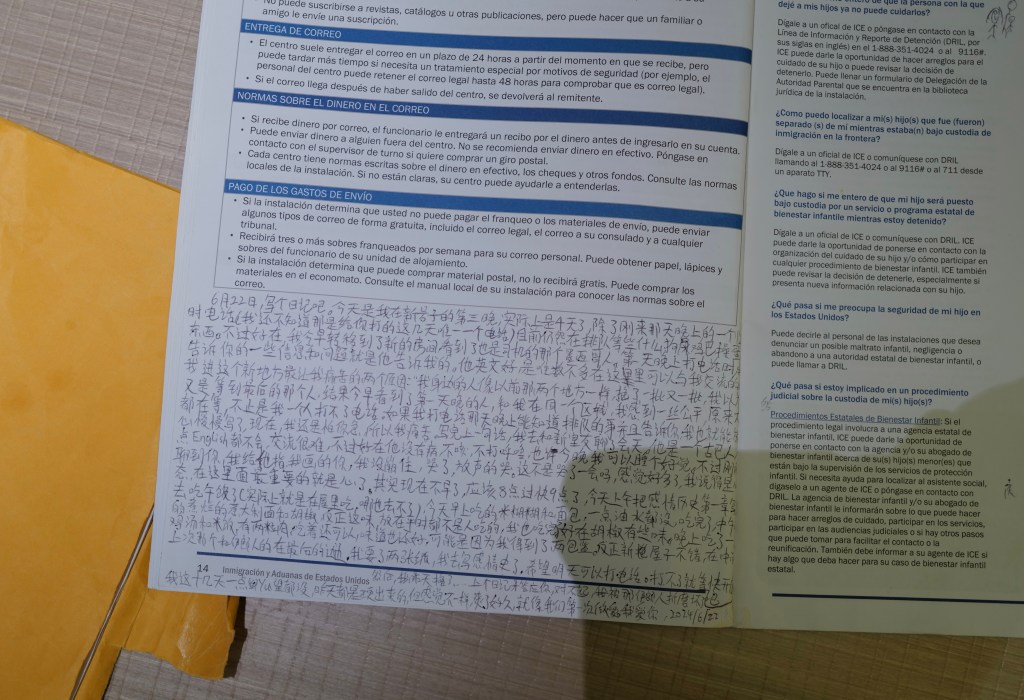
[Translation: June 22 … I’m still afraid that you’re worrying about me, and that thought alone brings me pain. After I finished writing my last sentence, I started chatting with my new cellmate. He’s from Cuba and doesn’t speak any English, so it’s hard to communicate. But at least he’s not sick—he doesn’t cough, which means I might actually get a good night’s sleep tonight.
We talked about you, and I showed him my drawing of you. I couldn’t hold it in—I broke down and cried so hard. But now, I feel a little better. The most important thing here is keeping the right mindset.]
…
Two days later, Wang was transferred to another cell in the K section, where he was placed with an Iranian cellmate who coughed up blood every night.
“Every day, people are malnourished, faint, and are taken for resuscitation at Otay Mesa. Every single day,” Wang said.
I spoke with some other Chinese migrants who shared similar experiences with Wang. They said that all medical requests must be submitted as handwritten forms to an officer, often followed by extensive wait times for a response.
“Unless you pass out or are about to die, no one will look at you right away,” a detention center director told Shicai Xia, a detainee on his sixth day in custody, according to Xia’s memory.
After being detained at the facility for 20 days, Xia began coughing. Despite submitting multiple requests, he had not seen any doctors or medical staff for treatment.
“Whether you live well or not depends entirely on the officer’s personality. There’s no system or authority to regulate their behavior,” Xia said.
Wenqi Ma, a detainee who spent over six months at Otay Mesa, said the facility required people to sanitize their cells three times a day using brooms, mops, and disinfectants.
“The AC brings in some dust and viruses. But overall, the hygienic conditions were up to standard,” Ma said.
As his cellmate was taken away, Wang sank back into loneliness. His mind drifted to the first room he had stayed in after intake, where he had noticed the walls covered in words and numbers etched in various languages—marks left by those before him to track time or record their immigration status.
Among them, the earliest Chinese writing dated back to 2021.
“It was horrifying and heart-wrenching,” Wang recalled. “I cried when I saw it for the first time.”
Malnutrition has been another problem in cells. Every day, Wang subsisted on a food paste made from beans and vegetables.
“It was a very small portion, probably less than 3 oz with a musty smell,” he said.
Besides paste, he was given rice and boiled potatoes accompanied by a small packet of salt and pepper. The best meal he had in the cell was chicken onion soup.
Occasionally, the officer would leave a food cart in the middle of the hallway, opening each gate and asking detainees to pick up their meals themselves.
“For those few dozen seconds of freely walking,” Wang recalled the moment he stepped out of the cell. “It felt like the most precious time I had.”
Adriana Jasso, program coordinator at American Friends Service Committee, has visited Otay Mesa several times. She likened the experience to a situation where “someone visits your home, and you make it very clean and presentable.”
Ian Seruelo, an immigration attorney in San Diego, said that he felt “depressed” every time went to Otay Mesa.
“I sort of suffer from imagining the condition of people who are detained in the facility,” Seruelo said.
Ma recounted instances where officers would play loud, unsettling sounds from thriller movies as early as 5 a.m. to wake them up.
“It’s not physical, fist-to-fist violence. Most of the time, it’s a psychological, calculated form of violence,” Ma said.
Chaotic System
In 2023, 6,521 immigrants were detained in the U.S. Immigration and Customs Enforcement facilities across the United States, with an average stay of 31 days.
However, many detainees felt they were held for much longer. Their time from entering the detention center to appearing in court was often marked by confusion and chaos.
Dulce Aguirre, general manager at Border Angels, acknowledged that many immigrants she has encountered waited three to four years before their cases were heard.
“I think it’s a systematic problem. Even when we try to request answers or reach out to them for updates, it’s just overall very delayed,” Aguirre said.
Due to language barriers, many detainees were unaware of the next steps or the purpose of the forms they were asked to complete. Wang recalled helping multiple Chinese migrants translate their information into English, only to later discover that the form they had signed was a voluntary repatriation agreement—a document in which detainees consent to being deported without contesting their immigration status or seeking legal counsel.
“Many people had no idea what was happening and were cheated until they sat on deportation planes. People like me, who can speak English, are almost non-existent there,” Wang said.
In 2023 and 2024, ICE operated with a $9.1 billion budget. According to the budget report, an additional $556.8 million is set to be allocated in 2025, raising the total budget to nearly $9.7 billion.
Priscilla Merida, managing attorney at Al Otro Lado, said extended wait times in detention centers could have serious consequences for detainees in their hearing processes.
“At the end of the day, in my opinion, their due process rights are negatively impacted when they’re detained and subjected to deplorable conditions, medical neglect and abuse of treatment. It really stifles it,” Merida said.
Aftermath
When Wang was released from Otay Mesa, he had lost nearly everything—his car, two phones, and his wallet containing all of his bank cards.
He moved twice and spent three months fighting to retrieve his car from the Asset Forfeiture Office in San Diego. Despite contacting Otay Mesa multiple times for updates, his two phones remain missing, and one of them was later activated in Mexico, according to Apple’s Find My app.
He received stacks of documents from the Department of Justice and the Department of Homeland Security, but none mentioned or offered any apology and compensation.
“I wasn’t wrongfully detained for nothing, because I did have three illegal immigrants in my car when he arrested me,” Wang said. “But the overall system is chaotic and resulted in me receiving injuries that I didn’t deserve.”
He now struggles with sleep disorders, often waking in the middle of the night from nightmares. The ordeal left him disillusioned with the system and deeply shaken.
“If everything starts over, I will choose to leave the United States. I will never want to come back,” Wang said.
Wang booked a flight back home in December 2024.
Note: Quotes from Ziming Wang, Wenqi Ma and Shicai Xia are translated from Mandarin.
This was a well written story and it captured the spirit of this young man and his struggle in detention. Very eye opening.
44,000 USD online People’s lives are changing rapidly. Every year more and more people are participating in online trading. 73.3 million Americans donated last year, and that number is expected to grow significantly. q
For INFO click my user Name<<<<<<<
I’ve heard that human smugglers get paid well. How does a 23 year old college student from China afford a $90,000-$150,000 Porsche? Something doesn’t add up about this story. This all happened under Biden / Harris, long before the Trump administration but the atory is being written now in a failed attempt to blame Trump. This is a very dishonest tactic of the media. Also, it looks like Wang is doing well in China, the photo at the top shows him driving his car, a Porsche that costs more than most American citizens make in a year. What is his profession again? A “Tiktoker” with a mere 20,000 followers. Yeah, right.
Would standard journalism protocols not include explaining at the outset of the article that this individual is a citizen of another country on a visa? Stating that he was a 23-year-old college student from Los Angeles without this further information is an editorial failure at best, intentionally deceptive at worst. Only at the end is this tucked in. The insights into the detention system are quite eye-opening, although mostly unverified, but would a foreign national picking up and transporting other undocumented foreign nationals not expose themself to outcomes that might not be faced by a U.S. citizen? Were I to visit China and intentionally pick up unauthorized immigrants I would not imagine the outcome would be quite as in this case. In fact, I might still be in prison.