
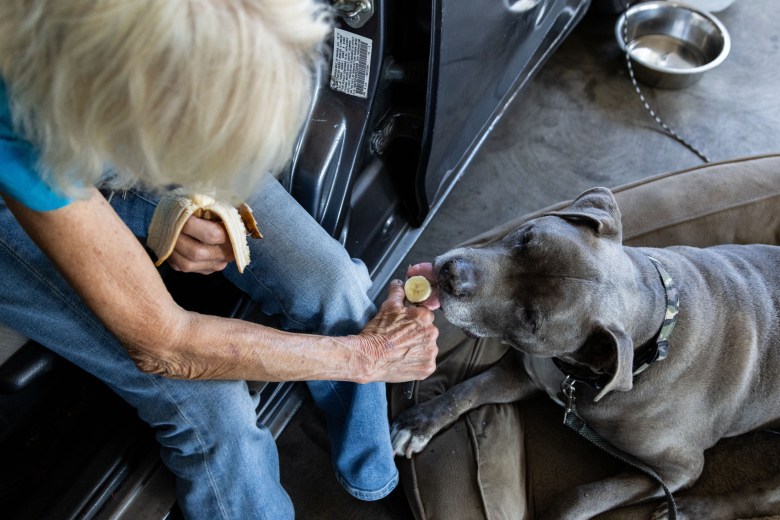
For the first time in nearly three years, San Diego had more people exit than become homeless – advocates are crediting diversion as the reason why.
When Susan Peterson went back to living in her car in San Diego, she was embarrassed to reach out for help again.
After years of sleeping on and off in her car, homelessness caseworkers had arranged for her to move to North Carolina. The 75-year-old managing a leukemia diagnosis was going to move in with her daughter. Unfortunately, that didn’t work out.
In February, Peterson was back in town, sleeping in her car at a parking garage near the El Cajon library. Her former caseworker, Vani Melei, called her by mistake looking for another Susan and learned the sad news.
“I told Susan it was fate that I called her on accident,” said Melei, a safe parking program manager at Crisis House. “I reassured Susan that I’m back on her support team and that I will make some phone calls on her behalf.”
So began the work of diversion, a strategy gaining traction in San Diego thanks to its success rate in getting homeless people in permanent homes.
Diversion is an approach that focuses on helping people come up with solutions to their own homelessness. It is often coupled with financial assistance to help resolve a one-time expense. People who have recently become homeless and have a job, a car or relatives who could take them in are ideal candidates.

Caseworkers with homeless serving groups identify an area of need, like a security deposit or the cost of car repairs, that if covered, would help someone remain housed. They also help individuals comb through their connections and evaluate their options. Once the caseworker knows what would help, they pull the one-time expense from a fund backed by the county and philanthropists.
The goal is to divert people from the existing and overrun homeless response and shelter system and help them find stable housing as soon as possible.
In Peterson’s case, her caseworker, Melei, connected her to a caseworker with People Assisting the Homeless, or PATH San Diego. From there, the county’s Office of Homeless Solutions enrolled her in a Safe Parking program.
Peterson told Voice of San Diego she never considered staying at a safe parking site. She said she felt safe already with her 13-year-old pit bull Ninja and didn’t see why she should move elsewhere. But county case managers told her enrolling in a safe parking program could open doors to other housing opportunities. After learning that, Peterson said the decision was a no-brainer.
She started spending the night in the safe lot in Valencia Park.
Days later, Peterson received a Section 8 housing voucher. The federal program provides rental assistance for low-income people, allowing Peterson to afford a roof over her head.
“I don’t want to let this get away,” Peterson said.
How Diversion Got Started
In 2018, the Regional Task Force on Homelessness, which leads San Diego’s homelessness response, contracted Ed Boyte, a nationally recognized educator in conflict resolution and diversion training, to help train San Diego service providers.
He helped train people across the county in diversion tactics and taught them to teach others. At that time, diversion was a pilot project with little funding.
In 2024, the task force ramped it up after the county, city of San Diego and philanthropists pulled together $1.5 million to support it.
The data shows it’s working.
According to task force’s report on diversion from that year, 93 percent of the near 600 people who accessed diversion strategies got permanent housing. And almost all of them remained housed for the next year.
The task force credits the program as the reason why in November and December 2024 more people exited homelessness to permanent housing than became homeless for the first time in almost three years.
In 2025 the task force’s annual census of homeless residents made note of about 9,900 people experiencing homelessness in San Diego county. The year prior, while diversion was being scaled up, it counted around 10,600 people.
When someone enters a shelter it’s more difficult to have them exit to permanent housing. One family shelter in San Diego, run by Alpha project and the San Diego Housing Commission since 2023, reported that in the second year of being operated by Alpha it reported a 50 percent positive exit rate, helping 18 household get into permanent housing.
Diversion was able to serve 489 households in 2024, with an exit rate forty percent higher.
“It gives us a chance to get ahead, so that resources can actually make a dent in the chronically homeless population,” Sofia Cardenas, data and compliance manager at Alpha Project said.
Diversion has proven to work fast.
Typically, caseworkers will be able to have a solid plan for someone’s housing in about 30 days when taking a diversion approach. Usually, it takes nearly six months for someone in a homeless shelter to find housing, according to the task force.
Peterson said she couldn’t believe how quickly they were able to help. She connected with Melei in early July. By July 31, she was about ready to move into her new place.
“It gives our case managers another set of options when usually so much of our answers are telling people to wait,” said Cardenas.
Why Diversion
Diversion typically costs $3,150 per person in the form of a one-time payment according to the task force. Compare that to the average 169-day stay at a homeless shelter which costs the organization running it around $20,080.
The reason diversion can be cheaper is because caseworkers are trained to look for candidates who would stay successfully housed if they got one of these one-time payments, Cardenas said.
Tamera Kohler is the CEO of the task force. She said they initially thought the sweet spot was when someone is initially about to fall into the shelter system, but it can also be once they are past that point of crisis from initially becoming homeless.
Cardenas at the Alpha Project said about 30 percent of their clients fit that mold of someone who is about to be homeless.
Historically, Kohler said by allowing people to take ownership of their own journey out of homelessness there’s a motivation to make the solution last.
“You can imagine, for someone who feels very unseen and unheard, how incredibly valuable it is that someone believes that maybe you’re also working hard to end your homelessness, and maybe you got a good idea,” Kohler said.
Peterson knows this well. She fell back into homelessness once before after trying to get out. Eventually, through diversion, Peterson said she received the help she needed to get herself out of homelessness. She could finally tell a caseworker what she really needed to get out – help finding an affordable place – and the caseworker listened.
Diversion’s Potential
Homelessness advocates are happy with the results so far, but it’s not baked into the larger, traditional homelessness response the county relies on. The program needs more and consistent funding to keep going.
San Diego County Supervisor Terra Lawson-Remer helped secure money from the county for diversion, and she wants to see it used more often.
The supervisor’s spokesperson Spencer Katz said they are looking to get more investments from philanthropy to keep the momentum going.
Cardenas said more money means more and better-trained case workers. Training is key to a successful program. Caseworkers need to know how to identify people who would benefit and let them lead in coming up with solutions to their homelessness.

For Peterson, after about four years without a home, she described it as “surreal” to know she will have a place of her own soon. All she’s waiting for is the apartment complex to do some final processing of her application and to drop the keys in her hands.
She feels lucky her building has a laundry room, and that the location is close to the doctor who monitors her leukemia.
The thing she’s most excited about is having air conditioning. Right now, she parks on the second floor of a parking garage because there’s a nice breeze to keep her dog cool, who suffered from heat strokes as a puppy. She keeps a cooling towel for him and cranks up her car’s AC just for him while she wears a hoodie.
“It’s not his time to go,” Peterson said, her eyes welling up, “I’ve had him for eleven years. I can’t imagine life without him.”
I like this! It is fast, it is effective and it is cheap. In an era of budget deficits and cuts to federal funding, this will make our dollars go farther and it gets people off the street without months on a waiting list. Well Done.
If you believe all of the “data” in this article, you are part of the problem since all of the poverty pimps “helping” the homeless always claim their solution works and they constantly scream for more funding.
It does work. They explained the difference in diversion and 6 months in a shelter. That’s not counting all the ones who go to the ER every few days to be locked up in a mental ward just to have a roof. That has to be way more expensive than the 3100 or so for one time payment. Also when people get into a home and know that they have help making the rent it’s something they don’t want to lose so they pay the next bill and get empowered and then continue. They need to use the population they are housing and train them to work w y’all to get people off the street bc those people know the problems N can spot the ones w potential and the ones that don’t.
great
https://post4boost69.blogspot.com/
How does one contact diversion program?
211 or housing first hotline. (619) 578-7768
I still don’t completely understand what Diversion does. None of our sick and elderly should have to deal with being homeless. I’m very happy for her but, if there are no Section 8 vouchers, how on earth did she get one ?
ExLACKly, I did total of 1 year and a half in shelter case worker was a dunce 8th grade level at best.He actually did me wrong.getting my stuff stollen including my dentures. Preventing going out on Thursdays.Asking why was told to take talk over plan with our case workers total lie seen my worker in a hall ask him what’s going on sez. Oh,I’ll come by your bed or find you, B.S. He punched out went home. Just an example of the whole time there, waste of time. Im back on the streets. Want Something done,Do it Your self. Illumination Foundation did me actually wrong if I was to explain
Id be here till who knows and its only 11:35 am.
homelessness is out of control.. why don’t we read about getting these people off their butts and obtaining a freaking job??! expecting society to fix problems irresponsible behavior created is gross..
Try filling out a job application!
You are actually suggesting an elderly / already at full retirement age individual, who is fighting a long term battle with Leukemia (aka CANCER!!!), get “off her butt” and get a job? AND that her circumstances (developing CANCER!!!) resulted from her own irresponsible behavior? You truly are an ugly human being. “For there, but by the grace of God, go I” I would be curious to see how different things would be for yourself, if (God forbid) you find yourself or a close relative in the same or similar circumstance. I mean this lady even tried moved to the opposite side of the country to stay with her own daughter to escape homelessness, and while the article didn’t elaborate on specifics, that move “didn’t work out” and had to return to a situation she made attempts to get herself out of. Let me guess, you tout yourself a Christian don’t you? I don’t think you and I serve the same Christ.
I got a section 8 voucher while I stayed at a shelter, didn’t like the shelter, but it beats being on the streets and the police officers always bothering the homeless and making the homeless move all over the city. I wish we had diversion here in our area. I think this would help our huge homeless population.
So the success story is someone who was as living with family in North Carolina moved to San Diego to be homeless? This supports the idea that increased funding = increased homeless.
No that’s NOT what the article says. She was already homeless and already battling Leukemia, when she moved from California to North Carolina to move in with her daughter and no longer be homeless. Sometimes after arriving in NC (unfortunately no specifics given but I imagine she doesn’t want to elaborate on whatever one might consider private family dynamics) that situation “didn’t work out” so being forced back into homelessness she chose not to stay in the unfamiliar area of NC and returned to California where she to some extent knew her odds of surviving while homeless would be better, because she would be familiar with other resources / locations / people in the area she had been previously homeless in.
It was not diversion that fixed her problem it was getting a section 8 voucher in months not 10-15 years. It was having a case worker and a program (PATH) who actually cared about helping this woman.
The hotel and safe parking programs are great but the cost of those programs are astronomical. It would cost less to fund section 8 and get people real permanent housing. A voucher is $2500 a month about. The hotel program cost $3500-$4000 per person per month at bare minimum. Where’s the logic in that?
I completely agree. I am still not understanding how she was able to get a voucher so fast. She deserves it of course don’t get me wrong, I’m just wondering about the program. Is stated that it pays for like a hurdle or something one time that someone need and then they get housing I guess? I’ve been homeless in my vehicle for going on 4 years, but now in a shelter and I’ve been on the section 8 waiting list but just wondering how the program works because it sounds great, and I would love that to happen to me as well.
Why you have to become a homeless in order to get section 8 vouchers? Why people especially ones who senior citizens, have cancer, and live on badges, and can’t afford outrageous rent in San Diego can’t get there section 8 vouchers before they actually get evicted especially when there already more than 12 years on waiting lists for that program)
My brother is homeless needs a roof over his head, he had heart surgery and I taken so many of pills, he sleeps in his truck and receives 1000.00 a month for food, gas and anything he needs to keep the maintain on his vehicle running so he can go to his appointments. He has told me he has almost over dose with his pills because he has ro much. His worker said she will pull strings for him. Which she has only pulled his leg. He needs help want to not live in his truck because he knows he will die. I’m his only living sister. My brother’s name is James Tan. There is always happy stories but never my brother’s way, that would be nice to see a happy story for him
Well can you help my daughter she has been homeless for two years and she can’t live in the shelter because they are full and she has a disability and she needs a family law attorney to get her kids back and a house now because that is what the court said Solano county doesn’t grantee safety in the shelters and so can you please help her get a house a two bedroom she will be willing to work to pay the rent a reasonable job email me at Rene5014@yahoo.com thankyou
“I work for homeless and mental non-profit donate to us and never ever give directly to them or they will waste it”