
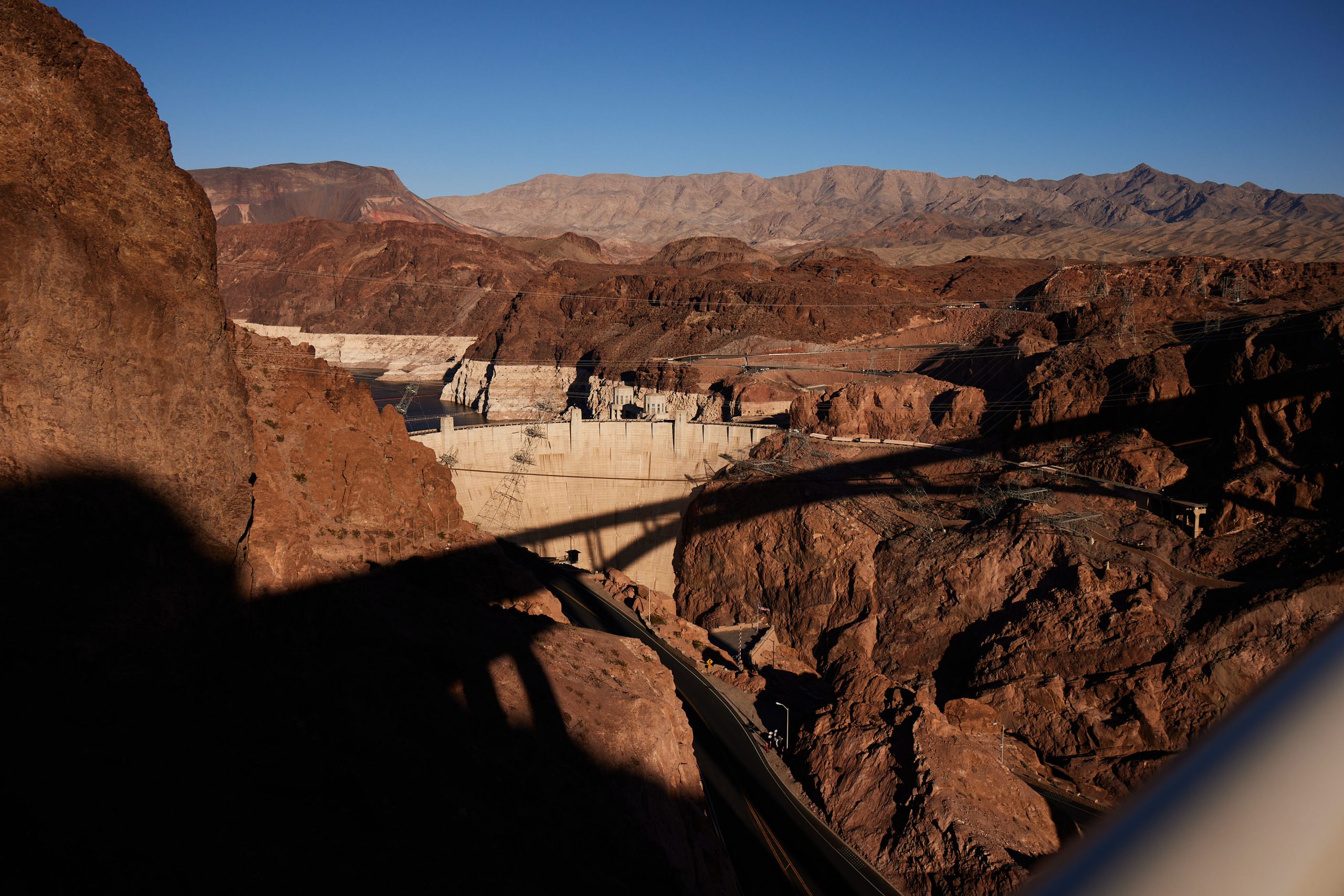
The river responsible for the very existence of San Diego is again in crisis with major reservoirs used to store water at critically-low levels again – and still nobody can agree on how to save it.
Feb. 14 marks another deadline imposed by the federal government on seven U.S. states that rely on the Colorado River to figure out how to use less of it. Cities, farms, industries and tribes are all vying to exist in a world where there’s less water to support them.
The Rocky Mountain snowpack in Colorado, the Colorado River’s water source, is doing particularly poorly this year. A warm and dry winter means those mountain tops have 57 percent of the snow they’re expected to have.

State governors (except ours) met in Washington D.C. earlier this month to try and hash out a deal. The Colorado Sun’s Shanon Mullen reported that Arizona appears to be the hold-out on an agreement.
Because it signed on later than many other river users on a Colorado River compact, it’s one of the first to get cut in dry times. The Los Angeles Times’ Ian James explained Arizonans were expecting river levels to fall so low that the state could claim northern river users were breaking that century-old agreement on how the river gets used.
My takeaway from the last round of talks held in Las Vegas in December was that this had become a very North versus South issue along the river. California, Arizona and Nevada presented a united front and committed to using less water – in effect goading Colorado, Utah, Wyoming and New Mexico to do the same.
But in those states, there are individual landowners who hold older and more powerful rights to use the river than whole U.S. states – because that’s how the Colorado River compact was set up.
“The Upper Basin states cannot legally commit to mandatory cutbacks,” Colorado Gov. Jared Polis told James, because it would mean the government was taking those rights away and “would be liable for hundreds of millions or billions of dollars.”
The federal government could step in at any time (and could have back in November when they had originally set their deadline but then granted another two-month extension) to be “the bad guy,” as I wrote back in December. Then state politicians trying to defend their constituents’ water rights wouldn’t have to take the blame for any loss of water.
So how will cutting back on water from the Colorado River affect Mexico? What is their allotment?
The State of Colorado diverts almost 30% of the CO river basin water to the East and South; Trans basin Diversions. Almost ALL of those diversions are with Jr. water rights, coming AFTER the 1922 Compact.
Colorado Governor Polis, and AG Weiser are either un-informed, or are lying. If it goes to the courts (the SCOTUS is the water court) Colorado will get caught in a lie. Colorado does not want to reduce ANY water use. That is left for the lower basin States.
Colorado diverts over 3,000,000 Acre feet of water (not 30%) into the North Platte, South Platte, Arkansas, Rio Grande, and San Juan rivers. All that is taken from the Colorado River. Most of it taken after the 1922 Compact.
Another inconvenient truth about the Compact is that the majority of the Colorado river water used by California before the 1922 compact would be considered California’s water rights, as they first put that water to productive use. The compact was a way to give the upper basin states additional water rights, that they did not have prior to 1922. The compact gave the upper basin states 100 years to “develop” their rights. Those rights were given up by California and Arizona in the Compact. This to achieve “comity” among the states.