
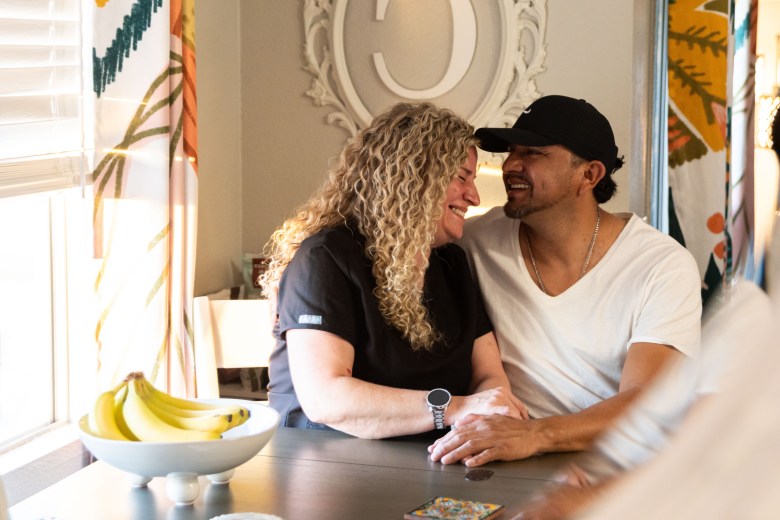
Trisha Sleek-Castañeda sat in the back of an immigration courtroom in Otay Mesa Detention Center, her hands clasped tightly, as her husband’s attorney tried — again — to get him out of custody.
She spoke with me in November after Immigration and Customs Enforcement officials arrested her husband, Misael Curiel-Castañeda, outside their home.
Since November, Sleek-Castañeda watched her husband, Misael Curiel-Castañeda, losing weight week by week as the federal government argued that he could not be released. That’s because the Board of Immigration Appeals had suddenly decided — in a major shift in its interpretation of the law — that people who had spent years inside the United States after entering without permission had to be held mandatorily in custody without a chance at a bond hearing.
“It was sad for me to see him because he didn’t look like himself,” Sleek-Castañeda said.
The Case

On Jan. 2, Curiel-Castañeda’s attorney Ian Seruelo had a plan. He had filed a writ of habeas corpus petition in federal court, which argues that someone is being wrongfully detained and should be released. Immigration attorneys have increasingly turned to this approach as the Trump administration detains more and more people.
A month before, a federal judge in the Central District of California ordered that the government had to provide bond hearings to people present in the United States who had entered without permission, as it had for years.
In Curiel-Castañeda’s habeas case, the attorney representing the U.S. government had acknowledged that Curiel-Castañeda was a member of that recent class action lawsuit and thus entitled to a bond hearing.
Seruelo showed Judge Mark Sameit that attorney’s filing, but because of a backlog, the federal judge in the case had not yet issued a final ruling. Seruelo argued that the admission from the government should be enough for Sameit to give his client a bond hearing.
Meanwhile, the attorney representing Immigration and Customs Enforcement in the detention center courtroom, Shane Chase, argued that the judge still had no jurisdiction because of the Board of Immigration Appeals decision.
“It is confusing that the United States could take two different positions, one in federal court and one in these proceedings,” Sameit said as he weighed the attorneys’ arguments.
The judge then decided that he could go forward with a bond hearing.
ICE did not respond to a request for comment.
Seruelo told Sameit about Curiel-Castañeda’s wife, a U.S. citizen, and she eagerly raised her hand to identify herself in the courtroom. The attorney presented his argument for Curiel-Castañeda’s release, saying that he was neither a flight risk nor a danger to the community, the two factors that judges have to weigh in immigration bond hearings. He said that Curiel-Castañeda provided for his family and took care of his wife, who has a serious medical condition. He noted that though Border Patrol agents had once arrested Curiel-Castañeda in 2007 because they believed he was working in a human smuggling operation, the agency had not pursued charges and Curiel-Castañeda had never been charged with or convicted of a crime. He was deported that year after agreeing to leave the country and returned in secret later that same year, eventually meeting Sleek-Castañeda and making a life with her.
Chase, the ICE attorney, argued that Curiel-Castañeda was a flight risk and said that he had reentered the country multiple times. No one corrected the attorney that Curiel-Castañeda had only reentered once, which frustrated Sleek-Castañeda, who sat quietly because she didn’t want to get in trouble for interrupting the judge.
In the end, Sameit decided to grant Curiel-Castañeda a bond amount of $7,500.
Chase, still not convinced that the judge had the authority to grant a bond hearing, said the government would reserve appeal, giving him 30 days to decide whether to send the case to the Board of Immigration Appeals. That meant that Curiel-Castañeda would remain at Otay Mesa Detention Center until the government decided that it didn’t want to appeal or for the duration of the appeal.
“I felt like I was dying,” Curiel-Castañeda said in Spanish.
He went back to his housing unit and cried.
‘I’ll Never Heal from That’
Outside the detention center, Sleek-Castañeda asked how much longer she would have to wait for her husband to come home. His birthday was coming up, she said. She asked Seruelo what else they could do.
He told her they would have to wait to see what ICE decided in the case.
What happened to her husband illustrates how the immigration system allows the federal government to keep people in custody in ways that would be considered illegal in the criminal context.
“The fact that Congress has set a more bare bones procedure that allows government officials to detain people more easily and to keep them locked up more often suggests to me that our modern inclination is to detain and forget about people without valuing the human consequences that confinement produces and without weighing very heavily the financial costs that goes along with that,” said César Cuauhtémoc García Hernández, a professor at the Ohio State University College of Law and author of several books about the detaining immigrants and the intersection of the immigration and criminal justice systems.
García Hernández said Sleek-Castañeda’s situation simply cannot happen in the criminal context because it would violate Constitutional guardrails. The government cannot appeal when a judge grants someone a bond in criminal court, and it has to release someone who has paid the required bond amount.
Five days later, the federal judge in the habeas case finally issued an order instructing the federal government to give Curiel-Castañeda a bond hearing.
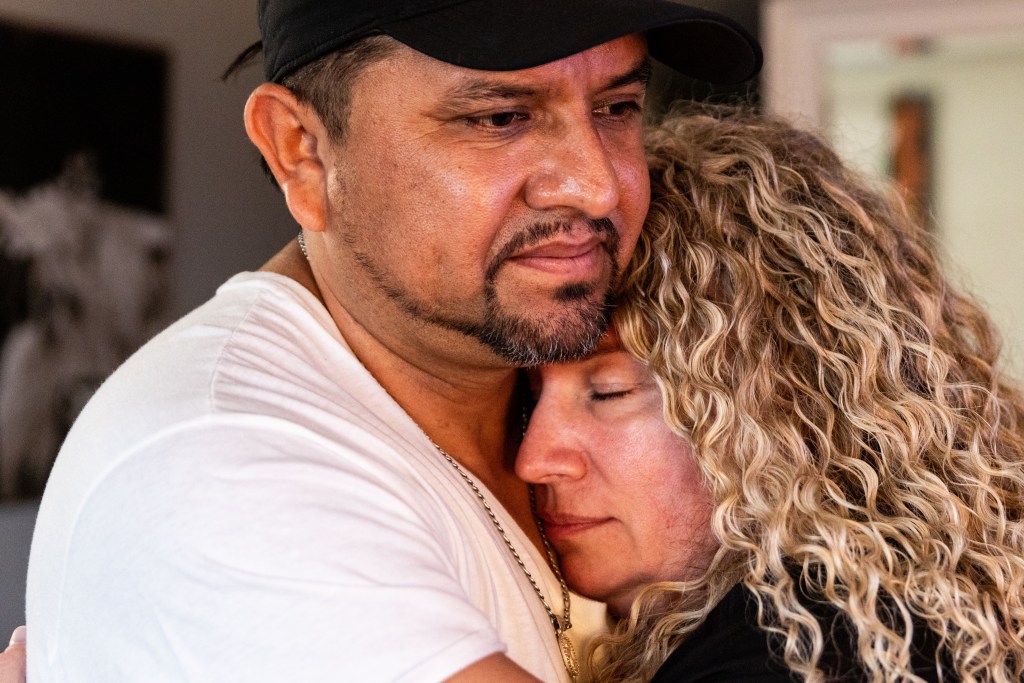
A week after that, Curiel-Castañeda stepped off a prison bus near the San Ysidro Trolley Station into the waiting arms of his wife. He lifted her with a smile, and then the two stayed in an embrace on the sidewalk, both growing emotional.
Sleek-Castañeda still tears up remembering the moment. Curiel-Castañeda was one of the last off the bus, and neither could believe he was really getting out until he set foot in front of her.
“I think part of me will always be sad to know he went through that, and there was nothing I could do to help him,” Sleek-Castañeda said. “I’ll never heal from that.”
But Curiel-Castañeda said he knows that his wife fought for him. She even drove down to the detention center and demanded that someone give him more blankets after he told her how cold the building was and that everyone was getting sick from it.
He said he told her not to come because he was worried about retaliation from the guards. She went anyway and found an official who was willing to listen to her and who brought her husband an extra blanket, she said.
Curiel-Castañeda said he thought the officials took his wife seriously because she is white.
“I wanted them to know he had someone that was out there and paying attention, and I was going to speak with loudness if anything happened,” Sleek-Castañeda said.
Ryan Gustin, a spokesperson for CoreCivic, the private prison company that operates Otay Mesa Detention Center, said that the facility staff closely monitor temperatures in the building.
“All units are set to climate appropriate temperatures,” Gustin said.
But to Curiel-Castañeda, conditions in the facility are inhumane. The beds are metal with a little pad on top, he said, and the food consisted mostly of rice and beans and sometimes meat that looked old.
“I was so sad,” he recalled. “Everyone is sad there.”
Gustin, the CoreCivic spokesperson, said the facility serves three nutritious meals a day and that any claims about low quality food are “patently false.”
Curiel-Castañeda said the worst treatment he received was before he went to the detention center — when he was in the basement of the federal building on the day of his arrest.
He said in the more than 12 hours he spent there, he received one sandwich that consisted of two slices of bread and one slice of ham. He said ICE officials in the basement bullied him.
When he was finally back with his wife, she took him straight to his favorite San Diego taco shop, where he ordered fajitas. His stomach had shrunk so much while inside that he wasn’t able to finish the meal, he said.
Since then, Sleek-Castañeda has taken him to all of his favorite restaurants. The couple quietly celebrated his birthday at the end of January.
When he’s not with her, he barely leaves the house, he said. He is scared that immigration officials might try to take him again.
He cleans the house, washes dishes and clothes and sits on the patio to feel the sun, he said.
“I’m still locked up because I’m afraid,” Curiel-Castañeda said.
Since his release, the American Immigration Lawyers Association issued a practice alert warning attorneys that the Executive Office for Immigration Review had told immigration judges not to follow the federal judge’s order from the class action lawsuit. It said many judges have since denied bond to people stuck in custody.
Thank you for reading. I’m open for tips, suggestions and feedback on Instagram @katemorrisseyjournalist and on X/Twitter and Bluesky @bgirledukate.
In Other News
1,500%: Wendy Fry and Natasha Uzcátegui-Liggett reported for CalMatters that immigration arrests in San Diego rose by 1,500% under the Trump administration.
Bovino: For inewsource, Sofía Mejías-Pascoe reported that Border Patrol leader Gregory Bovino’s return to El Centro brings a new tension to the community.
Denied access: Andrew Dyer reported for KPBS that officials at Otay Mesa Detention Center denied access to Rep. Juan Vargas when he tried to visit last week.