
Este artículo está disponible en español.
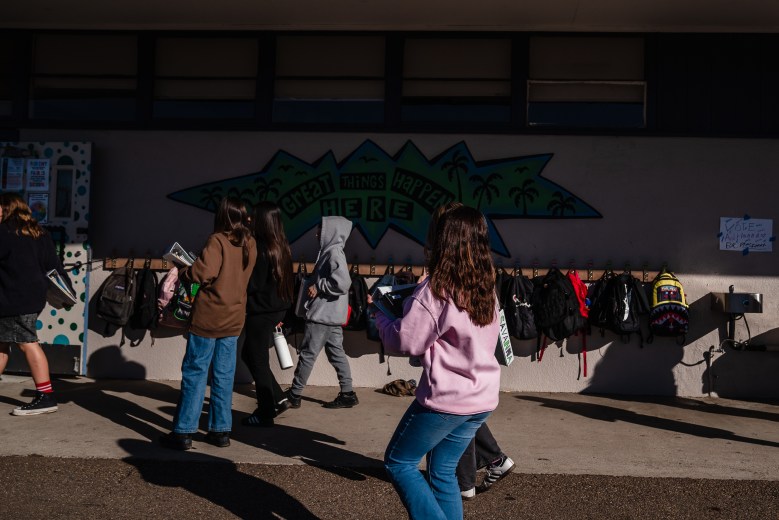
San Diego County’s schools are shrinking.
From 2014 to 2024, enrollment at local public schools declined by about 27,000 students – a 5-percent decline.
Those declines have played out at almost every single one of the county’s 43 local education agencies – from South Bay Union, where enrollment has plummeted by 37 percent, to Encinitas, where it dropped by 21 percent, to Alpine, which lost 15 percent of its students.
A Parent’s Guide to San Diego Schools: Our guide to San Diego schools provides families with everything they need to know to make the best choice for their child.
“It’s like a slow moving like train wreck,” Sweetwater Union High School District Superintendent Moises Aguirre said. “You see it coming but it’s in slow motion, so it’s hard to fully understand the impact that it’s going to have.”
And this is likely only the beginning.
Projections from California’s Department of Finance predict the county’s public schools will lose about 112,000 additional students over the next 20 years. That would shrink enrollment by a staggering 30 percent and inevitably lead to the closures of a whole lot of schools.
What makes the crisis so difficult to grapple with is the big socioeconomic trends driving it, like falling birth rates and the region’s unaffordability. Districts don’t have control over the cost of rent or whether a family has a kid.
But that hasn’t stopped school leaders from pulling the levers they do have.
Where Have All the Children Gone?
When people hear about this, many jump to one conclusion: because more families are choosing to send their kids to charter schools, private schools or to homeschool them.
That’s true in some ways, and false in others.
While the number of students attending private schools has stayed flat, the number of kids being homeschooled has nearly doubled over the past decade. Still, the figure remains inconsequentially low. In 2024, about .82 percent of local students were homeschooled.
Charter schools are a different story.
Over the past decade, their enrollment has shot up by about 41 percent. That’s driven largely by enrollment increase at virtual charters, which often have a spotty academic record and draw kids from neighboring counties.
But charters are still public schools. That means their increases are included in the overall 5-percent decline I mentioned earlier. When you take charter schools out of the mix, though, the rate of enrollment decline doubles to about 12 percent.
‘There Are Just Fewer Children’

What’s actually happening is much simpler – there are just fewer kids in San Diego County than there used to be.
One big part of that equation is affordability. In survey after survey, people who leave San Diego cite high cost of living as one of their primary motivators. That was especially true over the pandemic, which supercharged existing enrollment decline trends.
Nicole DeWitt, San Diego Unified’s deputy superintendent, said it’s a common refrain of parents who leave the area. Over the past decade, the district has lost about 16,000 students, a 12 percent decrease in enrollment.
“The cost of living has continued to grow, especially in cities like San Diego, so, there are just fewer children within our boundaries than there were before,” DeWitt said. “That is an outside force that we don’t have any control over.”
Another big factor is the region’s declining birth rate, which has dropped by about 30 percent since 1990. There are a lot of reasons for that, but rising costs is a big one.
This isn’t just a San Diego thing. Cities across the world are grappling with the same demographic trend. It’s left everyone asking a similar question: ‘What does it mean for our society for the next generation to have fewer people than the previous one?”
Alexander Alvarado, the California’s Department of Finance’s education projectionist, said that reality can be hard for many to come to terms with, partly, because it’s so new.
“We haven’t been in a situation where enrollment is shrinking. So, we’re kind of in uncharted waters,” Alvarado said. “But there’s nothing in the data that I’m seeing right now that that makes me think that we’ll be going back to a growth pattern anytime soon.”
What Now?

Even given the intimidating scale of the problem, districts are trying to mitigate it.
San Diego Unified, for example, has invested billions in bond funds to rebuild old schools. They’ve also engaged in community outreach and created new programs, like middle school sports and community schools, they hope will draw families back.
When Marianna Vinson was appointed the Superintendent of Lemon Grove Schools, the board gave her one clear objective: “We needed to stop the bleeding,” Vinson said. The district had lost about 22 percent of its students over the past decade. They projected they would continue to lose about two percent of students per year.
For Vinson, part of the task was to change the reputation of a district that’s long been viewed as struggling. Since the pandemic, which sent student performance at districts nationwide tumbling, achievement at Lemon Grove has ticked up each year.
So, she hit the streets to preach the Lemon Grove gospel. She met with community groups, created social media campaigns, briefed school sites and even pitched the district to realtors selling homes in the area.
But this was far from a one-woman show.
Vinson and other officials did roadshows at each school to underscore the importance of enrollment to maintaining programs and salaries. They streamlined processes to make the enrollment experience easier for parents and more welcoming. They even increased outreach from staff and extended their enrollment window.
It seems to have had an impact.
Last year, the district lost 69 students – about 2.2 percent of Lemon Grove’s enrollment. This year, they lost only 12 – an about .4-percent decline.
“It has taken everyone, from our school secretaries to our family and community engagement leads to our teachers and everyone in between, to commit to this effort,” Vinson said.
But she knows this doesn’t mean they can let up. Instead, they see it as proof that what they’re doing is working and that they need to push even harder in coming years.
“We have to double down our efforts, because every year we know it’s only going to get harder, because the societal trends you’ve documented are all still very true for us here in Lemon Grove,” Vinson said.
South Bay Union has lost more students than any other district in San Diego County.
In response, Superintendent Jose Espinoza said the district has worked to tailor its educational offerings to match the desires of the community. That’s included leaning into programs the community likes and more closely aligning curriculum to state standards.
That may dull the impact, but it won’t erase the reality of there being fewer kids. That’s why the board voted recently to close three schools over the next three years.
It’s the worst-case scenario for stakeholders, who uniformly abhor school closures. But while South Bay Union is on the frontline right now, Espinoza said that as enrollment decline bears down on districts countywide, many more districts will be faced with similar decisions.
“The first step is to accept this is happening,” Espinoza said. “Nobody’s making up these numbers. You can go into classrooms and go, ‘Wow. We used to have 700 students in this school. Now we have 300.’”
Maybe some of the 75,000 babies aborted in the last 5 years here in San Diego, would have been attending public schools.
Great job lefties
With the budget issues it is time to close a few schools. Reducing the cost to taxpayers should be something every elected official is looking into. Not creating more cost to taxpayer.
Agree, look at the story as good news!
If you want enrollment to go back up then find a way to make this question equal zero:
What’s the probability that my child will be shot or need to participate in lock down drills for active shooters while attending school?
Jakob McWhinney, the author of this piece has avoided the obvious – especially where South Bay Union School District is concerned – and that is close proximity to the border. Nowadays, it is not as easy to send kids from Tijuana here for a free education. Of course numbers are dropping. Additionally, quality of education matters and more and more parents are realizing that and looking at alternatives such as home schooling or charter schools or private schools.
Someone didn’t read the entire piece before spewing a comment about alternatives… “While the number of students attending private schools has stayed flat, the number of kids being homeschooled has nearly doubled over the past decade. Still, the figure remains inconsequentially low. In 2024, about .82 percent of local students were homeschooled.” And, “charters are still public schools. That means their increases are included in the overall 5-percent decline I mentioned earlier.”
The enrollment at private schools has not remained flat. It has if you are ignoring faith based schools, the charters have been fully subscribed for years, so that statistic is goofy in context.
Cool. Now do private school enrollment and homeschooling.
Funny how we totally ignore the idiotic policies enacted by the public school system when writing this article. There are exactly zero parents I know that support litter boxes in bathrooms, but here we are.
Schools are closed today and Monday. Then half days on Tuesday and Wednesday next week.
Gee I wonder why families are choosing to move to other schools districts or paying for private school. Total mystery.