

The events of the past year reminded San Diego-area leaders and citizens that, to paraphrase former President Barack Obama, elections have consequences.
Among the myriad changes roiling the San Diego region starting last January were challenges to the federal funding landscape. From a sudden and sweeping temporary funding freeze, to “shock and awe” agency and grant cancellations carried out by the so-called Department of Government Efficiency (DOGE), to specific cuts aimed at research institutions that rely on funding from the National Institutes of Health (NIH), local stakeholders frequently found themselves in the crosshairs.
The Trump administration’s aims to dramatically shrink the federal government gained further momentum as it released budget plans in the spring, passed a massive tax and spending cut bill in the summer, and accepted the resignations of tens of thousands of federal workers throughout the year.
Notwithstanding the chaos of 2025, new data show that the San Diego region finished the first fiscal year of the second Trump administration with its federal funding relationship largely intact. But the topline numbers tell only part of the story.
Federal Funding to San Diego Held Steady in 2025
From an economic standpoint, San Diego relies more on the federal government than most other regions. That’s down to not only its significant military and veterans presence, but also its R&D-fueled life sciences industry, and its location along an international border. Government funding makes up 17 percent of the local economy in San Diego, versus 10 percent nationwide.
Overall, recipients of federal contracts and grants in San Diego County—businesses, governments, nonprofits, and educational institutions—netted $17.2 billion last year, down only slightly from $17.6 billion in 2024.
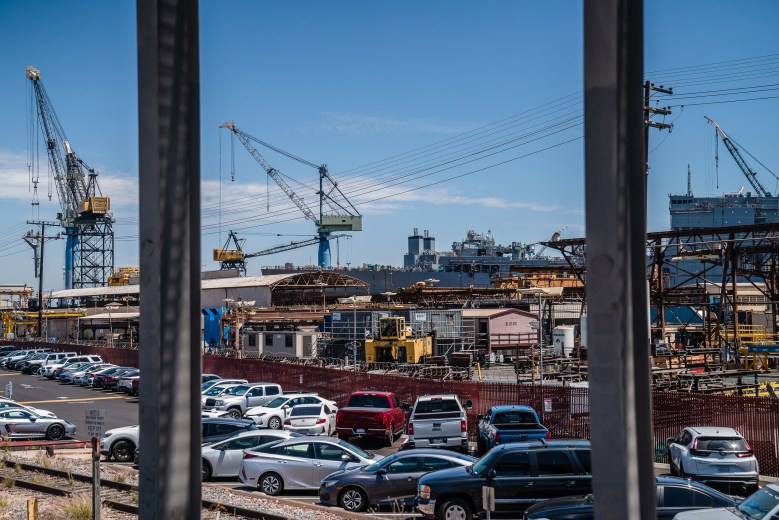
Most of these dollars—a little over 70 percent—come to the region in the form of contracts, and largely from the U.S. Defense Department. They fund the building of ships, aircraft, and related technologies by major local defense contractors such as General Dynamics, Northrop Grumman, and General Atomics.
Even so, San Diego’s federal grant haul of almost $5 billion in 2025 impresses for a region of its size. That nearly matched the sum awarded last year in Greater Seattle, a region with 25 percent more residents than San Diego County.
Funding Fluctuated by Agency
At the federal agency level, funding trends in San Diego were more uneven.
The Defense Department, San Diego’s largest source of federal funding, spent $10.7 billion on contracts and grants locally in 2025, down from $12.5 billion in 2024. That decline may reflect an initial slowing of spending as the Trump administration revises approaches to defense procurement (more on that below).
In light of the administration’s ongoing efforts to close the U.S. Department of Education, San Diegans might have expected funding from that agency to drop precipitously last year. However, local school districts received almost $100 million more in grants and contracts from the Department in 2025 than in 2024. Most of those extra dollars came through the state of California, which like other states redistributes certain types of federal aid—particularly funding for low-income schools and special education—to local districts.
NIH, another agency under fire from the Trump administration, turned out to be a stable source of support for San Diego-area researchers in 2025. They collectively received $1.1 billion in NIH funding last year, nearly the same as in 2024, making San Diego one of the top 10 U.S. counties for NIH grants. Notably, more of those dollars flowed during the last few months of the fiscal year than in prior years, after federal courts overruled earlier administration efforts to freeze, slash, or redirect health research funding.
To be sure, other smaller sources of federal funding to the region nearly dried up altogether. In 2024, the U.S. Agency for International Development (USAID) provided $9 million in grant and contract funding to local organizations including UCSD. Those dollars stopped flowing once President Donald Trump took office in January 2025 and rapidly shuttered USAID. Similarly, DOGE took aim at arts-supporting federal agencies including the Institute of Museum and Library Services, the National Endowment for the Arts, and the National Endowment for the Humanities, which provided only a fraction of previous levels of support to San Diego-area institutions in 2025.
What’s Not in the Numbers
Notably, the federal spending data don’t capture other sand in the fiscal gears affecting some San Diego grantees.
One of the largest federal grants awarded to a local organization in 2025 came from the Environmental Protection Agency’s (EPA’s) Greenhouse Gas Reduction Fund (GGRF). A La Jolla-based fund associated with the Coalition for Green Capital received $1.45 billion from the EPA to help subsidize energy efficiency and clean energy projects in low-income communities nationwide. However, the Trump administration moved to rescind those grants, and stripped the EPA’s authority to administer GGRF in last summer’s tax bill. Climate groups have sued the administration, and the dispute remains tied up in federal courts. (Without that single grant, the region’s funding total for 2025 is appreciably lower than for 2024.)
Other parts of the federal spending process also fly below the accounting radar. For instance, the federal Department of Housing and Urban Development (HUD) made a number of awards in the spring to support local homelessness service providers. However, it issued grant agreement letters alongside those awards that imposed new restrictions on providers related to immigrants and “gender ideology,” prompting court cases and delaying implementation of programs.
Looking Ahead in 2026
One lesson that Washington soothsayers should probably learn from last year is to avoid making predictions. Still, a few developments merit San Diegans’ collective attention in the coming months.
First, despite Congress neither checking nor balancing the White House very much in 2025, spending committees in the House and the Senate passed bills that fund most federal agencies at levels well above the President’s budget requests for 2026. Those bills, which President Trump signed into law on February 3, preserve prior-year funding for HUD (versus a 44 percent cut in Trump’s budget), trim EPA by 4 percent (versus a 55 percent cut), and slightly increase funding for NIH (versus a 40 percent cut).
Second, the Trump administration will nevertheless continue to push the legal envelope to curtail spending, including by attempting to deny federal dollars to so-called “sanctuary” states and cities. Its recent move to suspend federal income support payments to California and other Democratic-controlled states was a test run of sorts. Courts ruled against these coercive actions during the first Trump administration, and the dispute will likely head there again in 2026.
Third, other structural changes in federal funding flows will likely begin to impact the San Diego region. Procurement reforms at the Department of Defense will emphasize speed and prioritize more opportunities for startup companies, which could alter the landscape of a significant local industry. Meanwhile, more provisions of H.R. 1 will take effect, giving to San Diego in some ways (e.g., increased spending on maritime defense), and taking from San Diego in others (e.g., new restrictions on accessing Medi-Cal and Cal-Fresh).
We can be pretty confident that 2026 will bring a new round of unforeseen federal funding challenges for Greater San Diego to navigate. Optimistically, the region enters this year a bit wiser and more battle-tested for what’s to come.