
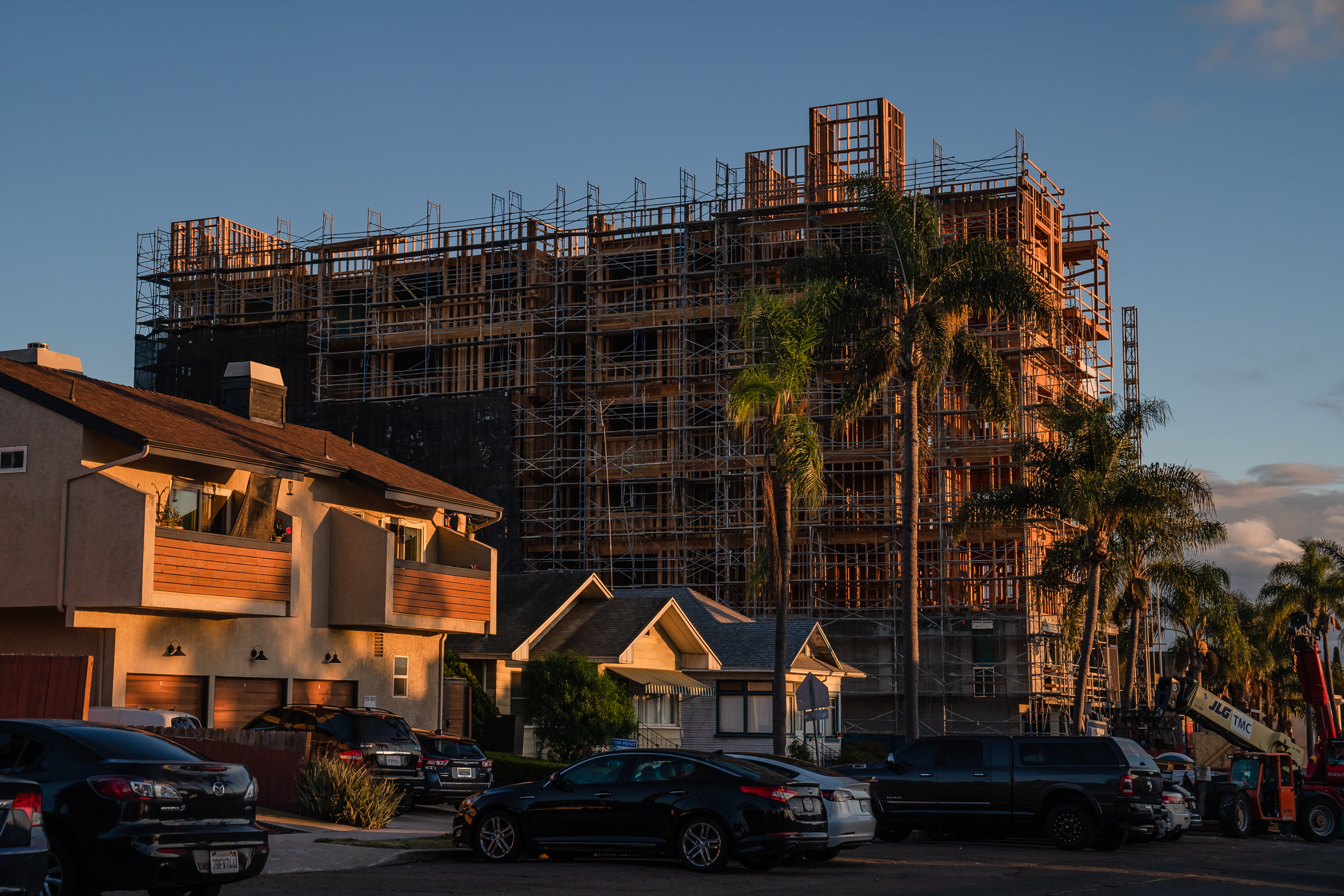
Today was the final day for California legislators to introduce new bills for this year. Some of the standouts? Another proposal to — you guessed it — make it easier to build more stuff in San Diego.
Let’s take a closer look at the bills.
Lawmakers Seek to Expand Housing Incentive Law
For at least three years, San Diego has led the state in approving new homes. One reason is a state law that allows developers to build bigger and higher structures if they include affordable housing.
It’s called the density bonus law, and Chula Vista Assemblymember David Alvarez introduced a bill on Friday that would give developers even more incentives to get around building restrictions if they build more condominiums or townhomes for low and middle-income residents. Housing projects solely dedicated to affordable units will also receive additional bonuses.
The Democrat held a press conference Friday at UC San Diego with local elected officials and student advocates announcing the legislation, which is sponsored by the San Diego Regional Chamber of Commerce.
It’s essentially the sequel to a density bonus law he authored three years ago — AB 1287 — that allowed developers to build bigger buildings if they included a certain amount of affordable housing.
The new proposal would also change the program’s name from density bonus to the “affordable homes bonus law.”
Why? There are some developers who don’t use the program over confusion about whether or not their projects would increase housing density, said Colin Parent, chief executive officer of Circulate San Diego, which helped craft the legislation.
“The purpose of the program is not to create more density, but to create more affordable homes,” Parent said.
Density Bonus Has Its Critics
Coastal communities in San Diego have criticized the law for not creating enough affordable housing and acting as a backdoor for luxury project developers to circumvent building restrictions.
A planned 22-story commercial building in Pacific Beach is one example. More than 100 units for the project are designated for hotel rooms while about 10 rooms are for affordable apartments.
The project has stirred fierce pushback from locals who blame the state’s density bonus law for allowing a commercial property to supersede height restrictions.
This ultimately led Democratic state Sen. Catherine Blakespear, who generally supports the program, to author a law to prevent similar projects in the future from using the state’s density bonus law for projects that aren’t majority housing.
San Diego Was An Early Adopter of Housing Incentives
The city of San Diego has been a trailblazer in approving new homes — it permitted nearly 9,000 homes in 2024, more than double its historic average — and researchers and advocates point to density bonus law as the reason.
“San Diego has been more receptive to certain kinds of density for a long time,” said Bill Fulton, a housing researcher at the UC Berkeley Terner Center.
San Diego became the first city to adopt its own density bonus law in 2016 that eventually became the model statewide.
This early adoption paid off and resulted in a much faster permitting process compared to other major cities, according to Fulton.
“Part of it is just in the willingness of local politicians,” Fulton said, and that a more laid back political climate in San Diego has helped create a less bureaucratic home-building process compared to Los Angeles or San Francisco.
More Efforts to Streamline Student Housing
Alvarez also introduced a bill, AB 1732, earlier this month to exempt student housing from a keystone environmental law to make it easier to bypass environmental reviews that can lead to costly delays.
It expands on the moves the Legislature made last year to remove new housing projects from review under the California Environmental Quality Act, or CEQA. Alvarez’ proposal would extend those carve-outs to include student housing.
This isn’t the first time Alvarez has pushed to make it easier to develop student housing. Last year, the governor signed a bill by the assemblymember that would give universities, namely UC San Diego, the power to decide how much parking is needed for student housing near the coast, an authority that was previously held by the California Coastal Commission and accused by critics of slowing housing production.
In Other News: Dems Convene to Talk Strategy
California Democrats are meeting in San Francisco this weekend to decide a slew of party endorsements ahead of the midterm elections.
There likely won’t be enough unified support to back a single candidate in the crowded governor’s race, but other endorsement contests between a grab-bag of establishment-types versus newer, younger candidates in a few key congressional races will likely shed light on what Democrats view as a winning strategy to help them take back control of the U.S. House.
What I’m Reading Now
EdSource sits down with Assemblymember Darsha Patel of San Diego before she takes over the powerful Assembly Education Committee next month.
San Diego businesses cautiously celebrate the U.S. Supreme Court’s decision to strike President Donald Trump’s tariff policy, from The San Diego Union-Tribune.
And for those keeping track: San Diego County’s GDP trumps that of 20 states and some countries, according to a report released this week by the U.S. Bureau of Economic Analysis, The San Diego Union-Tribune writes.
Thanks for reading the Sacramento Report! Please feel free to reach me at nadia@voiceofsandiego.org.