
Twelve years ago, in early 2014, Democrats held just a 1.7-point registration advantage over Republicans in San Diego County. Eleven of the county’s 18 cities still had more Republicans than Democrats. Today, Democrats hold a 12.9-point advantage, and only four cities — Santee, Coronado, Poway and El Cajon — remain Republican on paper.
Registration isn’t destiny; turnout fluctuates, political waves happen, and you can win elections on unfriendly turf. But registration is the political floor, the starting math every campaign must work from, and in San Diego County that floor has shifted dramatically.
There’s little sign the trend is about to reverse. Donald Trump remains deeply unpopular in California, with recent polling showing approval in the mid-20s across the broader San Diego–Orange County region. As long as that dynamic holds, local Republican registration is more likely to shrink than rebound. So what happens to a political party when the map beneath it moves?
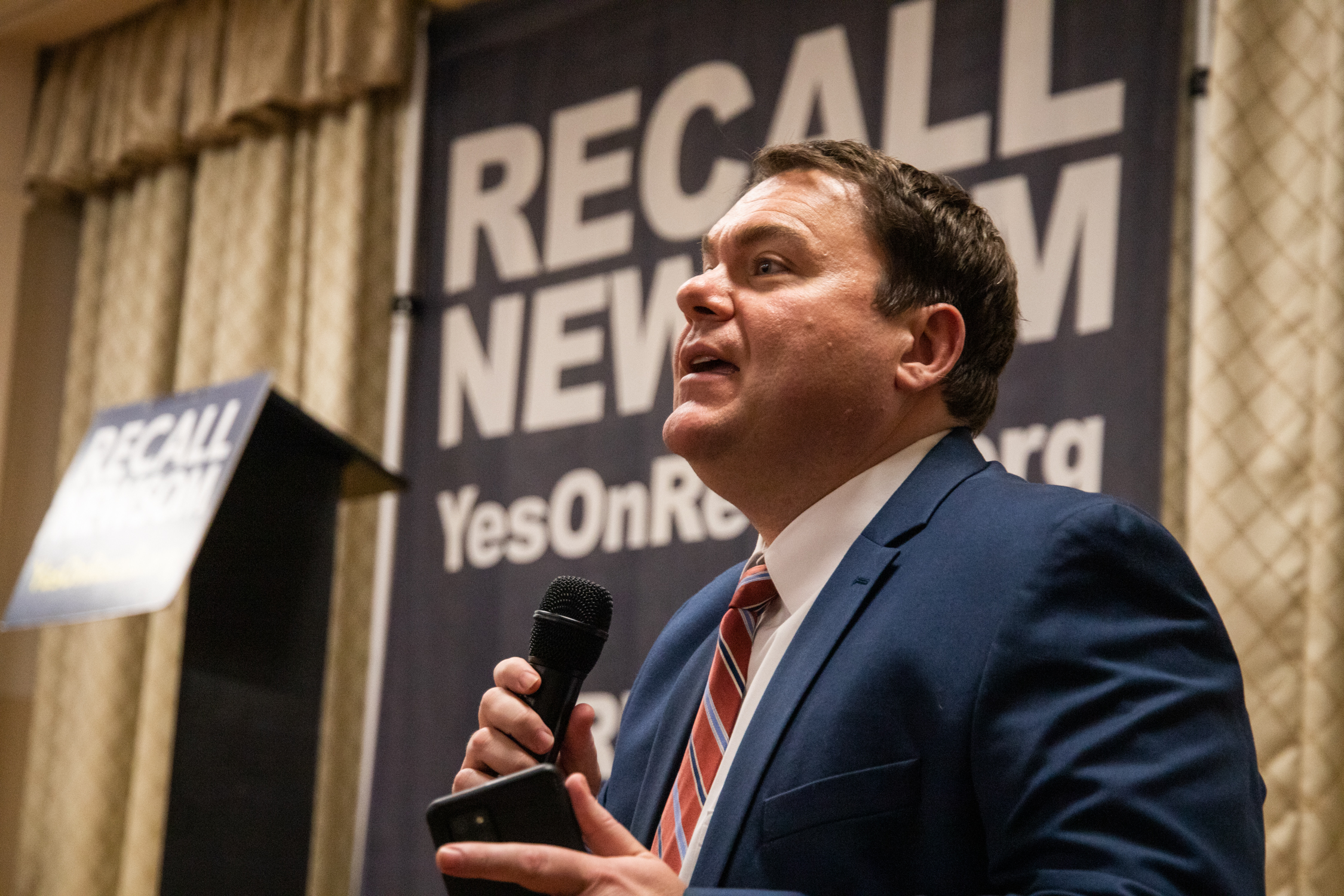
Right now, two right-of-center organizations are shaping that answer: the Republican Party of San Diego County and Carl DeMaio’s Reform California. They operate in the same political space, but their models are different, and the tension between them tells you something important about where local Republican politics is headed.
The county party is the traditional structure. It has an elected Central Committee that votes on endorsements. Unlike other independent groups, the party can legally coordinate communications with Republican candidates when speaking to Republican voters. It is, formally, the Republican Party of San Diego County.
Its fundraising reflects that role. Much of its money comes from businesses, trade groups and political committees writing large checks — builders, developers, industry associations and other donors who support Republicans not necessarily out of ideological conviction, but because they have practical reasons to want Republican officeholders in the room when decisions get made. Zoning, permitting, labor policy, tax rates — these donors give because governance affects their bottom line, and they tend to give when there are credible Republican candidates in competitive races. When multiple seats are in play, the party becomes an efficient vehicle for that money to reach endorsed candidates. When fewer races look winnable, the pipeline gets strained.
Reform California operates on a completely different frequency. It’s built around small-dollar donors—people giving $50 or $100 at a time—and its fundraising increasingly draws from outside San Diego County. Its revenue depends less on the odds of winning any single local race and more on maintaining a motivated audience.
That’s a crucial distinction, because it means Reform can grow its donor base, influence primaries and strengthen its broader brand even if a particular candidate ultimately loses. The County Party doesn’t have that luxury; its relevance depends on winning competitive seats.
Consider the 40th Senate District, one of the few seats in the county where Republicans still see a plausible path in November. Reform has endorsed Kristie Bruce-Lane in the primary. The County Party has declined to endorse either Republican candidate, which leaves San Marcos City Councilmember Ed Musgrove running without Reform’s backing and without institutional support from the party.
In a primary where money and visibility shape momentum, those gaps matter. A Republican will advance to face former San Diego City Attorney Mara Elliott in the general election, but in a district likely decided on the margins, a nominee who emerges divided or underfunded is going to face a steeper climb.
This is where the incentive structures start to pull in different directions, and it’s worth being honest about why. When there were many competitive seats across the county, internal disagreements could be absorbed—losing ground in one race didn’t threaten the party’s overall footprint. But when only a handful of districts remain viable, each nomination carries more weight, and the stakes inside the primary grow sharper.
If you have 10 competitive seats and a messy primary costs you one of them, you’ve still got nine other shots. If you have three competitive seats and a messy primary costs you one, you just lost a third of your opportunities to hold elected office in the county. That’s the difference between an internal disagreement that blows over and one that defines a cycle.
Small-dollar fundraising can remain strong even in a losing environment; national polarization often fuels it. Institutional donors, by contrast, tend to concentrate their giving where they see realistic paths to victory. A builder who wants a friendly vote on the planning commission isn’t writing checks to feel good about the cause. They’re investing in outcomes. When those outcomes look unlikely, the money dries up.
The party still holds formal advantages — legal coordination, official recognition, elected governance — and for many donors, that stability matters. Reform California, on the other hand, has shown it can mobilize energy and money quickly through a grassroots network. But the math is the math.
In a county where Democrats hold nearly a 13-point registration edge, the ceiling for Republican expansion is limited. If current trends continue, Republican strength is likely to become more geographically concentrated. The remaining Republican-leaning cities and districts will matter more while other areas drift further out of reach, which makes every competitive seat more important and intensifies disagreements about strategy, endorsements and resource allocation.
Over the next several election cycles, the central question for Republicans in San Diego County may not be whether they can expand their footprint, but how they manage what remains of it. Candidate recruitment, message discipline and fundraising efficiency all become more important when the underlying numbers are unfavorable.
Infrastructure matters, in other words, but numbers still define the boundaries. And if the registration gap continues to widen, San Diego’s Republican presence will likely become smaller, more concentrated and more internally contested in the years ahead. The fight won’t be about building outward. It’ll be about deciding how and where to hold ground, and who gets to make that call.
The two-party system itself is faltering. The parties have lost a lot of voter support.
DeMaio was a polarizing candidate even before Trump. But then the right embraced Trump, a toxic candidate who was very unpopular, especially with women. Many left the Republican party in response but still lean right.
Meanwhile, the Democratic party has lurched left and also embraced unpopular ideals (e.g. anti-racist ideology, open borders). And while Democrats haven’t left the party (yet), many are merely voting “not Republican” and would support more centrist candidates.
In California, the top two candidates advance, regardless of party affiliation. So, it’s quite possible that independent centrists could find a lot of supporters–if the candidates had money to bankroll their campaigns.
Wrong.
https://www.nytimes.com/interactive/2026/02/17/opinion/focus-group-democrats.html
DeMaio. Reichart, now Bailey, it just never gets better for the GOPhers and we’re left to suffer with incompetent Dems. The system is broken.