
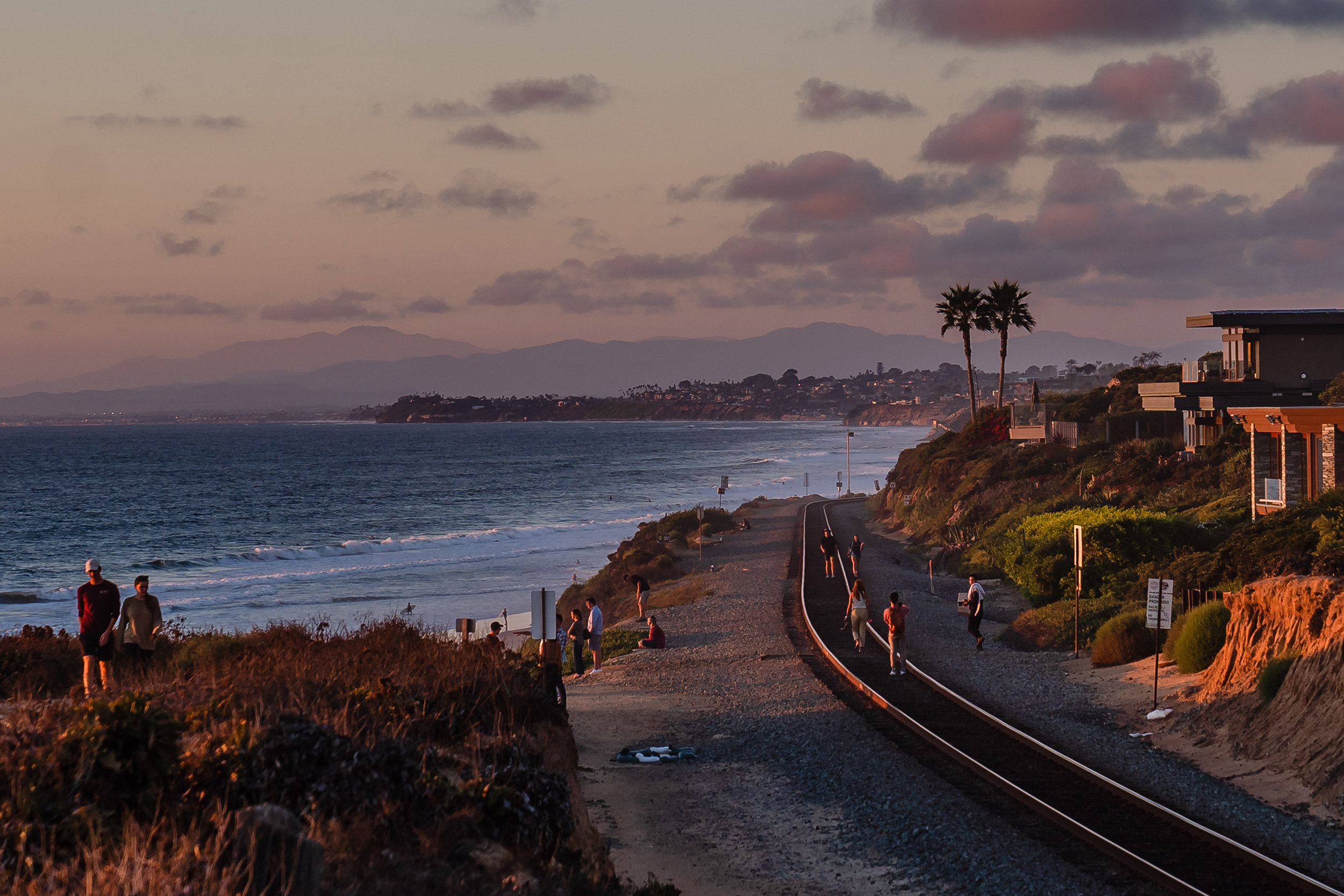
For years, transit enthusiasts have urged the state to throw more dollars at the troubled 351-mile-long Southern California rail corridor that stretches from San Luis Obispo to San Diego. They want to revive its crumbling infrastructure and address its declining ridership and infrequent service.
Local agencies and Encinitas lawmaker Catherine Blakespear, who chairs a legislative subcommittee dedicated to the Los Angeles-San Diego-San Luis Obispo rail corridor, known as LOSSAN, have said they’re committed to fixing its numerous problems. And yet, there’s been little to show for it.
Built in the late 1800s, the rail corridor is a relic and a core piece of California iconography. Segments of the track hug the Pacific Ocean, which has given riders for more than a century breathtaking views of the very bluffs that are eroding beneath it due to climate change.
The erosion is one of LOSSAN’s biggest issues, resulting in repeated track closures in Orange and San Diego counties for several years.
A state report about LOSSAN, the second-busiest passenger route in the nation, and why it’s struggling, was due to the Legislature this month, after Blakespear authored a law ordering it. But the report was not completed, which is more common than not. A CalMatters’ analysis found most of these “study bills” never get done and the laws initiating them are typically performative gestures by lawmakers. More than 70 percent of 1,118 reports due to the Legislature in 2023 were not submitted, while an additional 12 percent were late.
The state Department of Transportation has not started the report yet, according to Blakespear. Spokespeople for the agency did not immediately return requests for comment.
Lawmakers have argued that study bills asking an executive agency to review a particular issue avoid duplicative bills by requiring the agencies to look into problems first.
According to rail advocates, the LOSSAN bill didn’t initially start as a study bill. There were initially discussions about it focusing on changing the byzantine structure of county transportation authorities and commuter rail agencies which essentially govern the rail line.
Blakespear said she authored a study bill rather than legislation that would have required action because the state transportation agency is better equipped to identify what needs to be fixed about the corridor.
“Any changes have to be well justified and it’s not necessarily an easy path,” Blakespear said, adding that, as a freshman legislator at the time, she wanted to wait before making bigger demands.
Rail advocates in discussions with Blakespear at the time said they hoped the bill would do more.
“We wanted Blakespear to put something much stronger into the bill,” said Paul Dyson, a longtime lobbyist for the Rail Passenger Association of California and Nevada. He attributes much of the corridor’s issues to its fragmented governing structure, which spans multiple county transportation authorities and commuter rail lines.
In other words: he believes the operation is bloated, slow and complicated. His group hoped for legislation giving oversight to one agency, rather than several regional ones, that could more easily get projects done.
“We have too many agencies involved in really what’s just a handful of trains and owning the tracks they run on,” which includes Amtrak’s Pacific Surfliner and Los Angeles’ Metrolink.
He believes the bill was weakened because it would have taken away authority from local governments.
Blakespear said she plans to introduce more ambitious legislation on LOSSAN later this year.
No Democratic Endorsements In a Few Key 2026 Races
Democrats, as expected, didn’t manage to cobble together an endorsement for one of the nine candidates looking to replace Gavin Newsom as governor at the party convention last weekend in San Francisco.
U.S. Rep. Eric Swalwell, known for being involved in President Donald Trump’s first impeachment trial, earned the most support, but not a majority. Former State Controller Betty Yee followed in second and former state Attorney General Xavier Becerra fell third.
This was unexpected given that most recent polling has shown former Rep. Katie Porter generally receiving more support than Yee or Becerra, which signifies a race that remains far from settled four months shy from the June primary.
Having no clear front-runner has made some Democrats fearful that the top two candidates in the primary election may end up being the two Republicans running, conservative commentator Steve Hilton and Riverside County Sheriff Chad Bianco. In California, the top two vote getters advance to the general election, regardless of party.
Nor did the party agree on an endorsement for the 48th Congressional District represented by Republican Rep. Darrell Issa, where Democrats are expected to have a slight competitive advantage after voters approved gerrymandering the district last year.
Candidates need at least 60% of delegates votes to receive an endorsement. San Diego city Councilmember Marni Von Wilpert fell shy of that, with 55% support. Ammar Campa-Najjar, a U.S. naval officer, was a distant second, receiving 18% of the 33 total votes.
Voter ID Ballot Initiative Gains Momentum
A proposed ballot initiative that would require Californians to show proof of citizenship in order to vote has gained enough signatures to be placed on the November ballot, according to Assemblymember Carl DeMaio.
Leaders of the initiative, run by his conservative political organization Reform California, say they’re turning in more than a million signatures to county offices next week.
If passed, voters would be required to show a driver’s license, passport or other government identification each time they vote.
“I gave the politicians in Sacramento a chance to do the right thing to give the voters, not just Republican voters, but Democrat voters as well, a common-sense reform,” DeMaio told KCRA last week, referring to a proof-of-citizenship voting bill he introduced last year that died in committee.
“He has a right to do it and we will give him the fairness that his initiative deserves,” Secretary of State Shirley Weber said in response.
California’s elections are safe and voter fraud is rare statewide and across the country. Voting rights groups have criticized this and similar efforts as onerous and having the potential to negatively affect thousands of U.S. citizens who don’t have the paperwork readily available to prove their citizenship.
What I’m Reading Now
- Los Angeles schools Superintendent Alberto Carvalho was put on administrative leave after the FBI invaded his home earlier this week, from the Los Angeles Times.
- A KPBS and inewsource analysis finds that San Diego cities that shifted right in 2024 shifted back to the left in the 2025 special election in favor of Proposition 50.
- Longtime former San Diego-based state appellate justice Daniel Kremer died earlier this month, The San Diego Union-Tribune reports.
Thanks for reading the Sacramento Report! Please feel free to reach me at nadia@voiceofsandiego.org for any questions or feedback.