

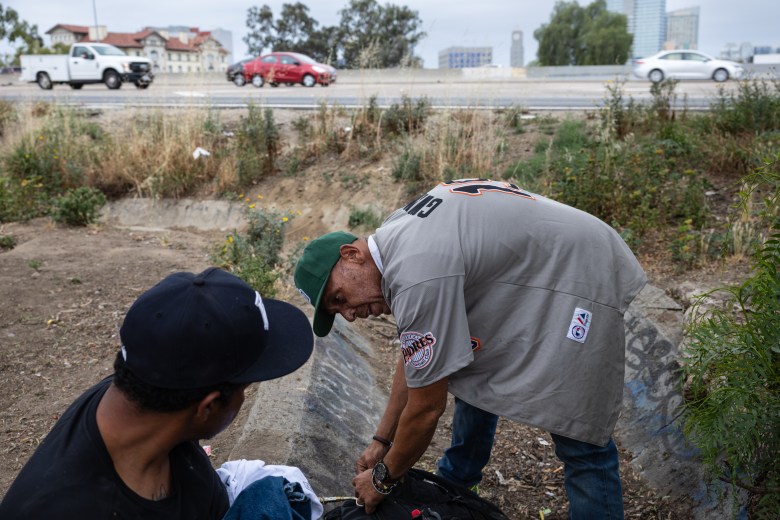
Manuel Cazanas has been living in a tent near a freeway on-ramp for more than a month. The 49-year-old moved to the area near Interstate 5 after suffering a spinal cord injury that cost him his job and apartment.
Despite his limited mobility, every few days he has to pack up his green tent and lug the rest of his belongings across the street. It’s a common routine for Cazanas and other homeless people in the area.
According to officials with the city’s Environmental Services Department, they have conducted almost 500 sweeps along freeway entrances and exits since the city got permission to remove encampments on state property last summer.
In the three-block area where Cazanas lives, which includes a freeway on-ramp and off-ramp near 19th Street and Imperial Avenue, city employees conducted 67 sweeps from July 2025 to March 30, 2026. That area and ramps near 17th Street have seen the most sweeps, said Matthew Hoffman, spokesperson with the city’s homelessness services department.
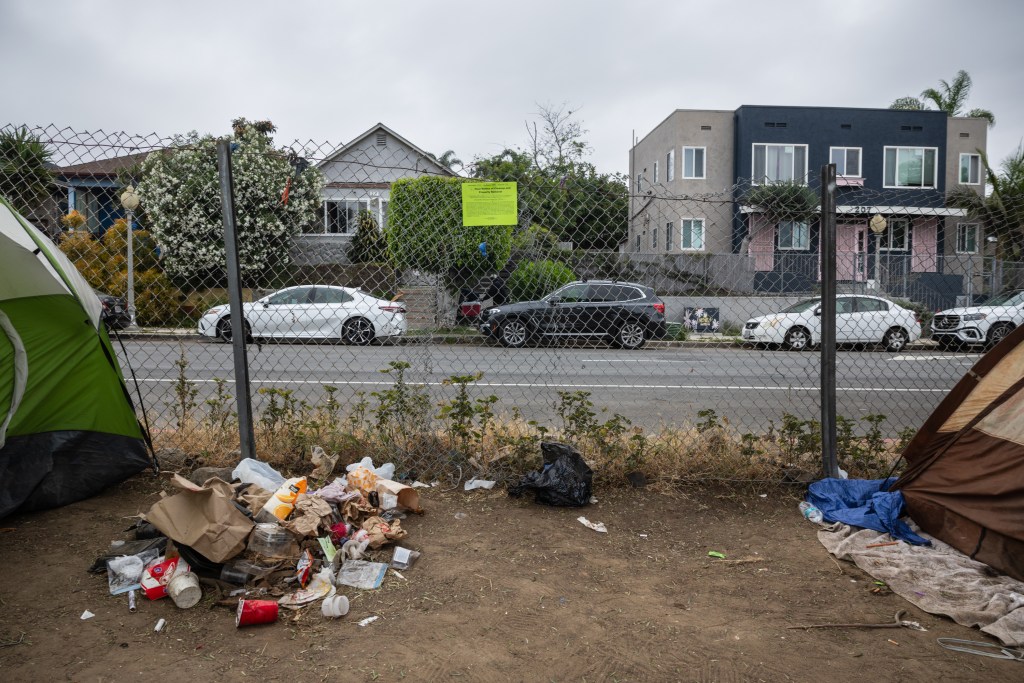
Last summer, the city entered into an agreement with Caltrans that allowed city workers to enter state property to clear encampments. But many homeless people keep going back to the same spots workers clear. Some people, like Cazanas, are waiting for a shelter bed spot to open, while others, a city outreach worker said, aren’t ready to accept services.
“I’ve been waiting 45 days for a bed, but they don’t have a bed,” said Cazanas in Spanish, seated on his rolling walker as he looked out at the street.
Since early March, city officials have spent more than $650,000 on removing encampments on state property. This includes costs for staff, contractors, trash disposal and more. Caltrans reimbursed the city $400,000 for that work, but city officials estimate that the city will spend up to $800,000 by July 2026, when the agreement ends.
The city and Caltrans officials are in discussions about the future of the agreement, but no decisions have been made, a Caltrans spokesperson said.
In Mayor Todd Gloria’s announcement of the agreement, he said the city would commit financial resources to the effort. City officials said they plan to keep doing the encampment sweeps despite the city’s own budget challenges.
“For the remainder of the fiscal year, we’re going to continue as much as we can,” said Franklin Coopersmith, deputy director of the city’s Environmental Services Department in an interview with Voice. “We are in budget crunch time, so we are gonna’ have to do our best to balance our approach.”

Since Mayor Gloria pushed for a camping ban in 2023, some homeless people have moved to harder to reach areas like canyons and freeways to avoid enforcement.
The agreement with Caltrans cleared the way for city workers to enter state territory. The goal was to clean up trash and connect people with services, Gloria said.
“We’re doing [outreach] in the state right of ways as a very prioritized and focused lens … because it is a public health and safety risk,” said Ketra Carter, program manager at the city’s Homelessness Strategies and Solutions Department in an interview with Voice.
The agreement applies to a five-mile stretch of freeways that run through Little Italy, Barrio Logan, Downtown, Sherman Heights and East Village.
Since the agreement began, city officials have received more than 1,000 reports related to homeless encampments in the area.
They have removed more than 260 tons of waste. Hoffman, the spokesperson for the city’s homelessness services, said that as of early March, staff connected 13 people with housing and 44 people enrolled in the city’s Safe Sleeping Program. Encampment fires in the area have also dropped by 39 percent, according to the San Diego Fire-Rescue Department.
City officials need to give a 48-hour notice to people in the area prior to a sweep. In that time, the city’s homelessness outreach team will go out to the area and try to connect people with services.
Cazanas said he attempted to get a shelter bed through the homelessness outreach team each time they visited the area.
“I tell them I’m disabled, I’m hurt, I need to leave the streets. Help me,” he said.

He said they will jot down his name, date of birth, make some calls and find out there are no beds. He’s been stuck in the same cycle for over a month and a half.
“They [outreach workers] have power,” said Cazanas. “But I don’t know why they [outreach workers] pick up some people more quickly than others.”
Lt. Matthew Botkin of San Diego Police Department’s Homeless Outreach Team said there can be “limiting factors” such as the need to accommodate an individual’s particular needs.
“The perception of picking up others is anomalous to our primary goal to place anyone who is ready, willing, and able to be placed,” said Lt. Botkin in an email statement to Voice.
Due to Cazanas’ limited mobility, he needs a bottom bunk bed.
“That is by far the most limited resource we have,” said Carter.
However, January 2026 data from the San Diego Housing Commission shows the top reason for an incomplete request for shelter is because no top bunks were available.
Ray Byars, 42, also lives in the encampment. He became homeless after his small business was forced to shut down during the pandemic and his only relative in San Diego passed away from brain cancer.
He said the constant clean ups make it hard to keep track of his things. He also struggles moving back and forth because of chronic pain in his legs. Like Cazanas, he’s been trying to connect with services.
“ The homeless team’s a joke. You’ll go to them and ask them for help – like for references for the tent city and stuff like that,” he said. “They tell you literally to wait here. If we get a bed for you, if there’s a bed open, then we’ll come back, but just wait here in this area. And you wait there in that area and then they never come back.”
Lt. Botkin said if space is available and an individual clears the required checks, the city’s homelessness outreach team “will always transport to the appropriate service provider.”

He said some people may not be in the area when they come back. He explained people may go to the bathroom or move to another area during the time it takes for the team to come back.
“If you really are intent on getting off the streets or even taking small steps towards that, perhaps waiting four or five hours for us to come back while we’re doing other things might not be the best strategy,” said Lt. Botkin in an interview with Voice. “You may want to go out and engage our other partners and other resources in the city which I promise you, we are delivering ad nauseum to everyone every time we interact with them.”
Carter said they have two dedicated outreach workers that go out to Caltrans land every Monday, Wednesday and Friday. They work separately from the homelessness outreach team and sweeping team to try to connect people with resources.
Beds continue to be limited across the city of San Diego shelter system. When we first reported on the agreement in July, only 12 percent of requests for shelter were filled in the previous fiscal year.
As of this fiscal year, more than 16,000 referrals were made for shelter beds. Only nine percent of requests for shelter were filled.
“If it’s a male availability, top or bottom, we’re in single digits. If we’re in female availability, we’re in single digits. So that has to do with a bed that has come available because someone has exited that bed. We generally are operating at 98 to 99 percent occupancy throughout our shelter system,” said Carter.
Carter also said some people are not ready to accept services. She said it takes time to build trust with some people, while others may be dealing with mental health issues.
“One of our challenges is when they say they’re ready, the resource isn’t ready,” said Carter.
On an early Wednesday morning David Joseph Caron, 50, scrambled to get his belongings together.
He camps out at the other area near 17th Street and Imperial Avenue that city officials say they consistently sweep. A green notice to leave the area in 48 hours hangs on a nearby fence.
A barefoot woman runs up to Caron and other people packing up their stuff. “Hey guys, I’ll pay you guys to borrow this shopping cart,” she pleaded. “We have to move. We’re going to lose all of our shit if we don’t move it right now. I need a shopping cart, wagon, or something.”
The woman took off with a black cart and some other people to help her. Caron secured a strap across a stuffed black suitcase before he made his way off the strip of land. Clean-up trucks and police cars started to arrive across the street.
“It’s like they’re just hustling us around — it’s like they’re moving cattle,” said Caron. “It seems totally unnecessary and it’s like busy work.”
Wow you’ll spend money to destroy encampments. But can’t spend money to actually solve the issue.
YOU pay… sell ur house if necessary; but YOU pay… i moved out of the City Limits to get away from this insanity. Now, it is ALL yours. So pay up.
That is solving the issue. You cannot let these lazy and drug addicted bums get comfortable anywhere or they will turn the area into a cesspool. These bums think they are entitled to anything they want and they certainly don’t want to work. You can see it in their statements in the article above…pure entitlement.
Sounds like the resources might be better spent on adding more beds, or building additional shelters.
Toad can’t do ANYTHING.
No, it would be better spent by giving the bums a couple of choices: drug rehab+ work or JAIL. That will take care of 90% of the problem. Then the city and county can tackle the lunatics.
I run a homeless out reach team that works in the East Village area and City Heights/Grantville area. We see this all the time, the city is on a merry-go-round. They are not solving anything just going round and round.
Lately there have been more people on the streets than before, we have been seeing that for the last couple of months.
The locations that scare me are the homeless moving into the canyons. We are going to have a huge fire one day and lose housing in the city because of it. This is because the homeless have been chased off the streets and in order to find a place to live, they moved into the canyons.
Pay MORE, ‘iggins.
Yes, and your worthless “team” is responsible for contributing more to the trash problem in the area with all of your worthless handouts. You are one of the few people who would be more productive if you remain rotting in your rocking chair. You have no formal training or credentials for working with this population and after all these years, it is obvious that your efforts are all ego driven, just like Mike McConnell. Thankfully, the fraud McConnell has disappeared and a lot of residents, legitimate homeless advocates and business owners in East Village wish you would disappear as well.
Why not use the money they are spending to build housing for these people right on the land they are using. Obviously it’s empty land and there is money available.
No WAY… for DOZENS of reasons.
The reason is simple: It is because the worthless, lazy and drug addicted bums don’t deserve ANYTHING until they get sober and get a job.
Cleanups may not have addressed the problem, but those ramp areas are no longer the toxic health hazard that they were when the camps were allowed to collect garbage, feces and drug paraphernalia.
It is VERY necessary to continually move these vagrants around; so the government can clean up these sites. Otherwise, these irresponsible individuals (most on booze/drugs and/or with mental illness), will quickly contaminate the area.
Well, thank you for moving out of city limits. We certainly don’t need another incompetent nudist pervert here to compete with our current mayor.