
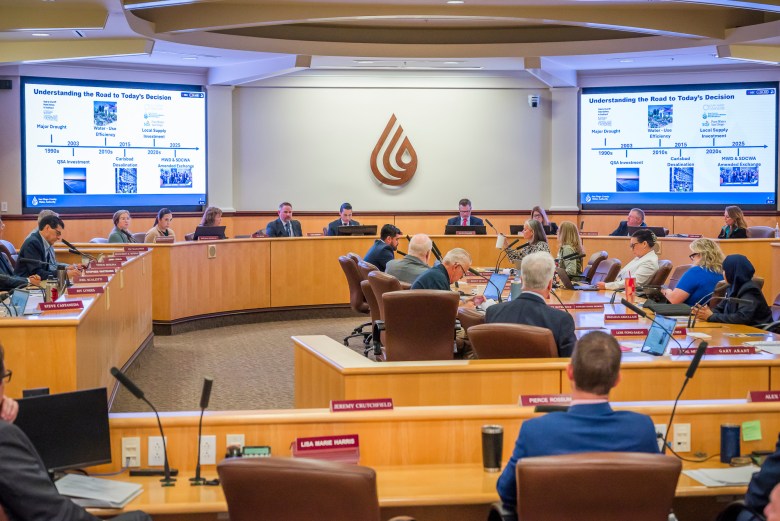
Getting rid of the San Diego County Water Authority might be the best way to address regional water costs and needs in the future.
That’s what the plurality of concepts studied by the San Diego Local Agency Formation Commission or LAFCO, suggest under its first audit of the county’s water wholesaler. The Water Authority fell under LAFCO’s scrutiny a few years ago after two member water districts fought to leave the agency over its high water prices.
So LAFCO decided to do what’s called a municipal service review of the Water Authority, which is basically an audit with recommendations on how to fix certain problems.
LAFCO came up with three possible solutions to the Water Authority’s dire financial straits: Dissolve the Water Authority into smaller water wholesale regions; or dissolve it and form a new special district to manage water treatment and reservoir storage while giving the rest of the Water Authority’s assets to the Metropolitan Water District of Southern California. The third option is to actually expand the Water Authority’s power by letting it absorb its 22 member water districts’ role of selling water to cities and the county.
In water world, dissolving the Water Authority and redistributing its power to Metropolitan is likely to really raise some eyebrows. There’s been longstanding hate between these two agencies due to a protracted legal battle, settled only recently, over the cost of moving water from one to the other. And its member water district’s eyebrows may actually fall off at the suggestion that the Water Authority absorb their power to sell water. Some local water districts have their own water resources or are embarking on expensive projects to create their own by recycling water to try and save their customers’ money.
Importantly, LAFCO is giving the Water Authority two years to get its house in order. The report gave a nod to leadership change at the Water Authority, General Manager Dan Denham.
“It is appropriate to allow current internal reforms time to demonstrate effectiveness before committing resources to explore fundamental organizational alternatives,” the report reads.
In other words, let’s give the Water Authority some time to make good on commitments to sell off expensive water supplies and hopefully bring down water rates.
The Water Authority responded to the report in a March 23 letter. The agency said LAFCO relied on “outdated and conflicting information” for some of its conclusions. And it asked for LAFCO to come back in five years instead of two to allow reforms going on within the agency right now “to mature.”
The agency reported that it has begun a process to review its business model working with general managers of its member agency water districts.
Denham has already been successful selling water. Under his leadership, the Water Authority has made two deals to sell water to thirsty water districts in Riverside County.
LAFCO can initiate a breakup of government service agencies if it believes the business model of the agency is substantively flawed. It has jurisdiction over boundaries endowed by the state legislature and also has the power to annex cities or services together.
The Water Authority now works like this: It acts sort of as a middle man, buying Colorado River water and water from northern California from the Metropolitan Water District of Southern California based in Los Angeles. Then, the Water Authority turns around and resells that water to 22 smaller, local water districts that service residents within cities and the county.
But the cost of water has been skyrocketing due in large part to a bunch of spending the Water Authority did years ago to ensure the region had a reliable water supply, especially during droughts. It made deals with farmers in Imperial Valley to buy Colorado River water that’s legally protected from being cut as droughts worsen in the West, and it built a desalination plant in Carlsbad that makes ocean water drinkable but at a very high price.
LAFCO’s analysts nudged the Water Authority with a few recommendations in its report. LAFCO said the agency should fix its governing board’s voting structure as the city of San Diego prepares to use recycled water and buy a lot less from the agency. As the Water Authority’s biggest customer, the agency is going to take a big hit in revenue when the city does this.
Smaller water districts want more power at the Water Authority. Currently its board votes are weighted toward agencies that buy the most, like the city of San Diego.
LAFCO also suggested it generate revenue not just via water rates (or how much water they sell) but via a special property tax to help support the growing fixed costs associated with building and maintaining all the pipes, pumps and reservoirs the region needs to get and keep water here. The Metropolitan Water District of Southern California already does this.
LAFCO is also going to take a look at Metropolitan’s finances and operations in a second part of this municipal service review slated to be released later this summer, said Priscilla Mumpower, assistant executive officer at San Diego LAFCO.
The most expensive water in the world is the water you cannot buy. And San Diego was in that pickle not all that many years ago. However actions taken since have buttressed the supply, and while costly, when you decide to use water, it is there. If you want to pay less, use less. It is easy to be critical when ignoring the past, instead of acknowledging how the area achieved, largely, a water independence and surplus that much of the state envies.
So they are in a position to sell water….who paid for that water? Didn’t ratepayers? Why isn’t that going back to ease the rising cost of water to San Diego water customers?
Water was secured. The dams/ storage have been ignored. Water and electricity has been lost. Expensive future toilet water is what we get. And it still takes water and electricity to make toilet water. Mindless SD politics.