
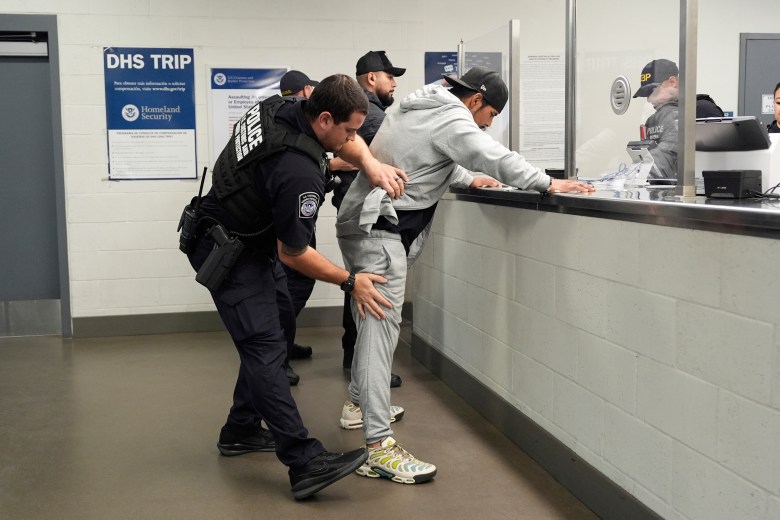
Most days, the immigration crackdown tightening its grip on San Diego’s border region is all but invisible.
Then, suddenly, it’s not.
Late last month, according to one eyewitness, five Ford Explorers with tinted windows screeched to a halt on a side street near Chula Vista’s Third Avenue business district.
Immigration enforcement agents wearing masks and tactical gear leaped from the SUVs and began chasing a group of men on the sidewalk.
The men, looking for work in Chula Vista after attending an asylum hearing in downtown San Diego, scattered.
Authorities caught two of the men, according to a local activist who monitors Immigration and Customs Enforcement activity and witnessed the event. One escaped by jumping into a nearby backyard.
“He was shaken up,” said the activist, who gave his name only as Aldo B. for fear of reprisal by authorities. “It’s the most powerful weapon in their toolkit: Fear. The fear they instill in the community. It’s an environment of uncertainty and instability.”
It has been a little more than a year since President Donald Trump launched a nationwide crackdown on America’s roughly 14 million unauthorized immigrants.
From the moment the highly publicized enforcement operation began, residents of South San Diego County, one of America’s most densely populated immigrant regions, feared the worst.
What unfolded since then has not been what anyone expected. But it has shaken the proudly international region.
South County, home to the world’s busiest transnational border crossing, is accustomed to immigration enforcement. Though comparisons are difficult because the Trump Administration has stopped updating several publicly available sources of immigration data, the region arguably saw more deportations during the Obama Administration than during Trump’s current surge.
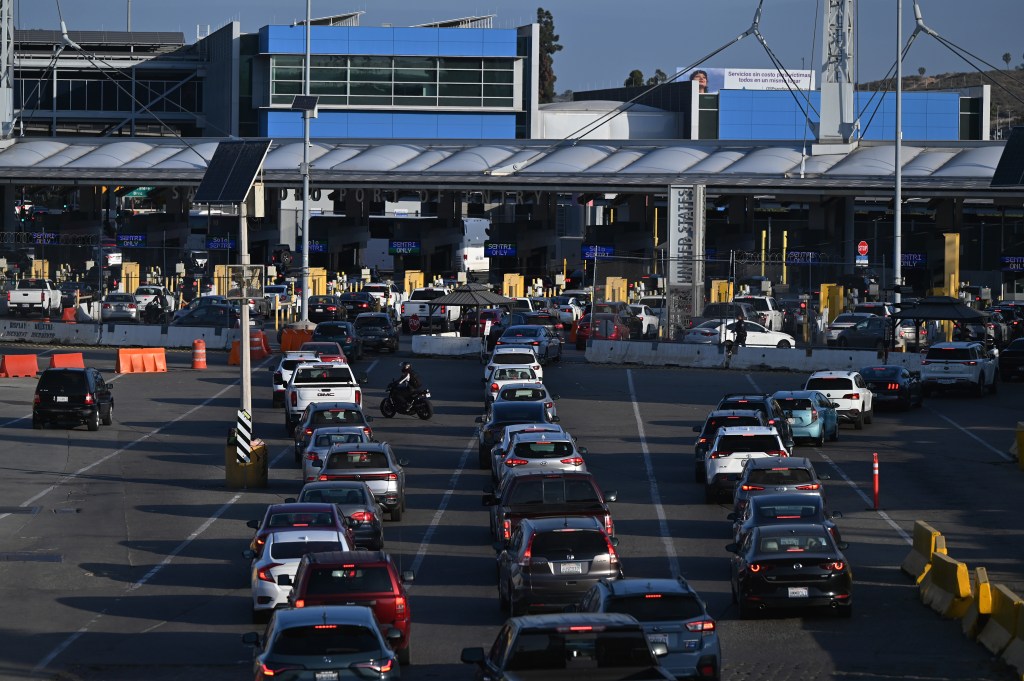
But today’s enforcement feels different, residents of South San Diego County say. The arrests seem more random. The agents act more ruthlessly. And the tactics sometimes appear flat-out unlawful.
That has led to measurable declines in business activity, public transit ridership and even visits to low-cost health clinics.
A once outward facing and aspirational region is suddenly anxious about its cross-border ties and uncertain of its future direction.
“The human toll is serious,” said Chula Vista City Councilmember Jose Preciado, who said his office receives a steady stream of communication from residents anxious about immigration issues.
“This federal government is turning its back on our immigrant traditions,” Preciado said. “We need to support as many people as we can.”
It may seem hard to remember, but just 18 months ago, many South County voters welcomed the prospect of more immigration enforcement.
Voters in the region shifted to the right, politically, in the 2024 presidential election, motivated in part by a sense that San Diego’s southern border had become too porous.
Shortly after the election, a prominent local Democratic political consultant told Voice of San Diego local Democratic officials were engaged in a panicked “run to the middle” on the issue.
“Stop talking about immigration,” said the consultant, who asked to remain unnamed to speak candidly of internal Democratic Party deliberations. “Just talk about renting a home and buying groceries…Latinos care about the same issues everyone else does.”
At first, such advice seemed sensible. Trump’s shift in immigration policy was barely visible on the streets of southern San Diego County.
Data from the Deportation Data Project, which publishes federal immigration enforcement statistics obtained via Freedom of Information Act requests, show that, during the first half of 2025, South County cities and communities saw comparatively few ICE arrests.

In the first six months of 2025, ICE arrested more than twice as many people per capita in the northern San Diego County city of Escondido as in Chula Vista, even though Chula Vista, South County’s largest city, is more than twice as big as Escondido.
By the second half of the year, however, enforcement activity began to rise. More alarming for residents, the rise followed no discernible pattern.
In National City, which has one of South County’s highest concentrations of undocumented immigrants, immigration authorities arrested just three people in 2025, according to the Deportation Data Project – a decline from the previous year.
In San Ysidro, by contrast, home to the region’s — and the world’s — busiest border crossing, there were 492 immigration arrests in 2025. That represented a sea change from the previous year, when the Data Project records no arrests at all.
(Graeme Blair, a UCLA political scientist who helps direct the Data Project, said the lack of recorded 2024 arrests in San Ysidro possibly stems from changes in how federal officials reported arrest location information.)
Though South County never saw the militarized enforcement operations that convulsed Los Angeles, Minneapolis and other cities, the slow-building wave of arrests felt harsher and less comprehensible than any the region had experienced before.
Three of the San Ysidro arrests recorded in 2025 took place on Christmas Day. One of the people arrested that day was a 77-year-old woman from Mexico for whom the Deportation Data Project records no prior criminal record.
Preciado, of Chula Vista, said authorities seemed to be arresting people at random, regardless of legal pretext.
“I’ve always believed in the rule of law and due process,” he said. “These Trump policies are not what I’ve always known.”
In Imperial Beach, a lull in arrests during the first half of the year suddenly gave way to 13 arrests in July, followed by sporadic bursts in August, October and November.
Chula Vista saw seven arrests in January, followed by just three in February. Nine arrests in October were followed by just two in September. There were no arrests in December.
“It will be dead for weeks, then a bunch of activity in a couple of days,” said activist Aldo B. of enforcement operations.
For many, the unpredictability became the surge’s defining feature.
“They are looking for people in schools and churches and homes,” said Antonio Cardenas, a Mexican citizen who lives in Tijuana and crosses the border regularly to shop and visit friends.
Speaking one recent morning in San Ysidro, Cardenas said virtually everyone he knows on both sides of the border is reluctant to spend time in public in the United States because they simply don’t know what might happen.
“We’re afraid,” he said.
Maricela Flores, a salesperson for the cell phone provider TruConnect, said the pervasive atmosphere of low-grade fear has dampened business.
“Business is down since last year,” she said earlier this month at a TruConnect sales pavilion across the street from the San Ysidro Transit Center.
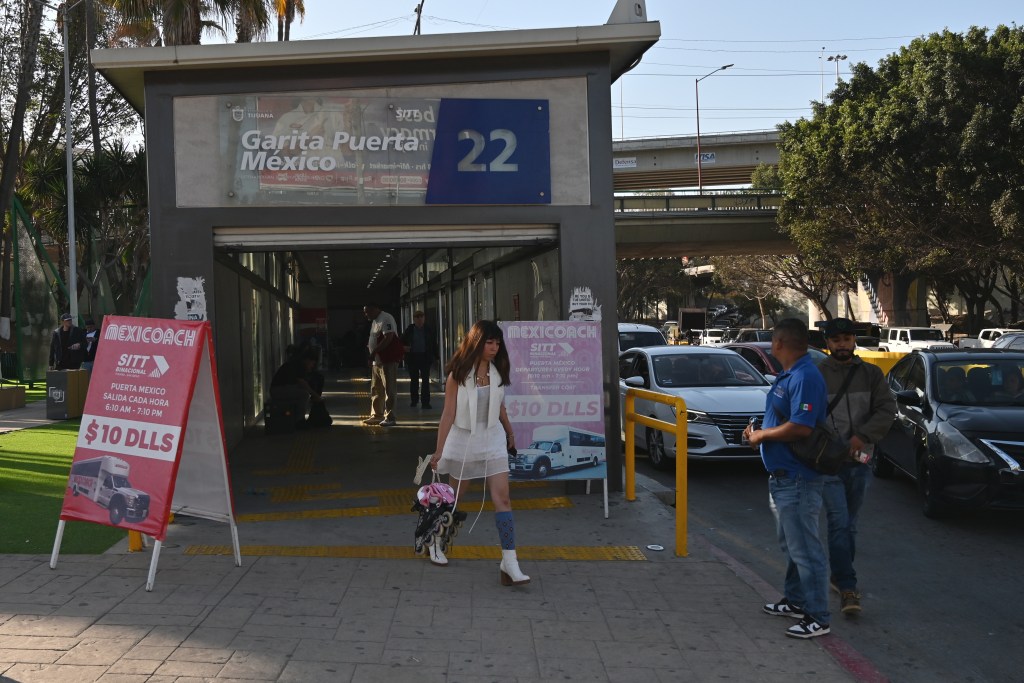
According to a recent San Diego Metropolitan Transit System mid-year performance report, ridership on trolley lines, including the Blue Line servicing the San Ysidro Transit Center, is down this year compared to the first quarter of last year.
MTS CEO Sharon Cooney told agency board members in March officials believe “federal immigration enforcement” likely contributed to the unexpected ridership decline.
“People in the community…are staying hidden,” said MTS board member and National City Councilmember Marcus Bush. “Businesses are losing because those that employ undocumented immigrants, it’s hard to hire people or sometimes employees don’t come to work.”
Scott Andrews, president and CEO of local Neighborhood National Bank, confirmed the hiring challenges.
“In some of the service industries, they’re definitely seeing issues with manpower,” Andrews said. “The labor pool has shrunk, and a lot of these might be immigrants crossing the border, and now they’re not.”
Jim O’Callaghan, president and CEO of the South County Economic Development Council, said in addition to labor shortages, business owners he speaks to cite a more general pall of uncertainty clouding their prospects.
“What we’re hearing and seeing is more trepidation and uncertainty than anything,” he said. “There’s a tightening of sorts from what they’d normally see of foot traffic. If they used to get the same visitor two times per week, now it’s once or none.”
In Chula Vista, city officials last month were surprised to discover hotel tax revenue from bayfront hotels was less than officials had projected.
The city’s finance director said hotel operators reported a decline in bookings from cross-border guests.
Even local healthcare providers have experienced a change.
San Ysidro Health, a network of federally subsidized low-cost health clinics that serves a predominantly Latino population in South San Diego County, reported a sudden drop-off in uninsured patients beginning in 2024, the year the Biden Administration began tightening border enforcement.
California residents are eligible to pay for care at low-cost clinics via Medi-Cal, the state’s federally funded health insurance program. Mexican nationals crossing the border for treatment are not.
The drop-off in uninsured patients continued last year, according to preliminary figures provided by a spokesperson for the San Ysidro clinic network.
Overall growth in patients also slowed in 2024 and 2025, according to federal reports. And in 2024, the number of what the reports call “migratory and seasonal agricultural workers” plummeted from 377 to just 31.
Giovanni Tec, the San Ysidro Health spokesperson, said equivalent migratory worker figures for 2025 are not yet available.
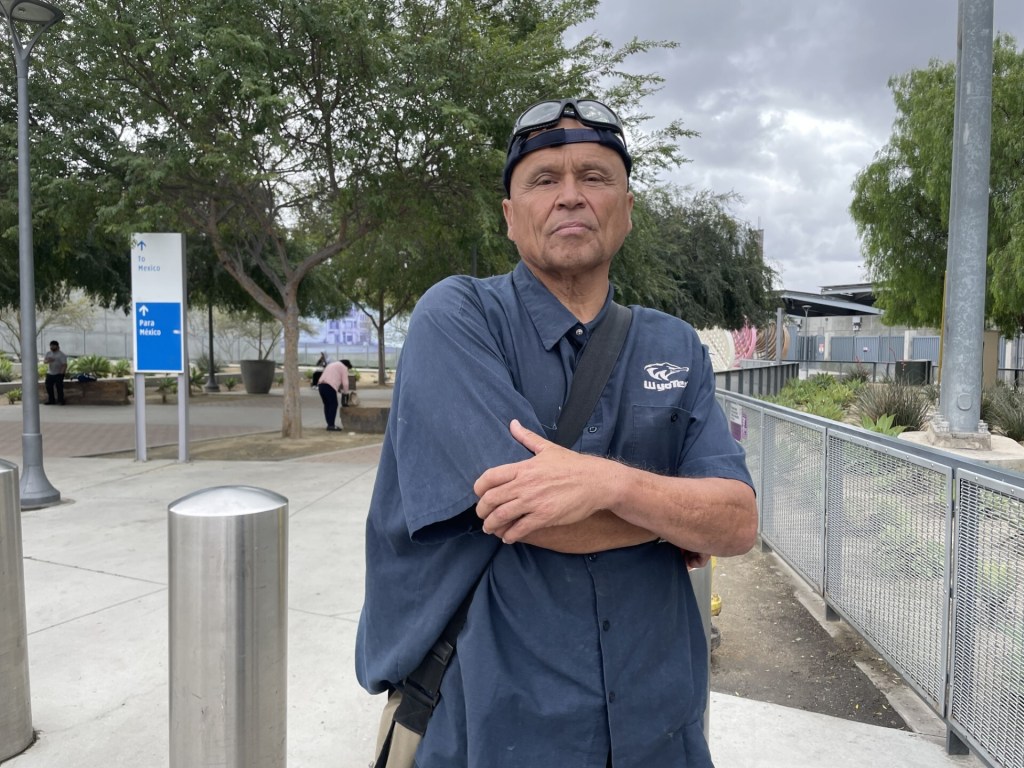
Felix Gomez, a contract welder at San Diego’s naval shipyard, said foreign-born workers are crossing the border less because “there are no jobs here. In the last three to four months, it went down…People are staying in Tijuana waiting to work again.”
Gomez said the job crunch is exacerbated by employers’ increasing strictness about employees’ authorization to work in the United States.
“With no papers, you can’t get anything,” Gomez said. “Even with papers, it’s hard. Even with a Green Card or U.S. citizenship. Last year, it was okay. This year, it’s going down.”
The ties binding South San Diego County with Mexico and other Latin American countries are deep. Residents said the sudden injection of fear into what once felt like routine cross-border connections has left them disoriented.
“Chula Vista is the hub of the San Diego-Tijuana mega-region,” said Chula Vista Director of Economic Development David Graham in an interview last year. “Forty-three percent [of foreign-born residents in Chula Vista] entered [the U.S.] before 1990. They came to us three decades ago.”
Now, those longtime residents say they are looking over their shoulders.
Chula Vista Elementary School District Trustee Francisco Tamayo was born in Mexico and became a U.S. citizen nearly two decades ago. These days, he said, he carries his passport everywhere he goes.
“Just in case,” he said.
Tamayo and other local leaders said foreign-born residents often ask for help. But with little control over federal immigration policy, officials mostly have resorted to incremental measures.
Chula Vista recently adopted an ordinance restating the city’s commitment to state-mandated limits on cooperation between local law enforcement and federal immigration authorities.
The ordinance added provisions limiting disclosure of residents’ personal information and restricting immigration authorities’ access to certain city facilities. Still, it generated comparatively little public debate and has not quelled residents’ demands for help.
At Southwestern College, which enrolls close to 600 students who are non-U.S. citizens, students packed a recent board of trustees meeting demanding a more vigorous response from school leaders to the immigration issue.
Trustees hastily adopted a measure similar to Chula Vista’s last month.
The rush to pass laws has led to debate among local leaders about how best to respond to the immigration crackdown.
“If you can accomplish something, great. If not, don’t,” said National City Mayor Ron Morrison, explaining why his city has not rushed to emulate what he called other cities’ largely symbolic efforts.
Morrison said though his city is home to a large foreign-born population, opinions about immigration policy vary widely.
He cited recent social media posts critical of a Jan. 30 anti-ICE protest in National City that some residents said had devolved into what Morrison described as “people doing donuts” in their cars.
Another recent social media post encouraging high school students to skip school to attend a protest “had 200 comments on it and 80 percent were against,” Morrison said.
Absent unified political leadership, residents have begun taking matters into their own hands.

On a recent Wednesday morning, roughly a dozen local activists gathered at a National City shopping center at the intersection of Plaza Boulevard and Highland Avenue.
Brandishing signs and a bullhorn, the activists announced the formation of what they called the National City Defense Coalition, a partnership of local community groups that plans to train residents to spot, monitor and, if possible, disrupt the activities of federal immigration authorities.
“A lot of people are really in fear,” said Izabella Lopez McGawley, a coalition leader. “We’re forming this coalition to stop that from happening.”
Judy de los Santos said her organization, Union del Barrio of San Diego, would train coalition members in monitoring tactics. Already, she said, her organization has been monitoring ICE agents in Linda Vista, Escondido and other parts of San Diego County.
“Today we’re adding National City to that work,” she said.
Coalition members said they plan to canvas local neighborhoods, handing out flyers in Spanish and Tagalog and encouraging residents to call a network of volunteer responders whenever they see immigration agents in their neighborhoods.
Aldo B., the Chula Vista activist, said it was a phone call from a watchful resident that alerted him to the enforcement operation against asylum seekers in his city.
“There’s definitely a lot of fear in the community,” said McGawley. “At the same time, there are a lot of people who are agitated in the current situation and pushed to take action in ways they never felt the need to before.”
“We’re looking at how to mobilize.”
If they are not legal immigrants, why hire? I have to credential everyone of my employees to be compliant. It costs more, but they are legal employees.
I always forget to check my browser settings before browsing for wedding ideas. Any tips on what to look for?
Don’t sneak across the border illegally and you don’t have anything to worry about.
How about you look at how our community is safer because of ICE and enforcement of the nations laws. If you illegal, go back and apply like a lawful person.
Illegals need to GTFO of the USA, period! Go ICE!
The US government is providing financial aid to self-deport. Instead of living in fear, illegal immigrants can simply self deport. If they are living in fear then they made that choice. I also wonder, what does “flat-out unlawful” mean? I seriously doubt that any of the people using that phrase knows what it means. ICE is only seeking to arrest people with removal orders issued by a judge. if a judge issued the order, then it is certainly lawful.