
Diego Armando Acosta goes to the beach with his father almost weekly to surf along the Baja California coast.
Though they live in Tijuana, the father and son said they often choose to head to beaches further south around Rosarito to look for cleaner water.
“It’s better,” the father, Diego Acosta, told me in Spanish. “You can see the difference.”
A nationwide study from the Comisión Federal para la Protección contra Riesgos Sanitarios of water quality in Mexico’s beaches at the end of March found concerning water contamination in several areas just south of the border. Of the 17 states with beaches, only Baja California had water contamination levels that meant some of its beaches were not safe for swimming.
Last year, the commission found that three states had beaches with concerning levels of contamination — Baja California, Guerrero and Nayarit.
Sewage contaminating ocean waters has led to long-term beach closures and even political careers on the U.S.-side of the border, particularly in Imperial Beach. But the contamination also affects beaches along Mexico’s shoreline.
Officials from both sides of the border met last week in Tijuana to announce another large investment in infrastructure work to try to fix the issue.
The beaches flagged in Mexico’s nationwide study as not suitable for water activities were not those closest to the border wall itself. The study found elevated levels of bacteria associated with fecal matter in San Antonio Del Mar, Baja Malibú and Playa Blanca, which are a short drive south of the main Playas beaches on the way to Rosarito. The three locations are private beaches controlled by gated communities.
But, a separate study published at the end of March by Proyecto Fronterizo de Educación Ambiental found unsafe levels of those bacteria in beaches much closer to the border wall including El Vigía, Cañada Azteca and Parque México. (The part of the beach closest to the border wall, known as El Faro, appeared safe.)
Proyecto Fronterizo, a member of Waterkeeper Alliance, monitors water conditions weekly with tests on Thursdays and posts on the organization’s social media channels on Fridays.
April studies showed downward fluctuations in contamination levels, but as recently as April 16, Cañada Azteca still showed signs of high contamination.
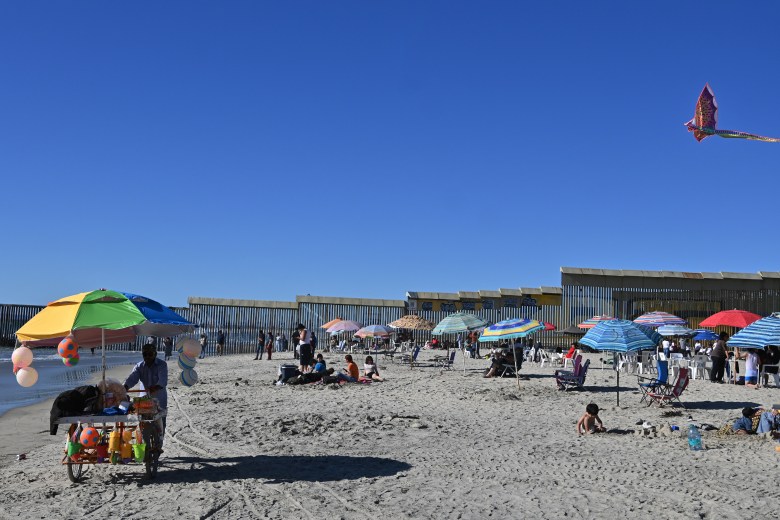
I met the Acosta family between Parque México and Cañada Azteca on a Sunday afternoon soon after Proyecto Fronterizo posted those test results. Along the beach, people swam, lounged under umbrellas and listened to the tunes of roving musicians.
The majority of beachgoers clustered closer to El Faro, where vendors circulated with sunglasses and an array of snacks. The vendors I spoke with didn’t seem to have much sense of whether the beach crowds change depending on the water contamination levels.
But, the younger Acosta, standing with his surfboard, said he keeps a close watch on the water contamination level testing and avoids the beach when the bacteria get too high. He said that when he surfs closer to the border in Playas de Tijuana, the water irritates his eyes. But sometimes he surfs there anyway because he doesn’t want to make the drive to Rosarito, he said.
A little further north along the beach, a family of five played in the edge of the surf.
Alex Briseño, the father, said that the family didn’t know anything about the water contamination.
“We don’t worry,” Briseño said. “The Mexican stomach is very tough.”
He said they live in Tijuana, but they don’t come to the beach very often. They had spent the whole afternoon there, playing in the waves and eating snacks from the vendors who walked up and down the sand. As he spoke to me, his daughter buried his feet in wet sand.
Thank you for reading. I’m open for tips, suggestions and feedback on Instagram @katemorrisseyjournalist and on Bluesky @bgirledukate.
In Other News
Lawyers in training: Gustavo Solis reported for KPBS that University of San Diego has a law clinic where student lawyers can help immigrants at Otay Mesa Detention Center.
Gun range: Federal immigration officials have been renting out the San Diego sheriff’s firing range training facility for years, Sofía Mejías-Pascoe reported for inewsource. That includes both Immigration and Customs Enforcement and Customs and Border Protection officials, who have collectively paid about $235,000 to the San Diego Sheriff’s Department since 2024.
Body cameras: Some Tijuana police officers have started wearing body cameras, particularly in tourist areas, Alexandra Mendoza reported for The San Diego Union-Tribune.
Steel imports: Adelina Dayebi Pazos reported for El Sol de Tijuana that Tijuana’s construction industry depends on U.S. steel, though Mexico is looking for ways to bolster its own steel production in light of U.S. tariffs.
Lawsuit threats: Punto Norte reported that the mayor of Tecate has threatened to sue the digital publication over reporting related to a removal of a 90-year-old woman and her family from a ranch.
Sanctuary lawsuit: The city of El Cajon sued the state of California over its laws limiting police interactions with federal immigration officials, Alex Riggins reported for The San Diego Union-Tribune.
Leave a comment