
We’re less than a week away from Tuesday’s statewide primary election, and in most ways, the field for California superintendent of public instruction seems as wide open as ever. What’s more is that, amid a fractured and contentious race for governor, voters barely seem to be paying attention to the similarly fractured race for state supe.
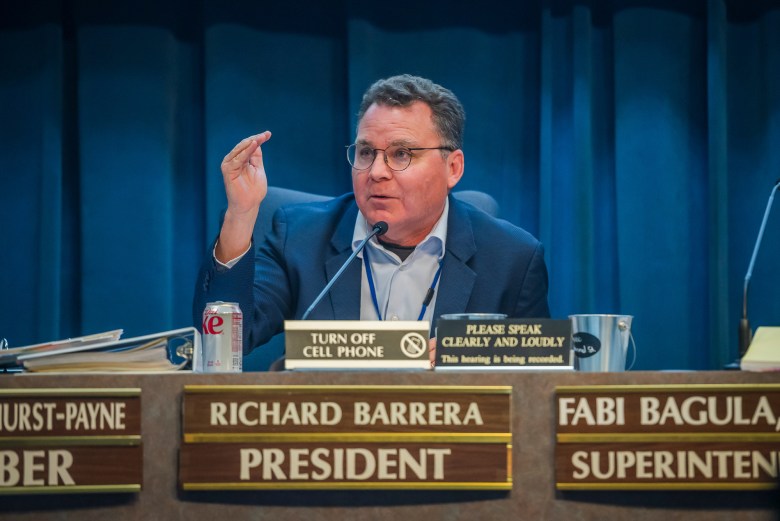
That may end up playing in favor of longtime San Diego Unified Trustee Richard Barrera, whose longshot candidacy was given fresh life by an endorsement from the state’s No.1 schools power player: the California Teachers Association.
Now, as the union pours millions into the race, it’s clear they’re not leaving his election up to chance.
It’s not hard to understand why voters aren’t plugged into the state supe race. The position’s powers can be more symbolic than practical. The state supe doesn’t develop educational policies, but they do implement them. They also don’t create budgets, but they do disburse funds. Much of what they do is advocate for positions.
The race is also a bit of a black box. More flashy races are getting all the attention and there’s little public polling on the state of the race. Fundraising offers a peek behind the curtain.
According to an EdSource tracker, Barrera has raised about $220,000. That lands him in fourth place behind California State Assemblymember Al Muratsuchi, conservative Chino Valley Union Trustee Sonja Shaw and former California State Senator Josh Newman who’ve each raised between $284,000 and $330,000.
Muratsuchi and former Speaker of the House Anthony Rendon, also transferred boatloads of cash from past campaigns they’d run – over $350,000 and $1.1 million, respectively. That gives them way more money to work with than the other candidates.
Bad news for Barrera, right? Not really.
His personal fundraising doesn’t really seem like it will matter. That’s because Barrera had the backing of the California Teachers Association, which for at least 40 years has acted as a kingmaker in the race.
This cycle had the chance to upend CTA’s staggering win streak. While labor organizations have often coalesced around a single state supe candidate, this year support splintered, with various unions supporting different candidates.
So, Barrera’s hopes hinged on just how much support he’d get from CTA. Turns out, a whole lot.
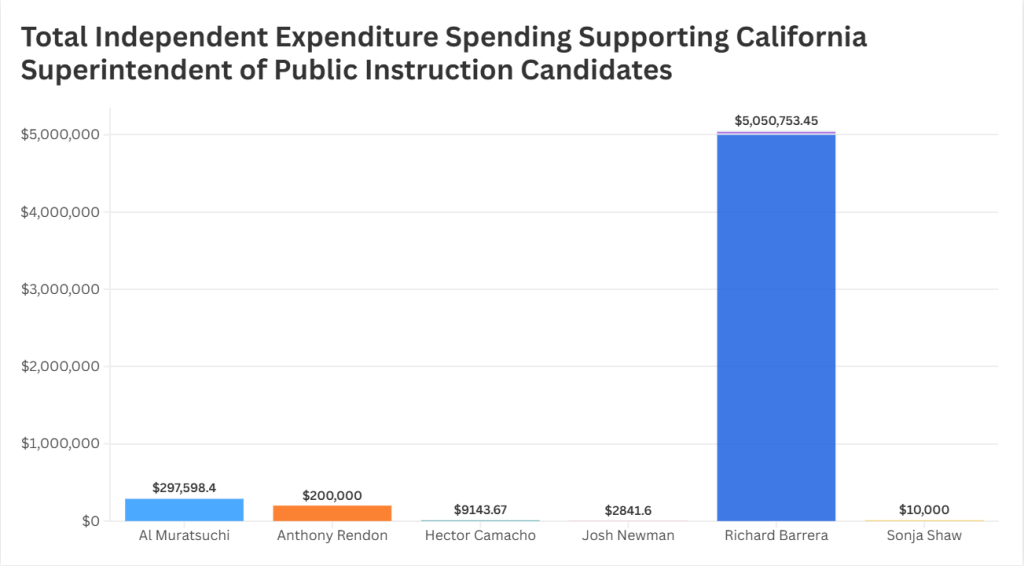
Over the past two months alone, the union’s independent expenditure group has dropped nearly $5 million into the race. CTA President David Goldberg told me there will likely be more where that came from.
“We are planning to spend as much as it takes for him to win,” Goldberg said.
It’s not hard to see why CTA put their considerable weight behind Barrera. He’s a true-blue labor guy who came to the board not from the classroom, but from organizing spaces. Over his nearly two decades on San Diego Unified’s board, he’s played perhaps the largest role in charting the district’s course. That includes the development of the district’s now tight-knit relationship with labor, its embrace of progressive programs like community schools and its unprecedented leap into workforce housing.
Even so, his labor history has earned him enemies. Those inside the labor movement have called on CTA to rescind its endorsement due to Barrera’s once-close connection to Mickey Kasparian, who was accused of sexual impropriety by a host of women. Those outside of the movement have alleged his close labor ties constituted a conflict of interest.
Those concerns haven’t swayed current CTA leadership, who’ve dominated the independent expenditures in the race. Of the nearly $5.6 million spent by independent expenditure committees in the race, more than $5 million has gone to support Barrera.
Even so, what little polling we have doesn’t show a clear favorite. A Public Policy Institute of California poll released in April showed just 7 percent of voters said Barrera was their pick. That placed him tied for second with Shaw.
Ahead of them were San Francisco Unified teacher Ainye Long, a virtual nonentity in campaign fundraising, and Anthony Rendon, a former speaker of the California Assembly, each of whom had 9 percent of the vote. Meanwhile, the shoulder shrug of “don’t know” far outpaced every candidate, with 32 percent of the vote.
That poll, though, was functionally conducted an eon ago as far as electoral politics are concerned. After all, then-Congressmember Eric Swalwell was voters’ top pick for governor. By the time the poll was released, Swalwell had dropped out of the race and even stepped down from Congress after women accused him of sexual assault and harassment.
All but $50,000 of the outside spending on Barrera’s behalf came after late March and early April, when voters we’re being contacted for the poll.
And Goldberg, for his part, said he feels good about how the race is shaping up.
“These races that are bottom of the ballot are often hard to break through. That’s very true this year, with so much going on with the governor’s race,” Goldberg said. “But I’m starting to see [Barrera] break through.”
There has been some momentum for his campaign. He’s pulled in a host of newspaper endorsements, like the San Francisco Chronicle and the McClatchy group, which includes the Sacramento, Fresno and Merced Bees. Barrera has also long counted current state supe, Tony Thurmond, for whom he works as a deputy, as a supporter.
Even the California Charter Schools Association, once the sworn enemy of the CTA, is backing Barrera who, despite his union bona fides, has long struck a more measured tone about the system than some of his compatriots. The group has dropped nearly $40,000 on television and web ads for Barrera.
One interesting wrinkle in the race is just how volatile the state supe position is in this moment. While it’s long been an ill-defined position, that could become even more true if proposed changes advanced by Gov. Gavin Newsom and then, in a much different form, by the state legislature, become law. Those changes would strip even more powers from the state supe role and award them to the governor, or the legislature, depending on whose version of the changes win out.
Needless to say, Barrera, like the other state supe candidates, oppose the changes. So too does Goldberg and the CTA. In any case, Barrera, who’s long been a more behind the scenes figure than an in-front-of-the-camera one, could potentially thrive in the soft power role of the state supe.
That potential dealmaking ability is part of why the CTA endorsed him. For Goldberg, Barrera also reminds him of another candidate the CTA has endorsed this cycle.
“Some of the reasons we’re supporting him are also why we endorsed (Tom) Steyer,” Goldberg said. “He’s talking about raising revenue in a way no other viable candidate is doing,” he said, referring to Steyer.
That’s true.
The billionaire is one of the few gubernatorial candidates who’s come out in favor of proposals like the controversial billionaire tax. Even CTA hasn’t spoken directly in favor of that proposal, likely because it would require new revenue be spent on healthcare costs. Barrera, similarly, has told me he supports taxes on the rich but would want the revenue to be put back into schools.
What We’re Writing
Officials at the wealthy North County Del Mar Union School District suspected an elementary student lived outside the district’s boundaries. So, they hired a private investigator to surveil the child’s home and follow them to school. The child’s mother was so frightened by the sight of a car tailing them, she called the police.
This is a highly opinionated and biased article. Articles like this show how far media has gone from neutrality to trying to sway public opinion on whomever pays them the most.