
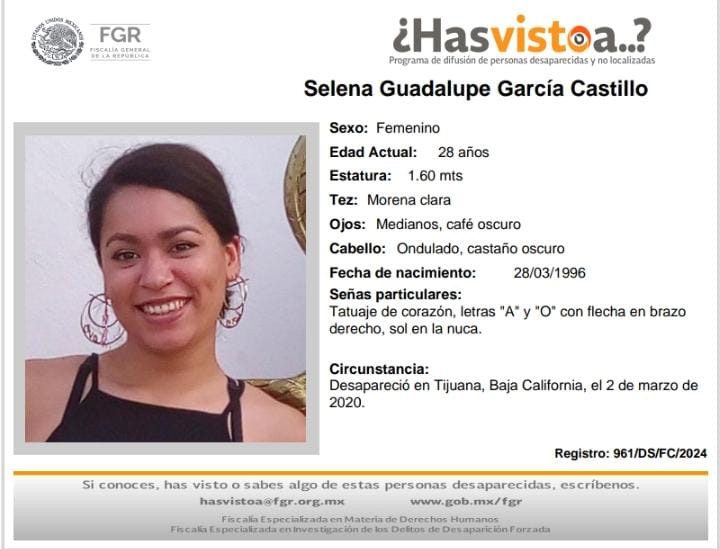
Olga Castillo’s daughter disappeared in Tijuana in February 2020. A group of men took her and her boyfriend, who she lived with at the time.
Selena Guadalupe García Castillo is among more than 128,000 people currently missing in Mexico, according to a 238-page report recently released by the Inter-American Commission on Human Rights. The country also has more than 70,000 unidentified bodies, according to the report. The commission called the number of disappearances in Mexico a humanitarian crisis.
Castillo said her daughter and her daughter’s boyfriend had been living in their new home for less than a month when they were taken. She said she’d started to worry when her daughter didn’t answer her calls or return her messages. Then, her daughter’s friend messaged her that a group of men had taken García Castillo.
“The world came down on me,” Castillo said. “That’s when my nightmare started. I didn’t know what to do. I went crazy.”
The commission, part of the Organization of American States, monitors human rights conditions throughout the hemisphere and makes recommendations to countries about how to improve. In its report published in February 2026, it found that Mexico needs to do more to investigate and bring justice for family members of the disappeared.
The report breaks the disappeared into several groups — men and boys recruited by criminal organizations, women and girls who are victims of gender-based violence, human trafficking victims, migrants, victims of hate crimes based on sexual orientation, journalists targeted because of their work and human rights defenders.
Castillo, whose daughter was taken from Tijuana, said most of the madres buscadoras, or searching mothers, whom she has met on her journey to find answers about her daughter are looking for men. She and a few other women looking for their daughters have banded together to support one another, she said.
When I covered the 8M March on International Women’s Day in Tijuana, the demonstration’s organizers created a section where families looking for missing women and girls could walk together.
In its report, the commission urged Mexico to take more preventive measures to stop disappearances by addressing the root causes of violence that leads to them, as well as holding accountable those who kidnap or kill to deter others from doing the same.
The commission also noted that because of delays in investigations and lack of results, many family members of the disappeared do not trust the government’s efforts, leading to high impunity rates, or rates of crimes without convictions. It found that in 2023, Mexico reported a 99.5 percent impunity rate in cases of forced disappearance, 98.4 percent in cases of extortion and 96.8 percent in cases of intentional homicide.
The commission also noted that in several high-profile cases, information that could have led investigators to suspect state actors was removed from the files.
Castillo is still searching for information about her daughter today.

She said that she has lost faith in the police and the government, and that she has been investigating by herself as best she can.
“I lived in a bubble thinking the government protected us and took care of us,” Castillo said in Spanish. “Now I”ve discovered the cruel reality that we live in here. They don’t protect us. They are involved in all of this.”
She believes her daughter may have been sold.
“I put myself on my knees and pray to God and say, ‘You are the only one who can help. The only justice is you,’” Castillo said.
Now, everywhere she goes, she takes flyers about her missing daughter. She and other madres buscadoras even travel to other states to look for information and pass out flyers.
“My daughter has a sweet, noble heart, very genuine,” Castillo said.
An aspiring rapper and dancer, García Castillo was studying international relations in school, Castillo said. The last time Castillo saw García Castillo, the daughter had cut her hair short, but she promised her mother that it would grow back.
Sometimes, Castillo said, she gets close to losing faith that she will find her daughter, but then she will hear news that someone else searching for a loved one finally found them. That keeps her going, she said.
She said she hoped that people will have empathy for each other, and that anyone with information about her daughter will come forward, even anonymously, to share it.
“I don’t want it to happen to anyone else with my whole heart,” Castillo said. “If the people don’t unite, if they don’t have empathy, this won’t stop.”
Thank you for reading. I’m open for tips, suggestions and feedback on Instagram @katemorrisseyjournalist and on Bluesky @bgirledukate.
In Other News
Blocked border: Protests by a teachers union in Tijuana have blocked U.S.-Mexico border crossings intermittently in recent weeks, including last week, Giovanny Urenda reported for El Sol de Tijuana. The Athletic reported that the protests, which are also happening in Mexico City around the World Cup stadium, are because the teachers believe that President Claudia Sheinbaum broke a promise about changing a law related to pensions.
Iran in Tijuana: Alexandra Mendoza reported for The San Diego Union-Tribune that Tijuana was preparing to host the Iranian World Cup team, which will sleep in Mexico and compete in the United States.
Mega hearings: I reported for Daylight San Diego that an immigration judge ordered 50 people deported over the course of about eight minutes during the first day of “mega” master hearings in San Diego Immigration Court.
High bonds: Gustavo Solis reported for KPBS that lawyers are concerned about unusually high bond amounts issued to immigrants with no criminal convictions who are trying to get out of Immigration and Customs Enforcement custody.
Deported paletero: A beloved community paletero opened a new restaurant in Tijuana after he was deported, Alexandra Mendoza reported for The San Diego Union-Tribune.
Leave a comment