

In late December, San Diego Unified leaders gathered for a ribbon cutting at Logan Memorial Educational Campus in Logan Heights. The school’s mariachi band played in front of the sprawling campus as everyone from Interim Superintendent Fabiola Bagula to Assemblymember David Alvarez made speeches.
The new facility at Logan Memorial, called El Nido, or “the nest,” is a first-of-its-kind for the district – an infant and toddler center for children between the ages of 2 months to 3 years.
District leaders have repeatedly acknowledged the underinvestment in the community. The shiny new Logan Memorial campus and groundbreaking programs like El Nido are, in part, a mea culpa of sorts. But even after Logan Memorial – the most expensive construction project in district history – opened, parents have been frustrated by what was delivered.
Some of the performance and behavioral issues that plagued the schools that were there before remain, and parents had concerns that some of what was promised would never materialize. District leaders repeatedly pushed back the launch of El Nido because of confusion about the program’s licensing. This left community members wondering if it was ever going to open.
Now that that it has, district leaders are eager to ensure the program lives up to the hype. For one board member, getting into the baby game represents not only the greatest aspirations of San Diego Unified, but also a potential guidepost for the future of public education.
‘Calm, Orderly, Intentional’
For Belinda Rico, the administrator in charge of El Nido, one of the most exciting things about the center is its location. Montessori schools have long been available in ritzy neighborhoods like La Jolla and Rancho Bernardo for high prices. Historically they’ve been much less accessible to people in neighborhoods like Logan Heights, let alone for free, which is what El Nido offers.
Montessori schools were an invention of Maria Montessori, an early 20th-century physician who championed an approach that sought to lean into children’s independence and curiosity. They tend to encourage self-paced, student-led learning as opposed to the more standardized instruction of a traditional school.
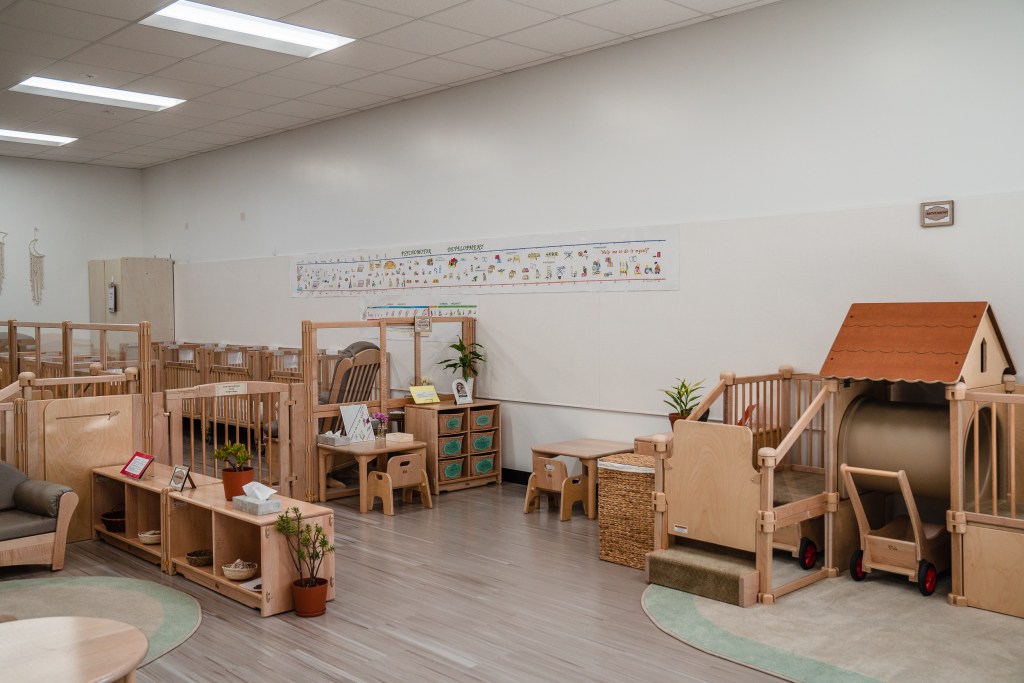
All of Logan Memorial, at least up until eighth grade, is Montessori-based. But the difference is evident in El Nido, down to the design of the classrooms. Unlike the bright, colorful design of traditional daycares, the inside of El Nido is nearly monochromatic. Clean white walls are offset by rows of tan cribs, tan shelves, tiny tan chairs and a tan playhouse.
“The classroom environment is designed to be calm, orderly, intentional,” Rico said. “Seeing everything in its place and organized is really a way for [kids] to stay calm through the entire day and be able to learn and receive the information that they’re getting.”
The program is small, with room for only 64 children ranging from 2-months-old to turning 4 between its five classrooms. Those five classrooms have adult-to-child ratios slightly higher than state requirements, which is especially exciting for Rico.
The creation of El Nido was a learning experience for both staff and parents, many of whom hadn’t worked or heard of a Montessori school. El Nido’s educators receive ongoing training via a partnership from Poway’s Country Montessori School and Rico said she’s created cheat sheets to help curious parents understand exactly what the program has to offer.
It’s still early, but there are some encouraging signs. The program, which is available to Logan Memorial families and families of the high school’s feeder schools, already has a waitlist with dozens of families.
Rebecca Rodriguez first found out about El Nido after she enrolled her 3-year-old son at Logan Memorial’s preschool program called “Casa,” or “House.” She said she noticed a difference right away.

“With my son, I saw a huge change in his independence. When you’re a parent sometimes you think your kids aren’t capable of doing a lot of the things that they actually can do,” Rodriguez said. “But he was like, ‘Oh, I can do it, I can put on my shoes, I’ll pick up my plate, I can wash my own hands. I don’t need your help.’”
The experience made her feel like maybe kids just aren’t getting the right tools in traditional preschools. So, she dove into the Montessori method, buying Montessori toys, working on exercises with him at home and even allowing her 5-month-old daughter to be a model for the El Nido teachers to work with prior to the program’s opening.
Her daughter is now 2 years old, and while Rodriguez wishes the program had figured out the licensing snafu earlier so her daughter had more time in El Nido, she’s still grateful for the experience.
“There are so many little things she’s done, like working on motor skills, that you don’t think translate into academics, but I’ve seen that they definitely do,” Rodriguez said.
For Rico, the program administrator, she hopes those little things all translate into big changes – a love of learning, increased independence, the ability to work collaboratively and the ability to stay focused.
“When they go to our primary, middle school, high school and beyond, we want them to leave with these skills,” Rico said.
‘Bring it to Scale’

Trustee Richard Barerra hopes El Nido is just the beginning. He’s long been critical of the patchwork system of childcare that’s taken root in California. To him, it’s something of a lose-lose situation. Childcare is often too expensive for families and frequently doesn’t pay those working in the industry living wages.
His solution is to continue to expand the domain of public education to include younger and younger kids. The arrival of universal transitional kindergarten, a state-funded initiative that opened up a new grade to all of California’s 4-year-olds was an encouraging sign.
But district leaders decided to go even further with the creation of El Nido, which put them out on a fiscal limb. Because there is no statewide funding allocated to infant and toddler care programs at public schools, the district has to pay for the program out of its limited discretionary funds. Those are funds that can be spent on any district program rather than being tied to a specific one.
“We saw the opportunity to be able to work with kids at the earliest stage and we believe it’s critical, so we were willing to kind of jump out there and take a risk and try to develop this program and learn from it,” Barrera said.
The program aims not only to bring new opportunities to a community long underserved by the district, but in Barrera’s mind, to also function as a sort of test case for a future expansion of public education.
“It’s very difficult to advocate for a sustainable stream of funding for bringing essentially, babies into the system if you don’t, if you don’t have a model that that you can point to,” Barrera said.
If the district can develop a quality program that can prove the value of early childhood education being provided for free at public schools, it may set them up to advocate for a permanent stream of funding for such programs. What he really hopes for is that years from now there are El Nido style programs available for free to all children within the district.
A large-scale expansion in the number of kids eligible to attend public schools would also significantly increase enrollment in districts across the state, which would also increase district funding. Just the rollout of UTK had a smaller, but significant, impact on enrollment at districts.
“I know this all sounds kind of pie in the sky, but 100 years ago high school was not something that was accessible and available in the public school system for all students,” Barrera said. “So, I think the idea is to create something great and then advocate for a sustainable source of funding to bring it to scale.”
How any parent(s) will allow any government organization to raise their child is basically someone who already relies on such to do so. SDUSD is more concerned about getting more kids to add to their attendance as that’s how they make $. They might tell you the budget issue has been solved but until they eliminate the free health care for teachers they will always be asking for a handout
This is disgusting. Parents need to be raising their kids, not the district. Too much government.. Does the government know how to raise your child better?? Scary stuff.
Now they get free child care too? Free healthcare, free housing, free clothes, free phones, free food, free internet, free heating and air conditioning. Why? They have earned nothing.