

After a hard-won fight to get the City Council to repeal a controversial zoning provision, known as Footnote 7, that allowed for more dense housing in southeastern San Diego, some residents of the Chollas View community had hoped a project they opposed would die.
It did not.
Late last year, city planners notified residents of a proposed 23-unit housing project on Klauber Avenue. Some residents hoped the repeal of Footnote 7 – which returned the minimum lot size from 5,000 to 20,000 square feet – would stop the project.
City spokesperson Peter Kelly, however, said the project is moving forward because the developer completed the application before the repeal took effect in March.
The 23-unit project on Klauber isn’t an apartment complex; it will be a cluster of 23 single-family homes. The project will subdivide a large lot into smaller lots that range in size from 5,000 to 14,000 square feet.
Chollas View, Encanto and Emerald Hills, where Footnote 7 applied, are unique. Like La Jolla and Miramar, they have a much larger minimum lot size than other parts of the city. Footnote 7 reduced that minimum lot size to a number more in line with the majority of the city – but the city didn’t do that in Whiter and wealthier neighborhoods.
The Klauber Avenue project’s eligibility under the old rules stems from how the city processes development: If an application is submitted and marked complete before zoning laws change, the city must review it under the previous standards. A property’s value is directly tied to what can be built on it. If an application is submitted based on zoning and land-use regulations that exist at the time of submittal, it could be considered an illegal taking of property to change it while an application is going through the process.
That hasn’t eased some residents’ frustrations.
Andrea Hetheru, former chair of the Chollas Valley community planning group, is still trying to figure out what the repeal did – and didn’t do.
“We were under the impression the repeal would stop projects from being grandfathered in,” said Hetheru. “But now the city is saying that as long as you got your paperwork in before the deadline, you can move forward like nothing happened. So, what was the point of the repeal?”
Kelly said that residents were informed back in January that repealing Footnote 7 would not retroactively apply to development proposals. A staff report presented to the City Council in January stated that “municipal code regulations adopted by the City Council through a publicly-noticed process remain in effect and must be enforced and applied.”
District 4 Councilmember Henry Foster represents southeastern San Diego. He actually believes the large minimum lot sizes in his district are problematic and exclusionary, he told the Voice of San Diego podcast back in March. But he also pushed for the repeal of Footnote 7.
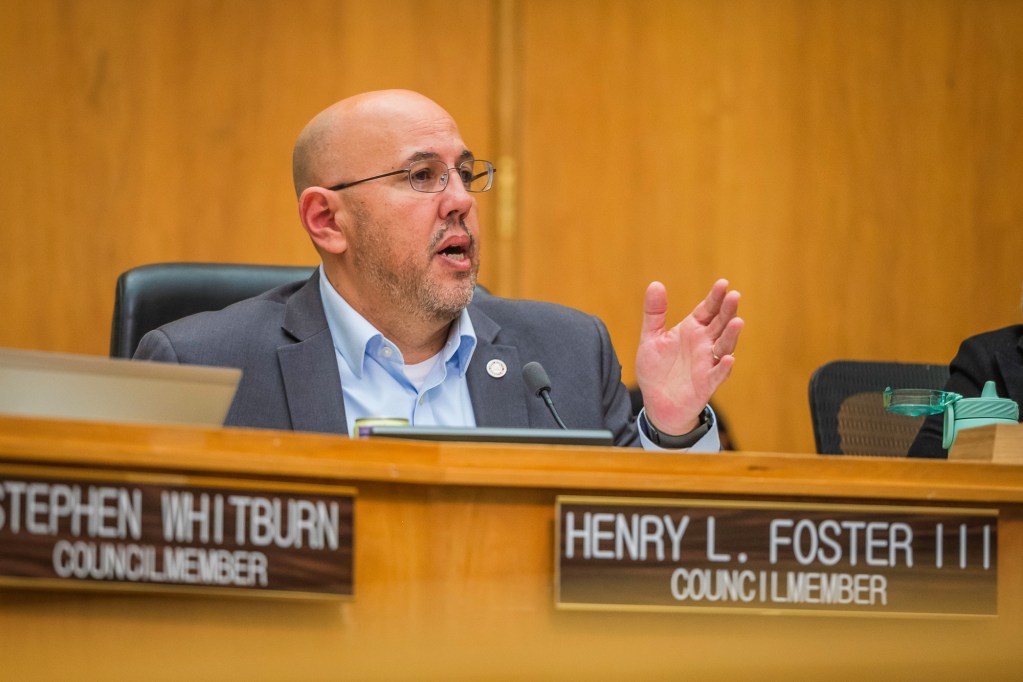
“That decision was very difficult for me,” Foster said. “I truly believe that large lot sizes are discriminatory.”
Foster, however, raised concerns about the “process and engagement” that led to Footnote 7. Even though he supported the repeal, he said he wasn’t sure that Footnote 7 was actually discriminatory – alluding to the fact that more housing is badly needed in his district.
“I’m looking at it from the standpoint of what is in the best interest of my community as a whole,” he said.
For residents, these lots aren’t just hypotheticals on paper, instead they are tied to actual properties residents hoped to see transformed into public spaces. One of them is the Old Memory Lane lot, a steep, grassy patch of land with panoramic views of the city. The site, once used for community gatherings, movie nights, and Fourth of July fireworks, now sits behind a locked fence. It’s private property, but some community members have long envisioned it as a park.
Kenny Key, a 50-year-old Emerald Hills resident, lives adjacent to the lot.
“I see a green space in my vision,” Key said. “So many people want this to happen. But some faces don’t want it to happen, because they don’t want this beautiful Black community to thrive.”
Key and other residents are pushing the city to convert the land into a green space. They’ve posted a video to the Chollas Valley Community Planning Group’s website showcasing their vision: telescopes, seating, and a gathering space for friends and family. Hetheru says she has not seen the latest plans and worries the public won’t have time to adequately respond or prepare an argument against the development. Instead, she says residents will have to solely rely on their limited public comment window at upcoming public meetings.
Like the Klauber Avenue project, the Old Memory Lane project is not an apartment complex. It is a proposal to build 123 single-family homes on lots smaller than 20,000 square feet, which Footnote 7 allowed. Thirteen of the homes would be deed-restricted as affordable homes.
Even though the project would, in theory, be allowed under the previous provisions of Footnote 7, it has not received final approval.
The project hasn’t yet been approved, but residents say they’ve had little visibility into its latest plans and worry it could move forward without extensive community input.
Though the City Council repealed Footnote 7, residents say the policy shift hasn’t stopped high-density projects from being able to advance under other city initiatives.
One of those initiatives is San Diego’s bonus accessory dwelling unit (ADU) program. While Footnote 7 focused on reducing minimum lot sizes, the bonus ADU program allows developers to build multiple bonus ADUs — the number is limited only by a lot’s size — if the property is located near public transportation. (A measurement known as “floor area ratio” determines how many square feet of construction are allowed on any given lot. The bigger the lot, the larger the building can be.)
Foster said both policies affect his community in similar ways. He said that applying the same policies across different neighborhoods has led to results the city didn’t anticipate, especially in places with histories of underinvestment.
“What I can also say is not every area is built the same,” Foster said. “Not every area has the same topography that my community has. And so this across the board approach that we take, I’m constantly questioning is that the right approach? Because I think that also creates the unintended consequences that we saw with the ADUs.”
To residents like Hetheru, the policies may differ in language, but the outcome often feels the same: Dense development moving forward with little regard for community priorities like infrastructure, safety and open space.
“The city’s reforms are well-intentioned,” she said. “But they don’t go far enough. We need to go back to state standards.”
To many Chollas Valley community residents, parks and green spaces are often overlooked and fall on the bottom of the priority list. However, Hetheru says this is vital infrastructure that supports the emotional, physical and mental health of residents.
“We’re not against housing,” Hetheru said. “We want infrastructure that moves us away from being treated like a slum and not closer to it.”
For now, the lot on Old Memory Lane remains vacant, a patch of land suspended between the city’s push for housing and a community’s call for equity. Whether it becomes yet another housing cluster, or a long-awaited green space may ultimately come down to political will.
“The park on Old Memory Lane is our last shot,” Hetheru said. “If we don’t have this, what do we have?”

For a while now, she had a job. However, last month she earned $11,500 just by using the computer for 9 hours each day…(h To learn more,
click on my username<<<