
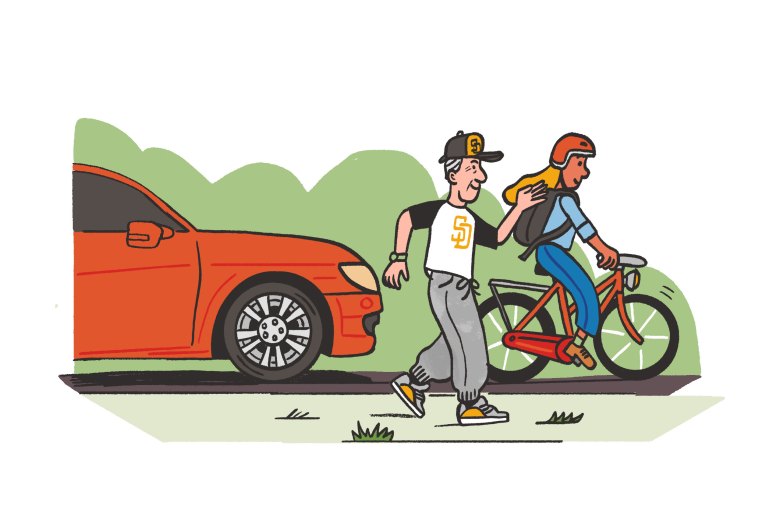
I always joke with my friends that I must spend at least an hour a week standing on the corner of 30th Street and El Cajon Boulevard, waiting to cross.
In the heart of North Park, this is one of the most walkable, busable, bikeable places in the city. Four bus lines carry riders to and from stops spanning from La Mesa to downtown. Bike traffic accumulates in the 30th Street bike lane. A small crowd of pedestrians waits on the corner – myself among them.
Still, I’m in the company of no less than 30 cars, waiting for their green light right alongside me. I feel them watching me cross the six lanes of traffic, but apparently not closely enough – I’m nearly struck by a driver trying to make a right-hand turn. When I cross by bike, the potholes are unavoidable.
This story is part of our Big Questions Facing San Diego in the Next 20 Years reporting project. Read more stories here.
Even at the best of times, in the best of places, San Diego’s car-free transportation options are not good. It makes perfect sense to me why most people drive everywhere. Transit will almost always take longer, and it’s probably not very close to your house. Unless you have no other choice or pay “walkable neighborhood” rent prices, going out of your way to reject car culture feels borderline masochistic.
Alas, the planet isn’t getting any cooler – and greenhouse gas emissions from cars are a massive culprit.
San Diego has a plan for a more sustainable future, one with “mobility hubs” and express bus lanes, and progressive politicians claim to support it. Yet, history suggests their allegiance to the long-term vision is less important than cutting their short-term political losses.
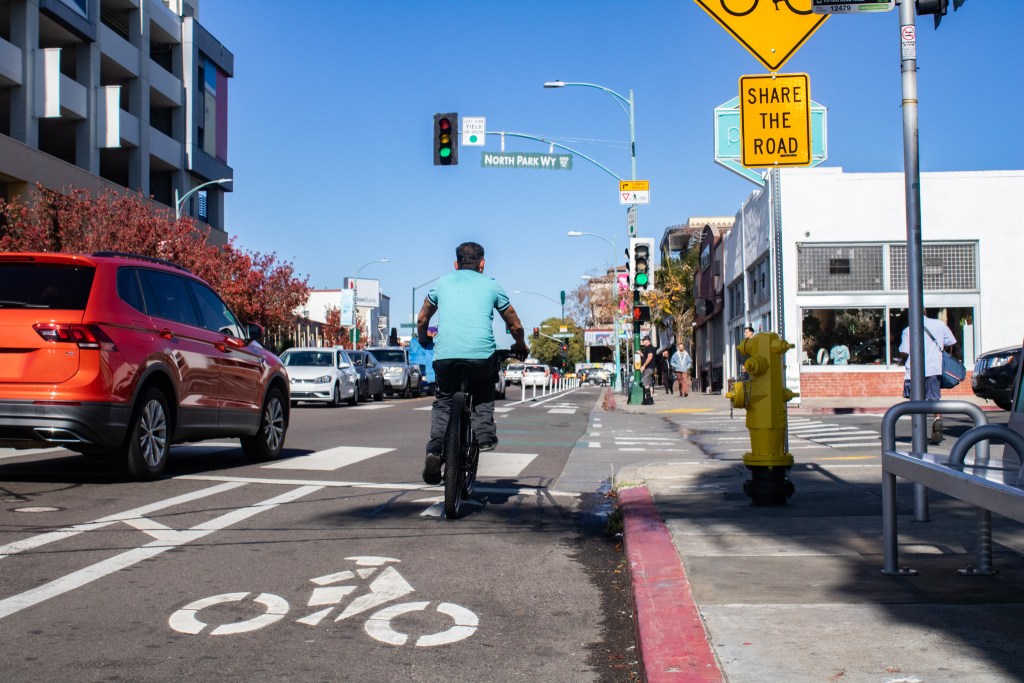
This plan will require most of us to drive less, but it also delivers on things that politicians and voters say they want: better transit, increased walkability, shorter commutes, safer infrastructure. These investments are largely incompatible with transportation as we know it. It’s no coincidence that the “walkable” neighborhoods where most people want to hang out also have the least parking.
The plan is not all stick and no carrot, but San Diegans seem to want all carrot and no stick.
California’s car culture currently thrives on a collective cognitive dissonance, and it’s reflected in our infrastructure. We call ourselves environmentalists but allow our transit systems to languish. We remove bike lanes just months after installing them. We reject much-needed housing near transit over parking spots.
We want the transition to be painless, and reject it when it isn’t. In doing so, we only make it more painful later.
Friction is the core principle behind most policies intended to discourage driving. In a recent essay, economic commentator Kyla Scanlon defines it as “the effort required to move through systems.” In other words, if we make it harder to drive, people will do it less.
In this case, it’s mostly economic. Policies such as charging more for parking, increasing registration fees for car owners and taxing drivers by the mile encourage behavior changes by making it more expensive to drive and generating revenue to invest in more sustainable alternatives. These policies will become increasingly important in the coming years as gas tax revenue – which our infrastructure depends on – is undermined by electric vehicles.
Policy based on friction makes sense, but politics are another story.
The last local bureaucrat who tried to change transportation in a big way is, according to his LinkedIn profile, #OpenToWork.
Hasan Ikrhata led the regional transportation agency SANDAG for five years before departing in 2023. His vision relied heavily on taxing people for every mile they drive, or a road-usage fee. Basically, the friction final boss.
“God knows they crucified me in San Diego, but I tried,” Ikrhata told me over the phone from his home in Los Angeles, where he now teaches at UCLA’s Institute of Transportation Studies.
Nobody was under the delusion that politicians from car-dependent areas like North and East County would be happy about a mileage tax, but the shock came when Democratic leaders from urban and coastal areas backed out a week before the vote.
The road-usage fee was dead. At least for the time being.
State mandates say the San Diego region has 10 years to cut its greenhouse gas emissions 19 percent from 2005 levels, which will be extremely difficult to do without a mileage tax. Finding a way to mitigate driving while generating funds for transit is also a central component of SANDAG’s 2025 Regional Plan.
Some states already have some version of a road-usage fee, and many more are considering it – including California. Experts largely agree the shift from gas taxes to mileage taxes is inevitable.
“All you have to do is start charging people the real cost of driving,” Ikhrata said, referring to the environmental, health and infrastructural costs of cars, “then people would run and force politicians to put out other alternatives.”
Still, the road user charge deserves scrutiny. Implementing a policy that requires tracking mileage will require safeguards to protect drivers’ privacy. Progressives are also quick to cite equity concerns. High gas and car insurance costs already create transportation barriers for many low-income people, and some fear a mileage tax would only exacerbate that.
These concerns are legitimate, but they should be the start of a conversation, not the end of one.
Our rejection of the mileage tax and policies like it rests on the assumption that the status quo is somehow better or more equitable than the alternative, or that people would be willing to change their behavior under less arduous circumstances.
Consider the fact that our transit system, which low-income people are far more likely to rely on, is currently in a financial death spiral with future service cuts looming. If knowledge of our impending climate doom were enough to inspire mass behavior change, would we even be having this conversation?
There is no order of operations to this policy equation that doesn’t involve friction (just as there is no version that doesn’t involve positive reinforcement), and there is no moving backwards. By fighting the inevitable at every turn, we only further delay our relief.
This doesn’t mean everybody has to get rid of their car, but there are many people who would if it were actually realistic to do so. Give those people another option, and the transportation system works better for everybody involved – including anybody who has ever wished there were fewer people on the freeway.
But we must psychologically accept that California is capable of building a better future, and accept our role in building that reality today – both as individuals and as a community. The next generation will be thankful that we did.
Correction: A previous version of this story mistakenly suggested the hole in the ozone was growing. The planet is getting warmer, but the ozone hole itself is shrinking.
The hole in the ozone layer is getting smaller.
Friction alone won’t do the job though. I would actually give a lot to avoid car commuting, but I still do it most days. The worst traffic I have ever experienced on my drive home in the evening is still faster than my transit option each way to work on a normal day. I can’t afford the extra time.
I biked to work yesterday, but it is far. Now that I have kids, I can’t afford the time every morning. While there are many days I might break even on the evening commute while biking, I need to get to work on time in the morning after dropping off kids at school. The kicker is, my bike commute is actually several miles longer than my car commute; there is no direct bike route between the places I need to go, but there are several reasonably direct freeway routes.
So yeah, friction by all means, but it will take an unreasonable amount of friction to encourage people to use the current systems. Without making the transit options more complete and the bike routes more coherent, we have a long way to catch up to make driving the less favorable option.
Even in the most transit accessible and bike friendly places I’ve lived a lot of people still drive, especially those with young kids. That sounds like where you’d be at this point in your life
Copenhagen still has nearly 30% mode share for cars and we’ll never get there in my lifetime
But yes and under discussed topic is job sprawl in San Diego. Upzoning around transit is good but it won’t get us where we need to be if the places most people
need to go aren’t also transit accessible.
How about fully committing to EV’s? The infrastructure needed to make that work is a LOT cheaper than what is required for workable mass transit, walk-able neighborhoods, etc, etc. Then we import cheap EV’s from China, and tell Musk, et al, to go pound sand. After all the goal is to reduce pollution, not to have the construction crew full employment project.
EV’s and a built out charging network will accomplish our true goal at a fraction of the cost and disruption of SANDAG’s latest boondoggle.
How about if we fully commit to an EV build out? The true goal is to reduce pollution. The infrastructure for EV cars is already in place all we need is to complete the charging network. That can be done at a fraction of the cost of what the SANDAG boondoggle would cost. We then buy cheap EV’s from China, and tell Must & Co., to go pound sand.
LOL, if it were only that simple as more people cram into overbuilt carbon footprint neighborhoods.
Unfortunately the city cant unilaterally override federal motor vehicle standards but you’re very close to the practical idea of building out a complete network of protected bike infrastructure so more people can ride e-bikes where they need to go
I want to go camping and bring my trailer, tell me how that happens? Oh, hook it up to the e bike and spin the tires. The grocery side bags and lumber racks alone would be third world.
Even if we got to Dutch level cycling adoption (which we won’t in my lifetime) 30-40% of people would still drive,
When it comes to campers the Dutch are actually pretty notorious for towing their trailers all over. So no I don’t think these things are in tension
“The infrastructure for EV cars is already in place” – not according to the IEEE, the Institute for Electrical and Electronics Engineers, the professional organization for those engineers. Those are the engineers who will have to design and implement changes for an effective EV infrastructure. The IEEE offers a free, 49 page, e-book, The EV Transition, detailing all of the technical details that must go right for the adoption of EV’s. You can find it by searching for “The EV Transition e-book”
The city needs to start enforcing existing parking regulations. Too many broken cars left on the street, in driveways, in back yards. Too many boats and trailers left on the streets. The “Get it Done” app is useless in this matter.
The hole in the ozone layer is shrinking, not growing. That’s because of the reduction in CFCs, not greenhouse gases.
California has unduly taken on the burden of of saving the world from climate change. We’re making things unaffordable for Californians, while countries like Mexico still burn their trash in open fires only a mile from the border. California (and San Diego) citizens cannot afford to continue to be economically punished for carbon emissions of the rest of the world.
https://news.mit.edu/2025/study-healing-ozone-hole-global-reduction-cfcs-0305
Bicycles are for the wealthy.
If poor, then you got lucky!
My bike pedals faster 🚲
Red limo has no room for bikes.
It’s always disappointing to me that articles and conversations on this topic never adequately talk about the core problem of zoning and our refusal to change zoning laws. San Diego simply isn’t a walkable or bikeable city. Put in all the bike lanes you want, people still live so far from where they work and shop that it won’t make a difference. Until we’re willing to change zoning to allow mixed-use neighborhoods, the places people need to go will remain out of reach from where we live. It doesn’t help that people don’t wish to change. Every discussion about zoning changes turns into “Don’t change the character of my neighborhood!”
I love driving, but I might take public transportation if it were very cheap or even free. It needs to be much more extensive though. And faster. Comparable to a drive.
I feel safer in my car, and I get where I’m going in 10-20 minutes instead of 2-3 hours.
My husband would like to carpool from La Mesa to Oceanside, there’s no easy way. He has taken the train and trolley twice but it’s not easier. Make it easier and cheaper.
Do you remember the freeways during Covid? Return to the Office initiatives will drive up traffic and costs for everyone.
Luckily, I’m still one of the work from home crowd. My car has to be plugged into a battery charger I use it so infrequently.
Not traveling if you don’t need to is the way to go.
You may as well ask, can San Diego end its dependence on modern sanitation and running water. This is 2025, not 1825. Trying to force people to go back to the pre-automotive era is just as asinine as forcing them to give up other necessities and conveniences of modern life.
That’s why Toad Gloria is spending 1.5B on recycling toilet water to drink.
I love the talk of spending $2bn on a 1 mile rail system from old town to the airport. Advocates have goals but no idea as to how to achieve them to they propose dumb things like this. We aren’t even dense enough to have a robust transit system, but at least we have one. And a decent one to boot. But it’ll never be enough for the keyboard warriors or the NIMBYs. Addressing the root issues will make it all easier for us, but that’s not how things work in the real world
You can already take a shuttle from old town to the airport, why would you spend another lost 2B? Get informed. No blaming nimby’s there.
The dream of the 1890’s… we all live in apartments, ride our pennyfarthings to the train station, and shuffle off to our… programming jobs in UTC?
The fantasy that taxing people out of their cars so they can start riding bicycles is some sort of progress… it’s not just impractical but deeply insulting to the elderly, disabled, and parents.
How about incentivizing employers to provide remote work? Solves your carbon crisis and costs nothing.
The next generation will have practically free limitless electricity and ride around in robo taxis. Where we are going, we don’t need roads or personal vehicles.
Thank you, Bella, for your excellent reporting. We are lucky to have you! Let us know if you ever want to collaborate on an article or op-ed
I am always surprised when Voice runs stories about the need to get rid of cars and parking and the need to take public transit and always ignores three facts: electric vehicles do not put carbon into the atmosphere during operation and will be the vehicle of the future; San Diegans will not give up driving due to the spread out nature of the city; because public transit is limited geographically, runs infrequently, and doubles or triples the time it takes to get to a destination. Electric cars will still need parking and they are the future of transportation in San Diego. A. Mileage tax would make sense for electric vehicles; it doesn’t for petroleum-powered vehicles since we already pay a tax at the gas pump and people rightly object to being taxed twice for driving their cars.
The Yimby slant is obvious. When you’ve crammed the hood with high rises where will the EVs be charged at? EVs I believe pay a $118 I’ve read in their registration which translates to about 200 gallons of gas tax ($118/ .60). You’d think the Mayor and city council would practice what they preach (public transportation) before shoving it down people’s throats. The infrastructure grid just hasn’t been addressed when it comes to adding more demand with EVs and data centers.
I’m not quite sure why you think I’m a YIMBY based on what I wrote. I am decidedly not. YIMBY groups like Circulate San Diego are ant-motor vehicles and Voice seems to take its leads from such organizations. My point is there will be a need for cars and parking places in San Diego for the foreseeable future and Voice is forever taking the YIMBY position that driving per se is the culprit for climate change and we need to ditch cars and parking spaces to have a livable future. My take was just the opposite: people will still drive, the can use EVs, and there will still be a need for parking. The EV infrastructure problem is certainly real but not insurmountable. I just find the Voice’s take on driving to be stuck in the 20th century before EVs have become a viable option. It has a blanket disapproval of all vehicles but the problems it highlights are not the problems with EVs.
Meaning Voice articles. Not you.
Dependence? It isn’t just about dependence, it’s also about preference. I do not want to share my commute with other people or their nonsense. I do not want to be held to a schedule for public transportation when I can alternatively use my own personal vehicle to come and go as I please. Personal vehicles represent FREEDOM, not dependence.
Great article! Another stick that would be more appealing to drivers (and the municipalities that dictate transportation) would be to slow cars down and rededicate space to other modes. If all non-freeway roads had design speeds of 20-25 miles per hour, and each arterial with 2 or more lanes and a bus route had dedicated bus lanes, our transportation system would be safer, and modes other than driving would be on a more even playing field.
And with many tires, pieces litterally hit the road.
How about a sign- up form for sliding scale. There used to be a woman from England who bought a house in Jacumba . She sold it and moved to Nevada. She said the taxes were too high. She sure did like to ride our roads and visit. Sliding scale. 7 out of 10. Or some such fairness. 🙏