
This post has been updated.
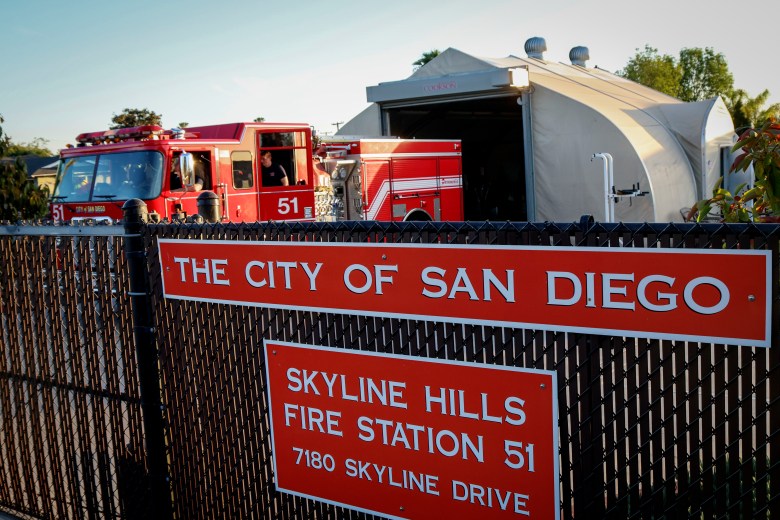
In 2015, construction workers plowed through an abandoned gas station in southeastern San Diego to make way for a new, temporary fire station.
The site, which would house a fire engine and an ambulance, was opening to improve emergency response times in the area after our reporting revealed people died of gunshot wounds and overdoses because emergency responders came too late.
Then-Mayor Kevin Faulconer applauded the city’s efforts at a press conference outside the soon-to-be station in 2015. He made a bold promise: “In two to three years, we will begin building a permanent fire station right here on this very spot.”
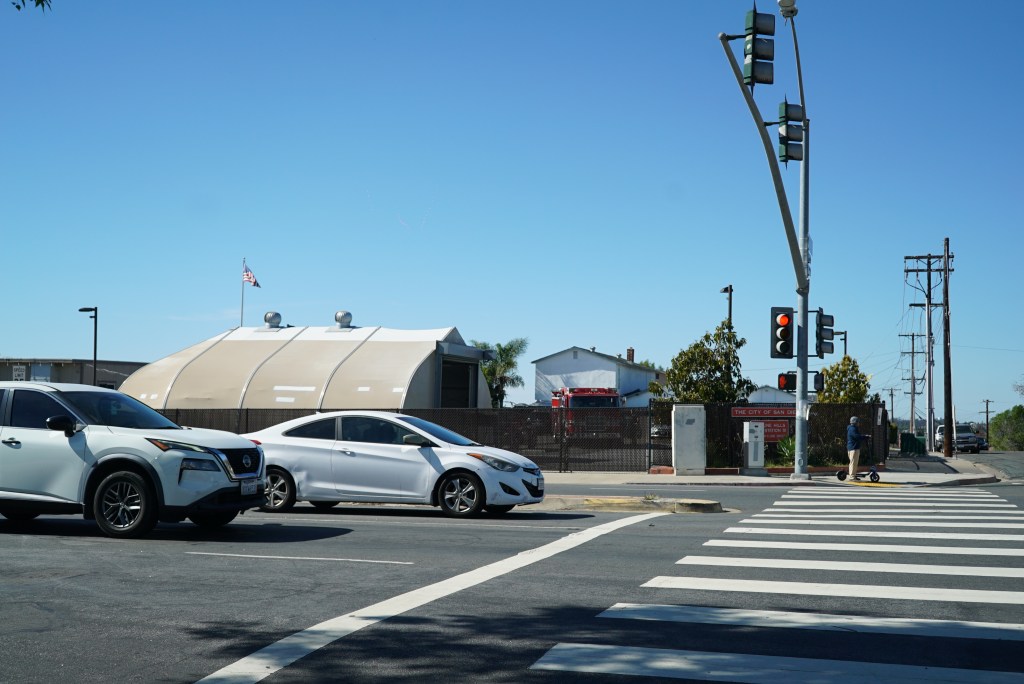
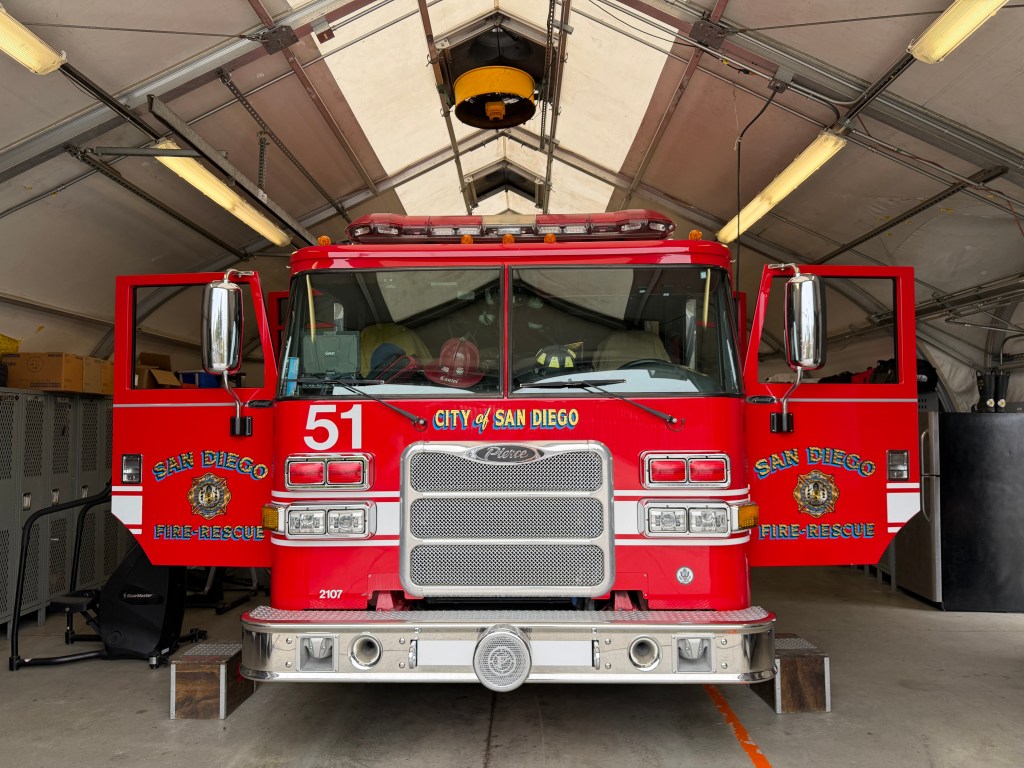
That never happened. Instead, Fire Station 51 is still a temporary fire station. The fire truck sits under a large tent and firefighters’ living quarters are a mobile trailer.
George Duardo, president of the San Diego City Firefighters IAFF Local 145, has worked more than 100 shifts as a firefighter at Fire Station 51. He said it does not meet the standards of a “modern fire station.”
Duardo said the station’s vinyl structure has slowly degraded, the station lacks enough bathrooms and needs an additional engine to fight brush fires. And Councilmember Henry Foster, who represents the area, says city officials prioritized other areas to build stations.
Officials from the city’s Fire-Rescue Department said funding challenges have prevented the city from building a fire station, but that the current station provides the same level of service as other fire stations.
“Though we keep hearing the word ‘temporary,’ I can assure you that Station 51 provides the same level of service as any of our other fire stations,” said Assistant Chief Theodore Moran in an interview with Voice. “The facility itself does not at all play into the service that we’re providing.”
They also say emergency response times improved in the area after the station opened, but Fire-Rescue data shared with Voice of San Diego reveals response times and incident calls, in general, are higher today.
Fire Station 51 is in the southeastern San Diego neighborhood of Skyline, a residential area surrounded by canyons. The neighborhood’s population is a majority of Black and Latino middle-class families.
In 2011, a study identified Skyline as one of the top five neighborhoods with the highest risk of delayed emergency response times in the city.
In response to the report, the San Diego City Council passed a plan to build five fire stations over the next five years in areas they considered to be a priority. Two years later, Voice reported that officials didn’t build the stations. Our reporting showed residents died when paramedics didn’t arrive in time to save them.
City officials promised to do better and put funding toward two new fire stations, including one in Skyline. The estimated cost to build a permanent station in 2013 was approximately $13 million. Two years later, city officials opened the temporary Fire Station 51.
“I haven’t received any clear information as to the why,” said Foster in an interview with Voice about building a permanent fire station. “What I’m seeing instead is an indication that this is an equity issue and it appears decisions have simply been made to prioritize other areas, which needs to change.”
The city built other fire stations in that time. This includes Fire Station 2, opened in 2018 in Little Italy for $15 million. Fire station 50 also cost $15 million and opened in 2020 in University City. City Heights also got a new and improved fire station in 2018.
In 2024, city officials opened the city’s “most environmentally friendly” fire station in La Jolla. UC San Diego covered most of the $22 million project and the city paid for a $2.1 million electric fire engine.
Duardo said the station’s vinyl structure has degraded over time with the sun and elements. He said in the summer, the temperature in the tent that houses the fire engine and equipment can get up to 120 degrees. While they haven’t experienced significant flooding, he said they do get streams of water coming into the tent when it rains.
“Having any degree of moisture – even though it really only happens during the rain, is not ideal by any means,” he said.
He worries about how the weather can damage their equipment.
He also said the station only has two bathrooms, which can create challenges as people are getting ready to start their shift.
“As people come and people go, bathrooms are really important,” he said. “Enough showers are really important. A place where you can clean your equipment, get carcinogens off your protective equipment… modern fire stations facilitate that.”
He also said with a permanent fire station, they could add an additional engine to solely fight brush fires in the area.
Without that, he said he’s concerned about the areas above and adjacent to Fire Station 51 which include Encanto and Skyline.
“If you were to take Imperial all the way out and it turns into Lemon Grove Avenue — it’s everything from the end of Imperial to the 94, drive that whole area, there is no fire station in that neighborhood,” he said.
He said these rural areas have big houses, few fire hydrants, and canyons full of brush. The other closest station would be Fire Station 12 about three miles west in Lincoln Park, or Fire Station 26, about five miles away on the other side of the 94 freeway near Chollas Park.
“ My biggest fear is because it’s [southeastern San Diego] at the periphery of the city, and there’s a lack of fire stations and coverage… It is gonna be very hard if there were to be a canyon fire in through there,” he said.
Candace Hadley, spokesperson with San Diego’s Fire-Rescue Department, said Fire Station 51 “is a fully operational station.”
She said the fire engine, personal protective equipment lockers and exercises space are housed “in the sprung structure designed for long-term to permanent use.”
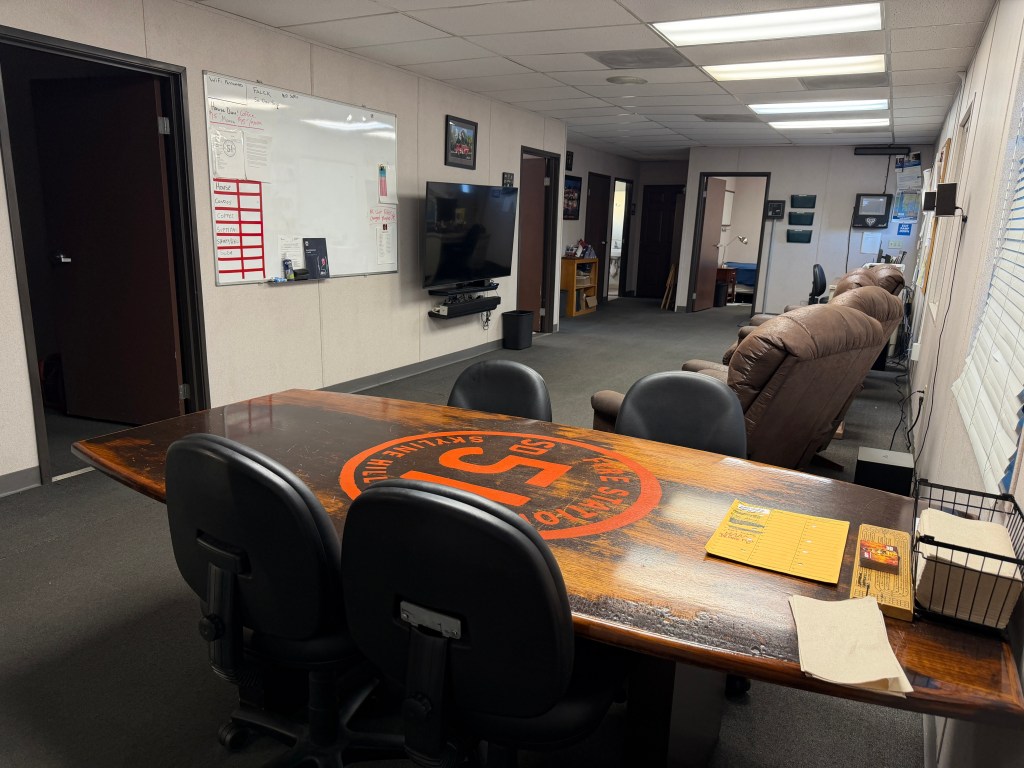
When firefighters work their shifts, they stay inside the mobile trailer which has individual sleeping quarters, restrooms, a day room and kitchen.
Moran said the most important thing is having a fire engine in that area.
“We were able to fill that gap by identifying that location, putting in the temporary facility, knowing that funding had to have been secured and identified in the future,” he said. “We would love to build a fire station overnight or within a year. Sometimes that’s just not feasible. Really what’s important to us is providing that service to the community where we showed a need for it.”
In 2011, the city’s emergency response time goal was six minutes, in line with national standards. This includes one minute for dispatch, one minute for the crew to leave the station, and four minutes to travel to the incident.
Our reporting from 2013 found that nine times out of 10, the department couldn’t meet that goal even half the time. Several months later, Fire-Rescue relaxed response times to seven minutes and 30 seconds. Fire responders aimed to arrive at medical emergencies in that time frame, nine times out of 10.
Fire-Rescue data shared with Voice shows emergency response time improved in the Skyline area after Station 51 opened in 2015.
From 2012 to 2018, emergency response time decreased by an average of 27 seconds, from five minutes and 53 seconds to five minutes and 26 seconds. Echo-level calls, or the most critical calls, decreased by 30 seconds.
However, additional Fire-Rescue data reveals that on average, emergency response times in Skyline are higher compared to when the station opened 11 years ago.
The average response time in 2015 was five minutes and 34 seconds. In 2025, that went up 11 seconds, to five minutes and 45 seconds.
Hadley said incident calls are up by approximately 27 percent citywide compared to 2015, and in Skyline, specifically, there has been a 19 percent increase.
“There are so many variables in what can affect our response times and our response or the volume of responses that we receive. I would say in layman terms there’s really not a solid predictor of whether calls are gonna increase or decrease,” said Moran.
Moran said things like weather, topography, and distance to the incident can affect response times.
“Is it hot and dry and windy out — and now there’s a vegetation fire in the area that’s pulling resources that’s obviously gonna affect the response time for medical aids that occurred during that other emergency.”
But a recent report by the city auditor’s office shows Fire-Rescue did not meet its current arrival time standard of six minutes and 30 seconds largely due to slow turnout times. Turnout times are the amount of time it takes for a crew to leave a station after receiving an emergency dispatch.
According to the report, only 69 percent of fire units in District 4 — where Station 51 is located — arrived within the city’s standard arrival time. between fiscal year 2023 and fiscal year 2025.
In a statement, Duardo said the audit does not consider budgetary challenges faced by the fire department.
“This ‘audit’ does not take into account the significant underfunding and understaffing that’s been plaguing San Diego Fire-Rescue for years — impacting response times, plus exhaustion and burnout for the firefighters we count on to be there when lives are on the line.”
Councilmember Foster still voiced concerns about the station remaining temporary.
“When you have poor facilities, over time that can lead to other health issues. That creates gaps and issues with staffing,” he said.
It’s unclear when the permanent Fire Station 51 will be built.
In 2013, then-interim Mayor Todd Gloria announced a multi-million-dollar bond to fund the permanent fire station and other infrastructure projects. This included $1 million toward funding design plans for the station. Fire-Rescue and City Planning Department spokespeople told Voice to file a public records request for information about the money.
City officials completed a design for a permanent station in Skyline in fiscal year 2026. The project is still pending funding. When Fire Station 51 first opened, the temporary station was a quicker and cheaper solution to reach underserved communities than building new permanent fire stations. Today, the cost to build Fire Station 51 has more than doubled to nearly $28 million according to the Fire-Rescue 2025 budget.
“In the meantime, necessary repairs and maintenance at the existing facility will continue to ensure uninterrupted service until construction of a permanent station can begin,” said Hadley in an email statement to Voice.
At a Feb. 19 meeting on the city’s capital infrastructure planning outlook, city officials shared fire stations have a $273.9 million shortfall of funding over the next five years.
Last year, the city had to close a $300 million budget deficit. We asked Fire-Rescue officials if they would consider adding more temporary fire stations like Fire Station 51 around San Diego to fill coverage gaps.
They said there’s no current plans to do that.
“The personnel cost is really the largest expense of a fire station,” said Moran. “We’re zeroing in on the term temporary, but temporary doesn’t necessarily mean cost saving on a operational standpoint.”
San Diego Mayor Todd Gloria is proposing a $27 million hike in funding for the Fire-Rescue department with a budget of up to $547 million this year, the Union-Tribune reported. While the increase would help fund overtime and staffing to meet response time goals, the department still faces cuts.
Correction: This post has been updated to remove a paragraph that misstated Henry Foster’s previous position at the city of San Diego.

It’s amazing how the City of San Diego has no shame in catering to preferred areas rather than taking care of the areas of town with much greater need. None of the areas that had permanent Fire Stations built (Fire Station 2, opened in 2018 in Little Italy for $15 million, Fire station 50, opened in 2020 in University City for $15 million, City Heights new and improved fire station in 2018, and In 2024, “most environmentally friendly” fire station in La Jolla.) were mentioned in the multi-million-dollar ($120M) bond to fund the permanent fire station and other infrastructure projects Mayor Todd Gloria announced in 2013! And now, she dares to request a $27M funding hike. I wonder what the $547M Fire Rescue department budget will be spent on this year…
Yep! and here’s District 4 City Councilman Foster said re: this: ““I haven’t received any clear information as to the why,” said Foster in an interview with Voice about building a permanent fire station. “What I’m seeing instead is an indication that this is an equity issue and it appears decisions have simply been made to prioritize other areas, which needs to change.”
I suspect there’s a connection with the “Fairmount Ave. Fire Station” issue – seemingly on hold for an election year…Astronomical expense to destroy a protected habitat in District 4…
And also, re: his lame quoted response above…it’s his job to PUSH for clear answers and to PUSH for funding resources. Given his racial slur against an in-person constituent last year, plus his lack of advocacy musculature, I’m voting for Martha Abraham for District 4 City Council in a few days! Be well.