

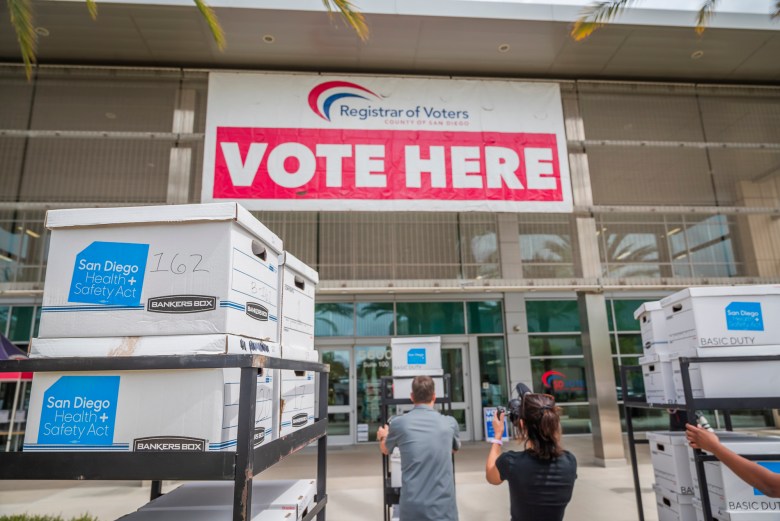
The county sales tax signature gatherers seemed to be everywhere – outside Trader Joe’s in Hillcrest. Or on the corner of 30th and University Avenue – the busiest intersection in North Park.
They all asked passersby one question: Would you like to stop the Tijuana River sewage crisis at the border?
They were promoting a citizens’ initiative to get a countywide half-cent sales tax on the November ballot. I asked one how it would be used on the Tijuana River.
They couldn’t point to a specific project. Probably because the “Protect San Diego County Health and Safety Act” doesn’t specifically point to one.
Fixing the persistent problem — what the Wall Street Journal called a “tsunami of raw sewage” — has become the main selling point of the tax, which could generate $360 million a year. The measure would dedicate about $80 million of it to “stop sewage flows.” If they packaged it into a bond, it could provide billions to invest immediately.
But proponents do not have a plan yet on what the county would do with the funding. A county supervisor mentioned a persistent and particularly gross and harmful area that needed immediate attention but also suggested that any hope Mexico and the U.S. federal governments would fix it are unfounded and the money should be used to ultimately divert the river entirely.

Its backers, a coalition of labor unions, a child care advocacy group among them, say this is the county’s chance to finally throw some real, dependable cash at the seemingly unsolvable sewage problem at the U.S.-Mexico border.
“When we pass this, it’ll be the first dedicated sustainable fund for the Tijuana River,” said Courtney Baltiyskyy, with Children First San Diego, an organization advocating for affordable child care – which 22 percent of the sales tax money would fund.
Baltiyskyy said sales tax proponents polled voters last fall. Voters said they were most worried about the sewage crisis. They also expressed concerns over health care, food insecurity, fire and emergency response – the other things the measure would fund.
“Voters across San Diego County are showing empathy and deeper awareness for the first time historically on this issue,” Baltiyskyy said. “It’s one of the our greatest pressing needs for health and safety.”
Balitskyy said the annual revenue could be used to pay back a bond, a big loan for expensive projects.
Reading further into the measure’s language revealed that it would be up to an appointed committee to make sure that money is being spent where the measure’s creators intended.
But so far, it’s not clear what those projects would be.
No Specific Tijuana River Plan
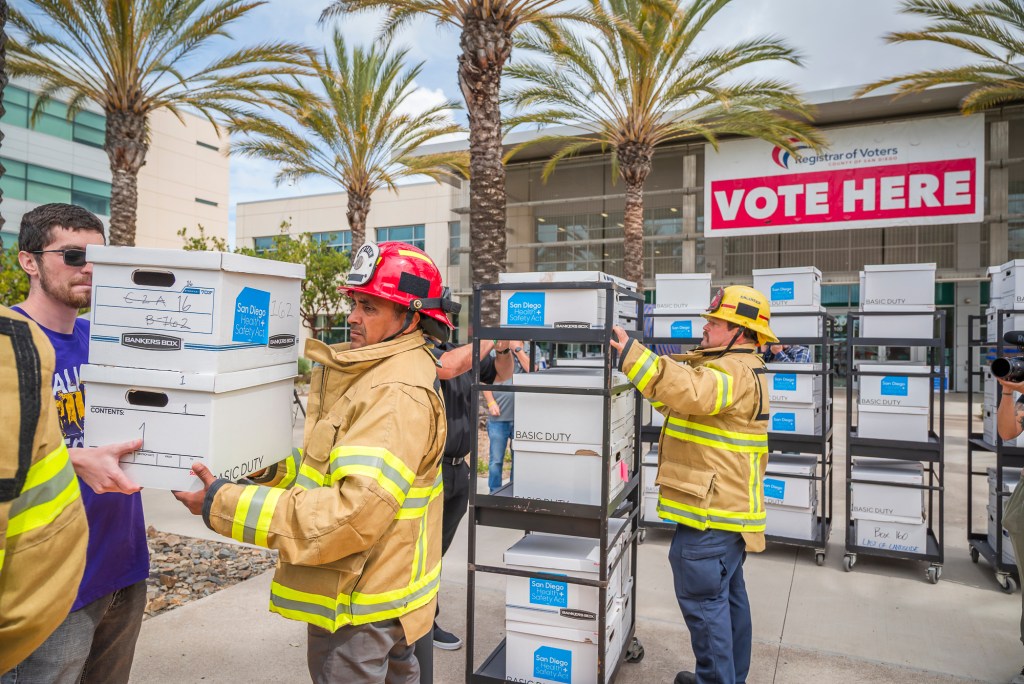
The sales tax measure’s expenditure plan says 22.5 percent of the money should be used on “environmental mitigation and related programs in connection with the toxic crisis in the Tijuana River Valley.” Twenty percent of that must be spent on “infrastructure and engineering projects to stop sewage flows from Tijuana into the U.S.”
That could mean a lot of things. But it shouldn’t take the county long to figure it out.
The U.S. Environmental Protection Agency already spent about a year studying what needs to be done on both sides of the border five years ago. They put $600 million-worth of projects on a big list and prioritized them. But the feds hit a bunch of snags trying to get those done – like a huge sewage main break in Mexico in 2022, then Hurricane Hilary knocked out the United State’s main treatment plant in 2023, etc. And Congress hadn’t yet dedicated enough money to pay for most of that.
Still, both countries agreed to do those projects under a treaty signed while Joe Biden was president. Then President Donald Trump basically had Mexico re-commit to doing those things again under another agreement.
However, $80 million a year for the Tijuana River sewage problem is a lot. It’s $30 million more than the entire maintenance budget of the International Boundary and Water Commission (the federal agency charged with treating Tijuana’s sewage at the border) just a few years ago.
Raising what the border sewage problem needs by locals taxing themselves is a much easier way than how it works now.
Most of the infrastructure installed at the U.S.-Mexico border to try and prevent sewage pollution is run by the federal government, which means it takes an act of Congress to secure funds to take care of it. It took the rewriting of the North American Free Trade Agreement during President Trump’s first administration to secure $300 million back in 2020 for all cross-border water problems (and there are many). San Diego had to fight hard to get most of that dedicated to its sewage problem with Tijuana.
San Diego’s Congressional delegates had to fight again to secure more emergency money to help fix a sewage treatment plant run by the United States, which Voice of San Diego revealed had been so neglected, it didn’t really work.
Who Decides Where Money Will Be Spent

The language of the sales tax measure requires the San Diego County Board of Supervisors appoint an 11-member oversight committee three months after the measure passed to oversee how the money is spent. None of the members can be elected officials. One of them must be from a community affected by the border sewage — Chula Vista, Imperial Beach, Coronado or San Ysidro.
This committee would pay for an independent auditor to evaluate whether the money is being spent according to the measure’s intent.
“These folks …make sure expenditures are in line with the will of voters and make a slate of recommendations to supervisors,” Baltiyskyy said.
The commission’s work would be directed by the county’s pollution crisis chief, a new position the county is apparently interviewing candidates for as I write this.
If the Tijuana River is ever cleaned, meaning it’s deemed safe for human recreation and is removed from the state’s list of polluted waters, the sales tax measure says that money could go to other environmental mitigation programs that protect clean water. The same would be true if the river is ever completely diverted and treated, which has been one of the options on the table for a long time – and what former Imperial Beach Mayor now Supervisor Paloma Aguirre has been talking about for years. (EPA prioritized that project last on its list.)
“First we have to prioritize the hot spot, because that is a major infrastructure fix that we’ve already invested $2.5 million in county money,” said Supervisor Paloma Aguirre in an interview Monday. “That’s an immediate thing we can bring relief to families.”
The so-called hot spot is an area in Nestor where the river spills from concrete pipes underneath a road, generating toxic air pollution.
“But of course the ultimate purpose is to eliminate toxic sludge coming through. And we can wait here another 20 years for Mexico to do it, or we can do it ourselves,” she said.
I asked Baltiyskyy if any of the money could be spent in Mexico, whose broken sewage infrastructure is the main source of the problem. The United States already spends millions of dollars on fixes to Tijuana wastewater systems as a result of the crisis (like the $13.4 million being spent on an old sewage pump in Mexico), which is typically the only way projects get done. She didn’t know whether, logistically, that could work.
“There’s enough to do on the U.S. side to use the locally-generated funding,” she said.