
Over the past few months, San Diego Unified officials have been ironing out the details of a new construction bond measure, set to go before voters in November. Construction bonds, if passed, raise property taxes to fund school construction and renovation.
At a board meeting late last month, staff gave the public its first real look at the new $3.5 billion bond ask.
Many of the features of the bond – from what officials say it will fund to how they say it will impact taxpayers’ pocketbooks – are essentially identical to previous bonds they’ve passed. That’s not entirely surprising, because that pitch has worked like a charm on previous bond measures.
Since 2008, the district has gone four-for-four. If voters pass the latest measure, they will have approved more than $15 billion in bond funds for San Diego Unified over the past 18 years. So, essentially, if the bond pitch ain’t broke, don’t fix it. Ironic, no?
First, a primer on general obligation bonds: For many districts, the cost of maintaining their facilities is exorbitant. Roofs begin to leak, plumbing breaks and everything just gets old. And for a district like San Diego Unified, which has more than 200 educational facilities spread out across 200 square miles, juggling those serious costs and still paying its more than 10,000 staff members is no easy task.
Enter the general obligation bond. These are essentially loans districts take out that can only be used for physical improvements – school modernizations, new football fields, new school labs, etc. Voters, though, are the ones who pay back the loan, through increases to property taxes.
The new (old) pitch: During a presentation to board trustees, Lee Dulgeroff, the district’s director of facilities, planning and construction laid out a pretty dire picture. Dulgeroff said the district faces $461 million a year in estimated deterioration costs meaning, despite the more than $11 billion in bond funds voters have approved since 2008, “our existing funding resources … will not keep pace with that need.”
“Mother nature [and] wear and tear occur at the same time as we’re renovating and replacing aging facilities,” Dulgeroff said. “Many of our core building systems are reaching the end of their useful life.”
Beyond the aging argument, a quick glance at the new bond proposal reveals that a whole slew of projects seem to duplicate previous ones promised by earlier bond measures. The district has pitched every single bond measure since 2008 as being aimed at removing asbestos and lead, repairing bathroom and plumbing and upgrading career and vocational learning centers.
The rationale is pretty understandable. As Dulgeroff said, as soon as a project is finished, it begins aging. Even if a new roof is installed, it will need to be renovated at some point or another. But after decades of promised fixes, some schools have still been left with stifling hot classrooms and leaky plumbing.
Like the last bond, this one also includes hundreds of millions in funding for educator workforce housing. So far, officials still haven’t announced how they’ll use the funds they secured in 2022.
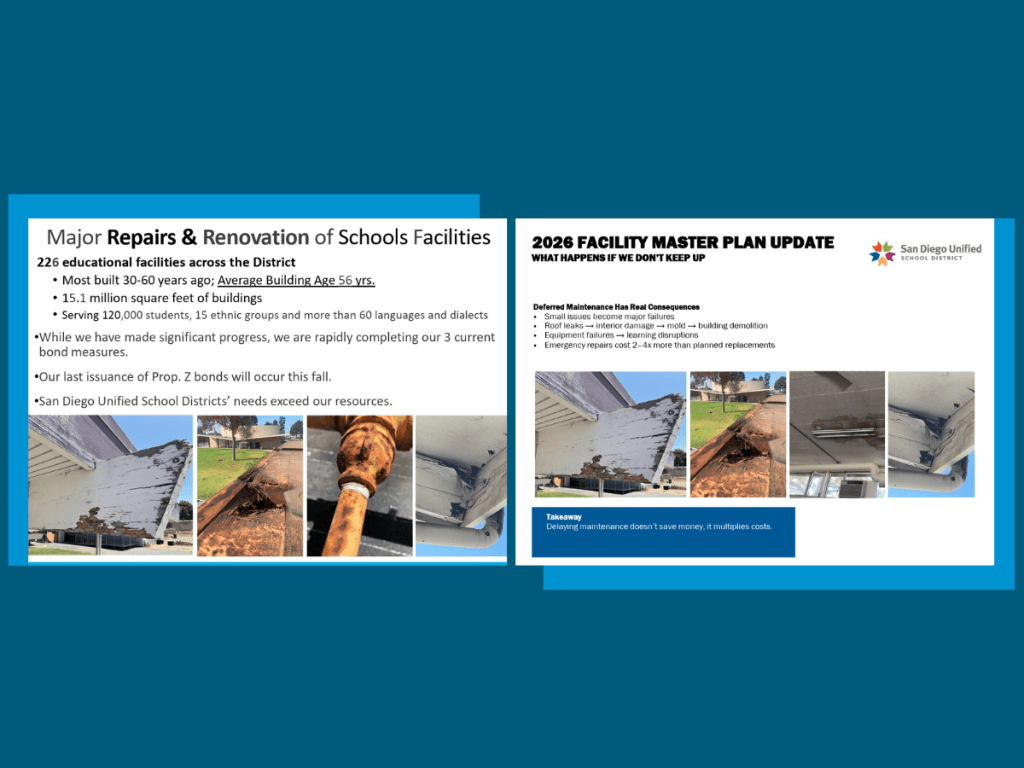
Amusingly, district officials used three identical photos of worn roofs in their 2022 presentation to the board for Measure U and their 2026 presentation for the latest bond measure. Hey, uhhh, if it also ain’t broke, also don’t fix it?
Some wrinkly bits: District officials have always sold the bond program as highly transparent. That pitch has worked because they’ve earned high marks from their bonds’ independent oversight committee. But it’s not entirely true anymore.
Last year, the San Diego County Grand Jury released a report criticizing elements of the district’s bond program. The report criticized the district’s commingled bond funds, which make it difficult to figure out where money for each new project is coming from. It also criticized the district’s duplicative bond priorities, which I pointed out above.
Another main criticism from the Grand Jury was that the district’s measures sometimes obscured that they increase property taxes. Like the previous bond measure, officials say this one will not raise taxes. In fact, it’s right there in the proposed measure’s name – “San Diego Unified School District Repair, Student Safety, No Tax Rate Increase Measure.” See?
They’re both sort of right and sort of not. Technically, the new bond may not raise the actual tax rate. That’s because, like the last one, it will likely slide into use as previous bonds are exhausted – think of the Indiana Jones scene with the statue and the bag of sand, minus the giant boulder booby trap.
But were a new bond not passed, the tax rate may actually drop because previous bonds were exhausted. So, while the rate may not change, property owners will pay more in taxes in the form of paying decades more of debt service. The district estimates the debt service on the new proposed bond will cost taxpayers $8.1 billion.
The new (new) pitch: One of Dulgeroff’s pitches for a new bond was a surprising one – potential district growth.
Anyone who’s followed my reporting over the past year will know that San Diego Unified, like most districts across the state, has been shrinking for years. Since 2014, San Diego Unified’s lost more than 17,500 students. To put that in context, the district lost one of every eight students.
This is happening for a whole bunch of reasons, from plunging birth rates to rising costs chasing young families away and even people switching to home school. State officials project the district will lose thousands more students in the coming years.
All this means that schools are underutilized.Earlier this year, I reported that internal district documents show that nearly half of San Diego Unified’s schools are operating at less than 70 percent capacity.
So, what gives? The crux of Dulgeroff’s argument wasn’t necessarily “yeah, but that decline is gonna’ turn around!” Instead, he argued the city is actually still growing, just in places where the district has historically had fewer schools. Those are places like Midway, Kearny Mesa and Mission Valley, where large-scale housing projects may bring tens of thousands of more people.
As I found out earlier this year, San Diego Unified no longer has their own demographer doing the difficult work of figuring out how populations are changing. So, they relied on SANDAG population projections. But those projections are only reason for measured optimism – if that. SANDAG projects the citywill grow by about 24,000 people by 2040 – from 1.09 million to 1.14 million – after which population will begin to decline once again.
Dulgeroff didn’t ignore enrollment decline in his presentation, though. In fact, he floated something that district leaders have been reticent to mention thus far – school consolidation, the edu-speak phrase for school closure.
“Bond funds can support reconfiguring campuses to better utilize these existing spaces, while right sizing and consolidating programs, where appropriate,” Dulgeroff said.
His presentation put a finer point on it. One slide read that “facilities don’t align with current enrollment,” and to optimize for today’s needs, the district would need to “right-size and consolidate where appropriate.”
Robotic Introductions
A couple of weeks ago, I published a piece about how the charter network Altus Schools’ purchased two ChatGPT-powered humanoid robots for $500,000. I’ve gotten a lot of messages since then.
Many have been from folks who were scandalized by the prospect of AI-powered robots in schools, and by the network’s decision to purchase them. A surprising amount have been from companies and PR people who seem desperate to shill their own brand of AI-powered robots.
One of the more interesting messages I’ve gotten, however, contained a video. It’s from Feb. 2025 and shows Altus Schools founder Mary Bixby introducing one of the network’s robots on stage. The robot then returns the favor. Its introduction of Bixby, who pushed to acquire the robot, is beyond glowing.
“Ladies and gentleman, brace yourself for the incredible Mary Bixby,” the robot says in its inhuman, Siri-esque voice.
The robot describes Bixby as a “visionary” and “dynamic leader recognized with multiple awards.” It also describes her as a “brilliant author,” before dishing out some effusive praise for Bixby’s two books. Hey, the robot may not be all that functional – yet – but if nothing else, at least it knows how to butter up its owners.
Thanks, Jakob. I think the School District folks are going to be surprised by the vote on this one. I guess they’re not talking about how much the bond will cost homeowners per $100,000 of value per year and how long the bond payment will go on? I’ll need that information to decide how to vote, but since you highlighted that they haven’t even figured out how to use the 2022 funds, I would say that a new bond measure is too premature at this time.