
This story was originally published by CalMatters. Sign up for their newsletters.
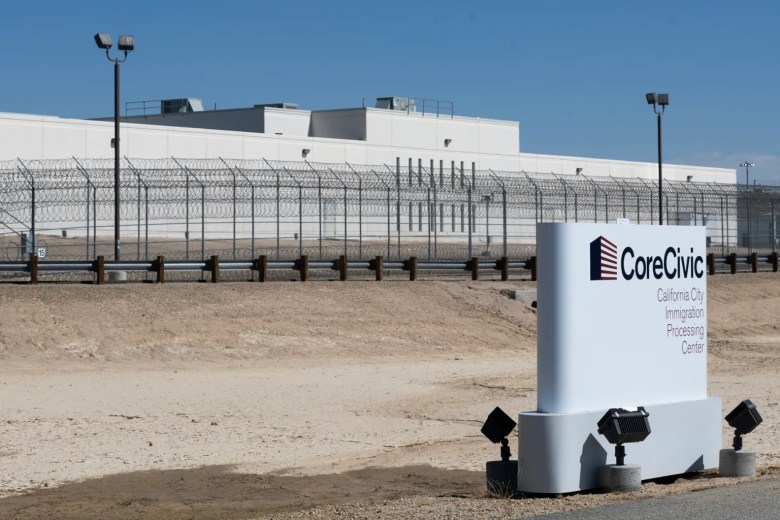
The private prison company CoreCivic has sold two of the largest immigration detention facilities in California to the U.S. Department of Homeland Security in a deal worth $1.5 billion, the company announced Monday.
CoreCivic said it anticipates that the sale of the Otay Mesa Detention Center in San Diego County and the California City Detention Facility in Kern County will bring the company an estimated net proceeds of approximately $1.1 billion.
The sale closed on July 2, according to a recent filing with the U.S. Securities and Exchange Commission, with the federal government paying $739.2 million for the 1,994-bed Otay Mesa facility and $732.6 million for the newly-opened 2,560-bed California City facility. The two properties were sold under separate purchase agreements, signed and completed on the same day.
CoreCivic said in a news release that it expects to continue running the day-to-day operations of both facilities under existing management contracts with the U.S. Immigration and Customs Enforcement. The company acknowledged in its filing that the terms of those contracts could be renegotiated now that the federal government owns both properties outright.
There’s no guarantee CoreCivic will keep its operating contracts, the company said in the SEC filing. The California City contract runs through August 2027, and the Otay Mesa contract runs through December 2029, with an option to extend for five more years.
The purchase of the California detention facilities is another step in the federal government’s plan to build out national immigration detention capacity that isn’t reliant on the two largest private prison contractors, according to a brief from the Brennan Center for Justice at NYU Law from February.
The proposed transition away from private detention was described at the time as the “ICE Detention Reengineering Initiative” in U.S. Immigration and Customs Enforcement documents released by the city of Social Circle, Georgia, where city leadership was worried about the strain on city services from a major detention facility housing between 7,500 and 10,000 people.
“This new model will allow ICE to create an efficient detention network by reducing the total number of contracted detention facilities in use while increasing total bed capacity, enhancing custody management, and streamlining removal operations,” according to the unsigned ICE memo.
The detention expansion program’s original goal was to acquire 24 warehouses across the country, eight of them large-scale detention centers and 16 of them listed by ICE as processing Centers.
The federal government apparently retreated from that plan when Markwayne Mullin replaced Kristi Noem as Secretary of Homeland Security and emphasized the government’s plan to rely on existing detention space.
The Department of Homeland Security’s purchasing program surprised local officials in at least five states, who only learned of the purchases and their purpose after the deals closed. Some of those projects have run into legal challenges, according to the New York Times, though the agency appears to be moving forward with four warehouse acquisitions.
California law allows state and local officials to inspect immigrant detention centers, and Democratic leaders have drawn attention to conditions at both sites since President Donald Trump began his second term. Eight ICE detention centers are operating within the state, up from six since former President Joe Biden left office.
The Otay Mesa facility has been at the center of an ongoing legal fight over local health inspections. San Diego County officials sued the federal government and CoreCivic in March after claiming health inspectors were blocked from a full inspection under a 2024 state law. A federal judge later granted county health officials access to the detention center.
California City opened last year in eastern Kern County about 100 miles north of Los Angeles in a site the company previously operated as a state prison.
The company also disclosed that it is having ongoing talks with ICE about selling the federal government additional detention facilities, though it said those discussions are in the early stages of a deal and may not close.
Maryland-based CoreCivic said the proceeds from the sale, which would be about $1.1 billion after taxes and transaction costs, could go toward paying down its bank credit and retiring $238.5 million in senior notes coming due in 2027. Any remaining funds are earmarked for further debt reduction or possibly stock buybacks.
Patrick Swindle, the president of CoreCivic, said in the news release, “We are pleased with the sales of these two mission-critical facilities for the Company’s government partner, while reflecting our role as a long-term, flexible solutions provider to government.”
Correction: This story was updated at 4:15 p.m. to correct an error in the amount of money CoreCivic intends use to pay down debt.
This article was originally published on CalMatters and was republished under the Creative Commons Attribution-NonCommercial-NoDerivatives license.
So in sum: a bunch of taxpayer funds just went to these private prison people who also keep running the place. Doesn’t this also change who is liable for misdeeds there (to the taxpayers?)?
Was any appraisal of the properties done? The price paid by the government seems really high – how much of it was a kickback to Trump?