When a San Diego renter disputed their utility charges from their landlord, they turned to a new city law for help.
The landlord billed the renter for water, sewer and trash, but the tenant didn’t understand how the charges had been calculated, according to a redacted June 30 complaint made to the San Diego City Attorney’s Housing Protection and Civil Code Compliance Unit.
The Residential Utility Fee Ordinance, passed by the San Diego City Council last year, requires landlords to provide tenants with copies of the building’s utility bills and the calculations behind the portion charged to them.
The renter asked twice but said they got no response. They said they subsequently faced eviction.
“I have been given a pay or quit notice because of non payment. I am currently facing eviction over this and have made past payments under duress,” the person, whose name was redacted by the City Attorney’s Office, wrote.
The complaint is one of seven that Voice of San Diego obtained from the City Attorney’s Office filed between December 2025 and August 2026. The complaints describe tenants asking landlords or property managers for utility bills and the formulas used to divide those costs among residents.
Some tenants say they never received the records. Others say they got them only after long delays or with information blacked out.
Several complaints also raise questions about charges included in those bills, including trash-related fines that tenants say were passed on to everyone in a building.
And in two complaints, tenants say their efforts to challenge the charges were followed by eviction threats or notices.
The complaints are allegations, not proof that landlords violated the law. Voice has not independently verified the billing disputes. The City Attorney’s Office withheld identifying information about the complainants, so Voice could not reach them.
But taken together, the complaints show how difficult it can be for tenants to use a right that was created, in part, to make utility charges more transparent.
City Attorney Heather Ferbert’s Office declined to comment on whether any of the complaints were under investigation.
The complaints were made to the city’s Housing Protection and Civil Code Compliance Unit, which Ferbert launched in August 2025 to tackle a number of issues affecting tenants, landlords and the city’s housing stock. That includes repeat code violations, violating renter protection laws, or poor rental conditions.
They say they received around 800 complaints in total since the unit was launched.
Gilberto Vera of the Legal Aid Society of San Diego said the complaints point to a broader issue with tenant protections.
“Passing a new law doesn’t necessarily always mean tenants are protected,” Vera said. “Enforcement that has to go into effect, so that landlords know, ‘Hey, not only is this a new law, we’re going to enforce it, and if you don’t comply with it, there’s going to be consequences.'”
A Right to See the Bill
The ordinance was designed to address a common problem in multifamily housing: Tenants are not always billed according to their individual use of water, sewer or trash service.
In many buildings, utilities are measured or billed for the property as a whole. Landlords can then divide those costs among tenants using a formula known as ratio utility billing, or RUBS.
Under RUBS, a tenant’s bill is based on factors such as the number of occupants, the size of the unit or other criteria specified by the billing formula, rather than a meter measuring that tenant’s actual use.
That can make it difficult for renters to determine whether a charge is accurate.
The ordinance was intended to give them a way to check.
Its stated purpose is to promote “fairness, equity, and transparency” regarding how landlords charge utility fees to residential tenants. When a tenant makes a written request, landlords must provide documentation showing the utility costs they incurred and how the tenant’s share was calculated. That can include copies of utility bills or tax-roll billing reports, where applicable.
Landlords have to provide the records within 10 calendar days of a tenant’s written request.
The ability to check those charges matters as utility costs – along with rent, groceries and everything else – is on the rise. Just months after the City Council passed the utility fee ordinance, councilmembers hiked water and sewer rates by more than 30 percent over two years. The city also approved new, hefty trash fees.
For tenants whose bills are calculated through RUBS, those higher costs can show up in monthly charges that fluctuate from one billing period to the next. Depending on the formula, a tenant’s bill can also be affected by costs driven by other residents’ use of water. And because the tenant’s own usage may be only one factor, or not a factor at all, using less water may not have much effect on the amount they owe.
“RUBS is causing housing destabilization,” Vera said. “You already have high rents, and then it’s hard for you as a tenant to budget when your utilities change, they change and go up and down every month.”
Tenants Couldn’t Get the Very Bills They’re Entitled to See
The complaints obtained by Voice describe several variations of the same problem: Tenants say they asked for records the ordinance requires landlords to provide, but did not receive them within the 10-day period.
In a Feb. 3 complaint, a tenant said their landlord was charging $321.58 a month for air conditioning using a per-occupant formula.
The tenant said they had not used the air conditioning that winter and had sent a written request more than 10 days earlier for the property’s master bill and the data used to calculate their charge.
They said they received no response.
In another complaint, filed Dec. 30, 2025, a tenant said property management had notified residents that they could request copies of utility or tax bills and the calculations used to determine their charges.
The tenant made the request.
Management responded in writing that it “cannot be shared because it includes other tenants’ information,” according to the complaint. The tenant was instead directed to Conservice, a third-party billing company.
The tenant said no bill – redacted or otherwise – was ever provided.
The complaints also raise questions about what those records reveal when tenants finally receive them.
In an April 29 complaint, a tenant said their trash charge for one month exceeded $200. On April 15, they asked management for the property’s full trash bill from the waste hauler, which was then divided among tenants.
Two weeks later, the tenant said, management still had not provided it.
The tenant said this was not the first time management had delayed providing the trash bill. The previous month, management eventually provided the bill, but the first copy had parts blacked out.
When the tenant received the full bill, they said it included fines for “misuse of trash.” Those fines, the tenant alleged, had been divided among all of the property’s tenants.
The tenant said residents had not been told about the violations or shown who was responsible.
A property manager from the same company acknowledged that the fees were “way too high” and promised to investigate, according to the complaint. The tenant said they didn’t receive a credit on their bills in response to the error.
A similar complaint filed May 6 describes a trash bill for an eight-unit building.
The tenant said they were charged $208.91 for trash in March. They attached a February invoice from the waste hauler showing $1,231.22 due for the entire building.
Their utility charges in May were $311.67.
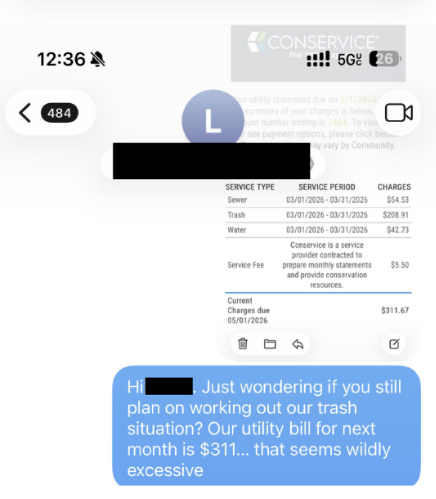
The tenant said they had asked management for the property’s full trash bill every month since January and were mostly ignored. When management eventually responded, the tenant said the bill was heavily blacked out. It took several more days, the tenant said, to obtain a clear copy.
That copy showed “misuse of trash” fines that had been divided among all eight tenants.
In a March 27 email to management quoted in the complaint, the tenant wrote that “Recycling Contamination” penalties assessed against the property had been divided by eight and billed to everyone equally.
“You are illegally charging me for a neighbor’s lease violation,” the tenant wrote.
The ordinance puts the onus on tenants to enforce their rights, including by asking a court to enforce its rules or seeking monetary damages.
When asked about enforcement when they receive complaints, the City Attorney’s Office said that it considers civil enforcement when complaints reveal broader issues, such as pattern or practice of violations by a landlord.
“When reviewing complaints, the Housing Protection Unit evaluates available information to determine whether conduct appears repeated or part of a larger unfair business practice,” wrote Ibrahim Ahmed, spokesperson for the City Attorney’s Office. “When that occurs, the City Attorney’s Office may take civil action to hold repeat or persistent offenders accountable.”
Asking for Bills Leads to Eviction Risk
Some landlords reacted in more extreme ways than others, according to the complaints.
In the May 6 complaint, the tenant said their attempts to get an unredacted trash bill continued after management had already provided an incomplete copy.
The tenant said they later found a letter at their door threatening eviction if they continued contacting management about the issue.
The June 30 complaint that opens this story describes a similar escalation.
That tenant said their water, sewer and trash charges are handled by a third-party company that provides utility billing services for the property manager.
The tenant said they asked their landlord and property manager in writing for the underlying utility bills and the method used to calculate their charges. They made the requests more than once and said neither party responded, even after the 10-day deadline had passed.
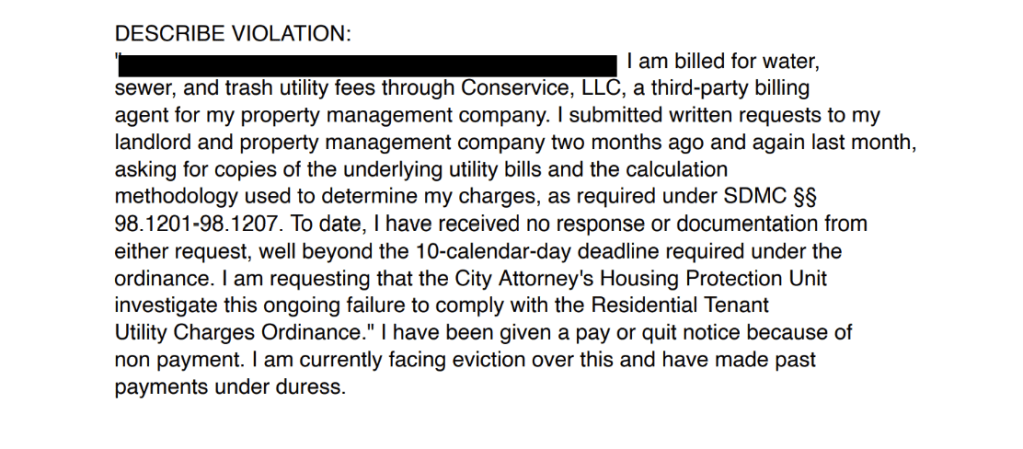
The tenant said they paid the charges anyway, “under duress,” or under pressure and against their will.
They later received a pay-or-quit notice for nonpayment, according to the complaint.
The complaint does not say what charges were covered by the notice or when the tenant stopped paying.