
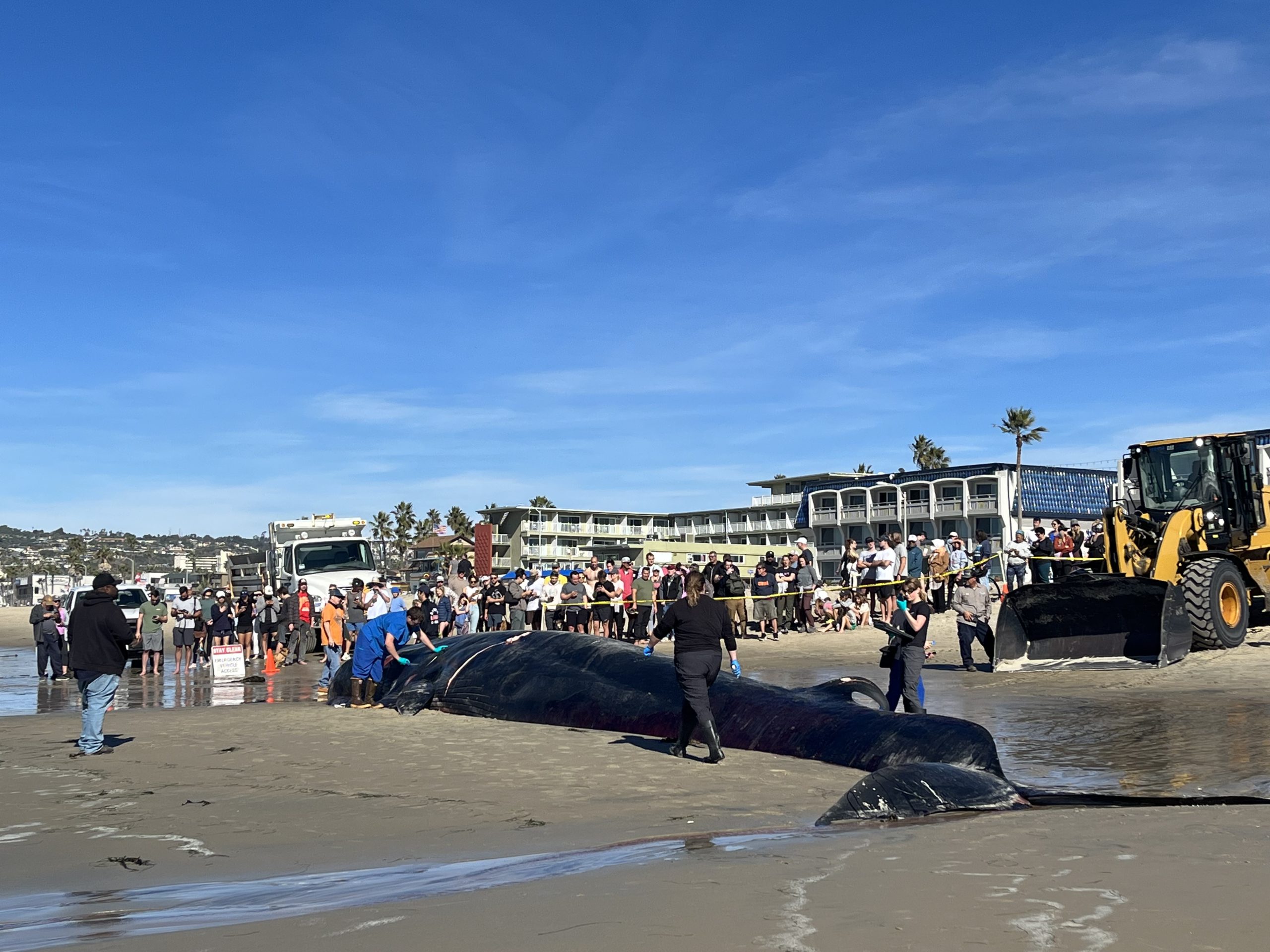
As it turns out, a whale, even in death, can still travel quite a distance.
The dead, female fin whale that washed ashore at Pacific Beach on Dec. 10 has since drifted 100 miles northward to San Nicolas Island, one of the Channel Islands off the coast of Los Angeles. And it’s still moving, last known south past the U.S.-Mexico land border.
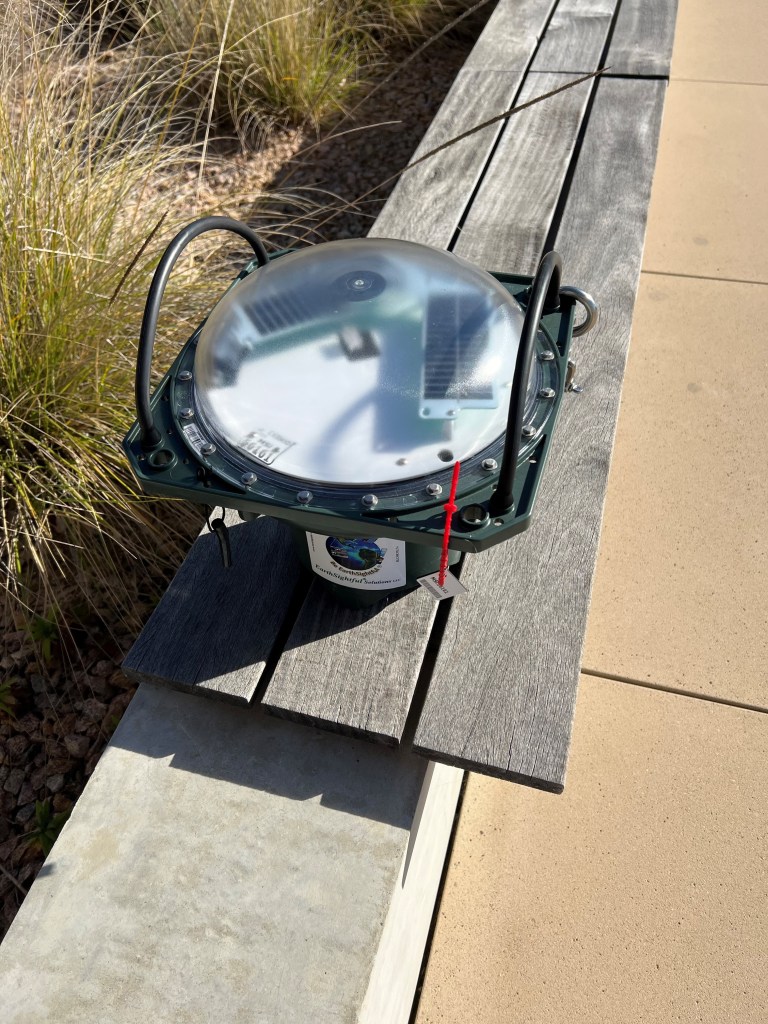
That information comes from a GPS tracker the National Oceanic and Atmospheric Administration, or NOAA, attached to the carcass the second time it was towed offshore from San Diego.
NOAA did that, in part, to ensure the decaying whale wouldn’t run aground again and to better warn mariners and sailors of the huge floating meat buffet. But her drift pattern can also help inform oceanographers like Amy MacFadyen, also with NOAA, who are working to predict the direction of oil spills, shipping containers or an overturned life raft among the complex motion of the ocean.
This whale initially sank after being towed just a mile offshore the day she arrived on Pacific Beach. But she floated back to the surface like a balloon, as gasses built up in her decaying body. Towed another 20 miles offshore by lifeguards, she’s since ping-ponged between the San Clemente, Catalina and Channel Islands National Park.
Where an object might drift is the sum of wind, water and the shape of the sea floor. Wind plays a big role in pushing everything from a large sailboat protruding from the water or a bloated, decaying whale, an influence called “windage.” A floating thing can be pushed by surface winds but also pulled another direction by the deepwater currents created when canyons, ridges and shelves of the ocean floor steer currents along its contours.
“It’s a very uncertain science,” MacFadyen said of drift prediction. “It’s like forecasting the weather a couple days out. We have the basics, but there will be obvious errors in the details of exactly how strong winds are going or the exact direction.”
We’re better at predicting weather, patterns of air, than predicting ocean currents, patterns of water.
“It’s a very chaotic, turbulent environment with lots of small fluctuations and eddies,” she said. “In a deterministic way, it’s impossible to say where something is going to end up.”
But scientists will still try. MacFadyen supported the emergency response to the Deepwater Horizon oil spill, the largest ever marine oil spill in the U.S. waters. Even a thin layer of oil riding the surface of the ocean is impacted by windage. So I asked her, whose drift is harder to predict: A whale or an oil spill?
The answer is as clear as an oil slick. Both floating things can change a lot over time in complex ways. MacFadyen is hopeful in research to develop new sensors to track both.
(For more on marine detective work, check out this Environment Report interview with another expert who worked on the Deepwater Horizon oil spill.)
A dead whale is the gift that keeps on giving.
She was a Christmas meal to great white sharks spotted feeding on her carcass near Catalina Island. On Monday afternoon, the buoy was still sending a signal which likely means the body has yet to sink. Once she does, that buoy should rise to the surface and be retrieved. Once on the ocean floor, her carcass becomes a “whale fall,” rich source of nutrients supporting ecosystems for decades.
Killer whale update: The Eastern Tropical Pacific orcas pinned for the fin whale’s murder may still be chilling around Southern California. Alisa Schulman-Janiger, lead research biologist for the California Killer Whale Project, said Monday they were seen heading southeast from Newport Beach toward San Diego on Thursday.
Whale watchers saw the orcas taking down a gray whale calf off the coast of Long Beach on Jan. 2, reported KTLA with accompanying videos from the incident. And then in Ventura County a few days later, according to the Ventura County Star.
In Other News
- There’s a cool art installation coming to the University of California-San Diego’s Geisel Library on Jan. 12: Blue-spectrum cyanotype prints, sculptures and paintings exploring 134 years of changing kelp forest habitats. The collection features La Jolla seaweed pressings from 1890 and onward taken by scientists and Scripps Institution of Oceanography namesake Ellen Browning Scripps among others. (UCSD)
- Opponents of new rules that slash the value of rooftop solar asked a state appeals court to rehear their case. (Union-Tribune)
- San Diegans will vote on a new sales tax measure to fund transportation infrastructure come November 2024. The tax could support a rail connection to the San Diego International Airport, HOV lanes on highways and bike infrastructure. (KPBS)
- Plans to redevelop Fiesta Island and an area called South Shores, begins in the coming months. The area is now home to a small passive park, shade structures and a parking lot for a remote control miniature airplane club. This is coming forward because the city is redeveloping another part of Mission Bay by restoring marshland, which creates less space for camping and boating. South Shores could serve as a replacement site for some of those activities. (Union-Tribune)
- A neighborhood garden in City Heights and founded in 2008 faces eviction from the community’s development corporation for managing the land without a valid lease, among other issues. The garden’s operators said they’ve been met with resistance in their attempts to get a valid lease. (inewsource)
- A piece of legislation that, it seems, everyone missed, called for reducing the cost of energy bills on residents. But it also calls for the creation of a fixed charge based on each household’s income. The way that will go down is in the hands of the California Public Utilities Commission and there are many proposed ways to do that coming from rate advocacy groups and the investor-owned utilities themselves. (Union-Tribune)
Really sad to see that… Upset to see the whales that are friendly in nature but decreasing day by day from universe.