

Supervisor Nora Vargas dropped a brow-raising notion at Voice of San Diego’s Politifest this year: San Diego County should be prepared to evacuate the polluted Tijuana River Valley.
“We’re not at that point right now, but I want to make sure that we’re ready if and when it were ever to happen,” Vargas said during a panel about whether the government could fix the Tijuana River sewage crisis.
At that point in the conversation between the five-member panel entitled, “Can the Government Fix the Tijuana River?” no one had brought up evacuations as a possible outcome of the decades-old Tijuana River sewage crisis.
For decades, San Diegans understood sewage flowing into the United States from Mexico via the Tijuana River and Pacific Ocean as a water quality problem mostly afflicting beaches, businesses and neighborhoods. The county deployed more sensitive water quality tests at the beaches, showing the ocean water could be much more polluted than we knew before.
But data revealed in early September by local researchers stoked fears that those contaminants could become airborne, spread and inhaled further inland. Those researchers held a press conference publicizing part of their data claiming toxic gases like hydrogen sulfide, a common and harmful byproduct of sewage, oil or gas, spewed from the river at levels dangerous to human health.
Vargas pushed back on researchers’ warnings. County hazardous waste experts deployed into the river valley couldn’t replicate what the researchers found in their preliminary air pollution tests. They also disagreed that the levels of hydrogen sulfide were high enough for people to stay inside or trigger wider public health warnings.
I asked Vargas to explain what she meant on the Politifest stage. What would the level of crisis have to be to evacuate a community? Vargas referred to her interim public health officer, Ankita Kadakia, who had told her the situation hadn’t “met those rules yet.”
Later, I turned to the county to explain these evacuation rules. California requires local public health departments play the lead role in early detection and coordinating the response to emergencies and disasters. San Diego County’s Emergency Operations Plan lays out when and how people should evacuate for the six most likely hazards that would trigger the need: dam failure, earthquake, flooding, tsunami, wildfire and terrorism.
Toxic gas exposure isn’t specifically considered.
Tim McClain, a spokesperson for the county’s Health and Human Services Agency, said the county “wouldn’t need a manual to decide whether to evacuate” from such a threat. A confluence of events would have to occur, including alarming air quality data from the local Air Pollution Control District which is just beginning to install the kinds of monitors needed to collect toxic gas information in the valley.
Or, if the county’s hazardous incident response team discovered toxic hydrogen cyanide gas in the Tijuana River Valley, (as the researchers’ claimed their data suggested, which later turned out to be false) and it spread to communities – that would be a situation that could require evacuation.
Whether to evacuate an area is often left up to first responders, like the sheriff, police or fire departments, McClain said.
The county and the Air Pollution Control District along with the U.S. Environmental Protection Agency and others are working on creating thresholds for what would be considered hazardous hydrogen sulfide exposure in the outdoors. The researchers and the mayor of Imperial Beach maintain the levels already detected in the river valley, while considered low compared to state and federal workplace exposure standards, are still high enough to potentially cause health complications over the long term.
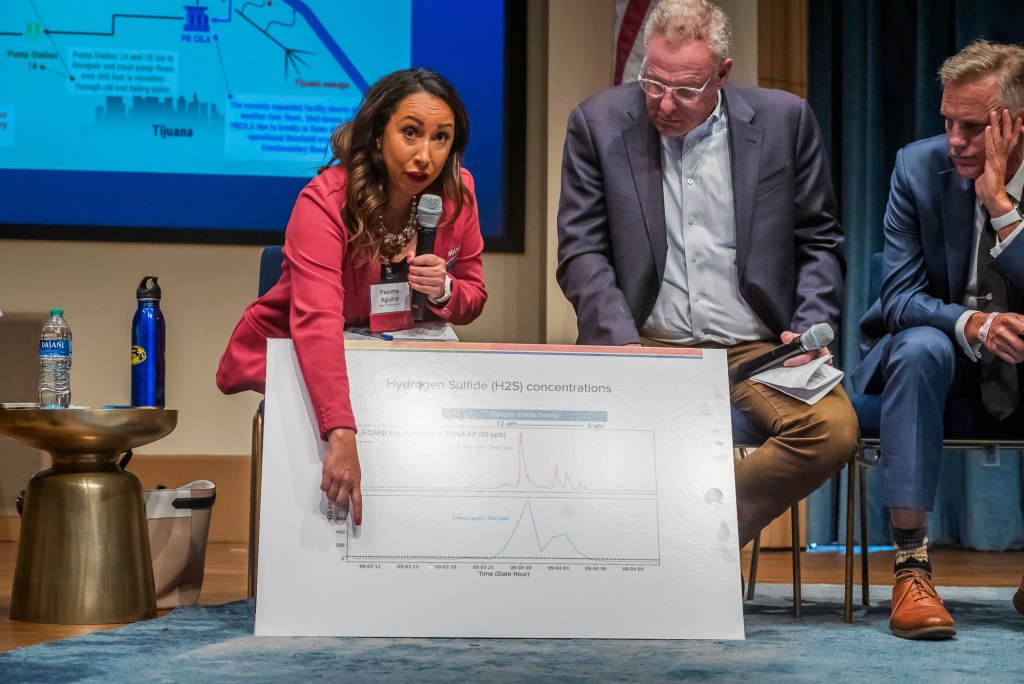
“The symptoms people are expressing are real,” McClain said. “Even at levels that measure very low, people can smell hydrogen sulfide and experience symptoms such as headaches and nausea.”
Still, McClain said the presence of a gas alone isn’t enough to evacuate an area. The county would evaluate how long the hydrogen sulfide stuck around in the atmosphere, how far it spread and weather conditions – like wind, temperature, etc.
“We have to be very careful to give the community accurate information, as we have already seen the effects of statements that proved to be alarmist and inaccurate,” McClain said. “To insinuate we are anywhere near such a level today, or even have been in the recent past, to conduct such an evacuation may further scare people.”
Back at Politifest, I asked Imperial Beach Mayor Paloma Aguirre – who’s been pushing for acknowledgement of her community’s health complaints as well as the contamination of the beaches, water and now the air – whether it was safe to live in her city.
“I’m very well aware that every time I speak about this, it has economic impacts as well. It’s hurting our mom and pop small businesses, right? Because now everybody knows us as the dirty town by the sea,” Aguirre said. “At the end of the day my responsibility is to the people’s health, safety and welfare.”
“The answer to your question is, TBD (to be determined),” she said.
There is another possible response, build a dam to prevent any discharge to the US side of the border.
About a dam…Not possible. Stop suggesting this until you gain more knowledge about the TJ river valley.
Kim Prather of “Covid spreads across salt water so we must close the entire Pacific Ocean” fame led the research team claiming the air was unsafe. Really all you need to know.
Yeah, right. Let’s kick roughly 63,000 people out of their homes. One more example of poor Democratic leadership.
Don’t like it? Vote differently!
While I certainly appreciate the continued coverage and that you are holding our elected officials accountable, and pointing out when they make harmful decisions, I wanted to point out something that’s off. This article states that the hydrogen cyanide level reading was “false.” The reality is that it was a false reading on the instruments because the hydrogen sulfide reading was so extremely high. It sounds here like the researchers lied. They’re trying to save us; they’re not lying about their findings.
One party rule has given us this result. Our elected officials can’t even read. Vote R or be ready for it to get worse.
thank you for making this article very useful and keep up the good work
Ok this is my 3 rd attempt. I was on the peer in imperial beach. last evening with my dog. I’m from the desert and wanted my dog to see the ocean. I took videos of the water and couldn’t understand what I was looking at. I am in shock. I’m totally hoping that this isn’t real and a horrific dream!
Ok it’s me Annette again to ad one more final comment. The lack of human intelligence in the age of being soo aware of saving the work just shows that we are such an ignorant race of humans and to continue to destroy marine life and the damage that it’s cause to our environment in unconscionable and a down rite Sin in the eyes of our creator. How can this continue with all the so called technology we have! I don’t have the words to describe what I captured on video. This is just sad!