

A new bill would scale back parts of California’s sanctuary law, possibly reversing a controversial San Diego County measure.
The bill, SB 554, by state Sen. Minority Leader Brian Jones, would revamp SB 54, a 2017 law that designated California as a sanctuary state, limiting local law enforcement’s cooperation with federal immigration enforcement.
After President Donald Trump pledged to carry out mass deportations, the San Diego County Board of Supervisors passed a resolution prohibiting sheriff deputies from helping immigration officers arrest people for potential deportation, regardless of the person’s criminal history.
Jones’ bill would prevent cities and counties from restricting local-federal cooperation on immigration matters, beyond what California’s current sanctuary law already allows. He said San Diego County’s resolution spurred his legislation, and if his bill passes, it would require the county to reverse its policy.
“Their reckless ordinance prohibited law enforcement from cooperating with immigration officials on illegal immigrants convicted of any crime, including the worst felonies,” Jones said. “This makes it easier for convicted illegal immigrant felons to return to San Diego streets and continue their crime sprees, regardless of how many felony convictions they have.”
Jones’ bill would also change requirements for local-federal coordination on those cases. While the state sanctuary law allows police or sheriff’s officials to cooperate with U.S. Immigration Customs Enforcement on immigration cases involving serious crimes, Jones’ bill would make that coordination mandatory.
Immigration advocates argue the sanctuary law keeps communities safer by building trust between immigrants and law enforcement officials. Jones said shielding immigrants convicted of violent crimes allows them to victimize law-abiding immigrants and the broader community after their release.
“Our bill was a direct response to this radical, unconscionable policy and was born out of concern from the immigrant communities in my district,” Jones said.
Pedro Rios, director of the U.S. Mexico Border program for the American Friends Service Committee, said he thinks the bill forms part of a national crackdown on immigration. He said the proposal aligns with Trump administration plans for mass deportations, arguing that “the real intent is to target anyone who might be labeled as undocumented.”
“It’s a political stunt,” Rios said. “It’s part of the political theater to introduce and encourage a false narrative about immigrants being a threat to safety in California cities.”
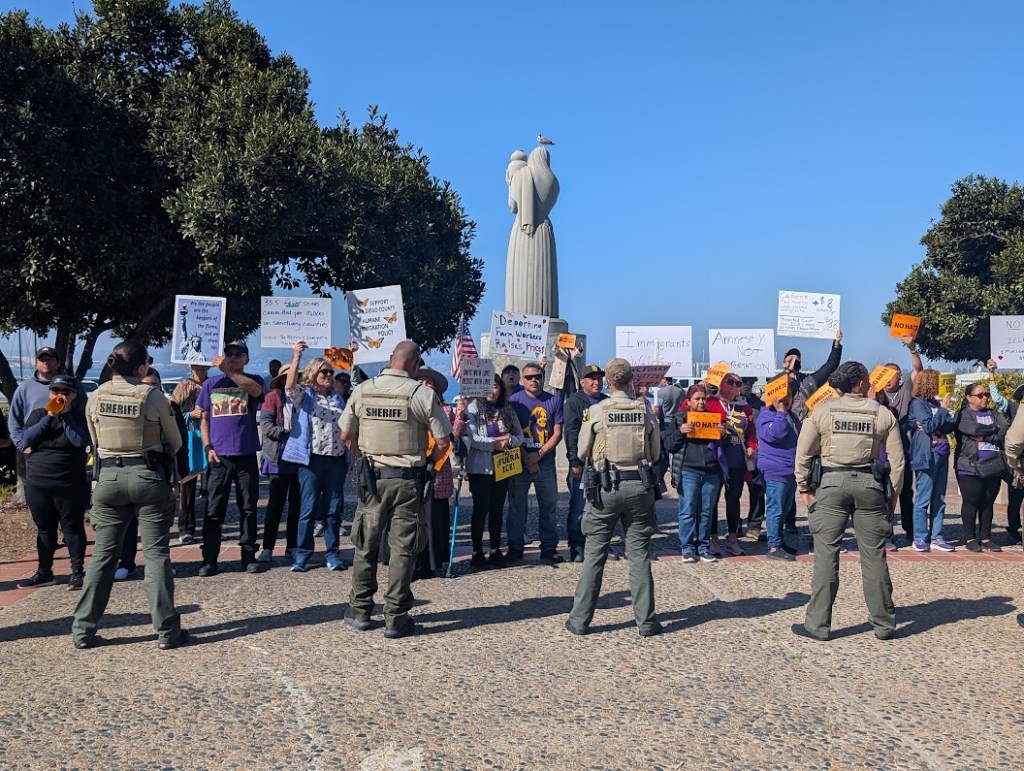
How we got here: The 2017 sanctuary law aimed to safeguard immigrants from unlawful detention by keeping local and federal law enforcement separate. Advocates say it makes communities safer by enabling immigrants who were victims or witnesses to crime to report an incident to law enforcement without fear of deportation.
While the law restricts most coordination between local and federal agencies, it makes exceptions for people convicted of violent crimes including child abuse, human trafficking, rape, kidnapping, torture, gang activity, DUIs and weapons offenses.
After President Trump pledged to carry out mass deportations, San Diego County went beyond the state law with a policy that prevented county resources from going to immigration enforcement, and prevented the sheriffs from sharing information with ICE without a warrant.
San Diego Sheriff Kelly Martinez rejected those restrictions, arguing she – not the supervisors – sets policy for her office and saying she would follow California state law. The county policy fell to the back burner after former Supervisor Nora Vargas resigned unexpectedly in January, leaving her seat and support for the resolution uncertain. Candidates to fill her seat said they’re not committed to maintaining the controversial policy.
Martinez hasn’t said whether she supports Jones’ bill, or how it could change protocols for her department. She told Voice of San Diego earlier this month that her role is to reassure people in San Diego that they can trust her if they are victims or witnesses to a crime, and said state law provides the right balance between preserving that confidence and coordinating with ICE on violent crimes.
“My ability to share release dates of those with serious criminal convictions who are in local jails ensures our communities are not re-victimized,” Martinez said in a statement Friday. “Protecting victims and preventing crimes committed against community members is my priority while ensuring we foster trust between immigrant communities and law enforcement. My goal is to create an environment where all residents feel safe reporting crimes and cooperating with local law enforcement.”
Her office provides immigration officers with release dates for undocumented inmates, but doesn’t proactively notify the agency when those immigrants are detained, she said. Jones’ office said his bill wouldn’t change that. Since local law enforcement isn’t permitted to ask about immigration status of arrestees or inmates, ICE must request that information by name.
Jones will face an uphill climb getting the bill through a Democratic-controlled legislature. He introduced it Friday with eight Republican co-authors, and said he’s trying to build support among Democratic colleagues as well. Regardless of their success, the bill is a first step in building community support for the changes they’re proposing, said state Sen. Rosilicie Ochoa-Bogh, a Riverside Republican and co-author of the bill.
“The changes don’t happen in Sacramento, unless people get informed and engaged,” she said.
AI Bill of Rights: State Sen. Steve Padilla wants California to adopt an AI bill of rights to ensure that “AI systems respect human rights, promote fairness, transparency, accountability, and safeguard Californian’s well-being.”
It goes without saying that’s not the default setting for AI. While the technology can be useful for tasks such as marketing and data gathering, it’s also implicated in plagiarism and privacy violations, as well as deepfakes, fraud and disinformation.
Padilla points out that President Joe Biden introduced an executive order in October 2023, that called on tech companies to adopt voluntary protections. Last month President Donald Trump rescinded that executive order, so Padilla wants to reinstate similar protections in California.
His bill calls for AI systems to include safeguards against “discrimination, privacy violations, and unchecked automation in critical decision making processes.”
Lawmakers are struggling to get a handle on the fast-moving technology. Last year Padilla introduced two AI bills to set safety standards for state contractors using AI and to establish a public/private AI hub. Both failed, along with a number of other AI proposals.
The Sacramento Report runs every Friday. Do you have tips, ideas or questions? Send them to me at deborah@voiceofsandiego.org.
Californians, including San Diegans, need to realize that a radical change has taken place in our nation. Illegals must leave, either voluntarily or through deportation, and apply to enter legally. It is that simple. The entire nation is onboard with getting illegals out. If you are here illegally, I recommend you leave of your own accord and on your own terms.