

Tariffs and immigration crackdowns have taken center stage in recent weeks as President Donald Trump pushes tougher border restrictions. But there has been another issue also playing out: water.
This month for the first time, the United States denied Mexico’s request for a special delivery of Colorado River water to Tijuana. Though not required in the 1944 U.S.-Mexico water treaty, these voluntary deliveries have been quietly taking place since 1972.
The reason for the denial: U.S. complaints that delayed treaty-stipulated water deliveries by Mexico on the Texas border are threatening crops there.
“Mexico’s continued shortfalls in its water deliveries under the 1944 water-sharing treaty are decimating American agriculture – particularly farmers in the Rio Grande Valley,” the U.S. State Department’s Bureau of Western Hemisphere Affairs announced in a March 20 posting on X.
Stephen Mumme, an emeritus professor of political science at Colorado State University, says the measure does nothing to alleviate the situation on the Texas border. It offers “no guarantee whatsoever that it will do anything more than tick Mexico off,” he said.
In addition, the move comes at a sensitive time in the Colorado River basin – just as negotiations are underway for managing future shortages, he said. The transfers “have been one of those areas that demonstrate the United States’ willingness to work with Mexico,” he said.
“It just boggles the mind why you would do this,” said Mumme, a longtime expert on U.S.-Mexico water agreements. “Any way you parse it, this has adverse consequences written all over it.”
The recent U.S. denial runs against a tradition of collaboration along the California-Mexico border on water issues, according to Vicente Sanchez, a retired professor of public policy at the Colegio de la Frontera Norte in Tijuana.
“This has prevailed, despite any differences or asymmetries and conflicts there could between the two governments,” he said. “It’s very delicate when these issues become politicized.”
Critical supply: Under the water treaty, the United States delivers 1.5 million acre-feet of water to Mexico annually near the U.S. border at Morelos Dam outside Algodones. But drought has been forcing reductions in deliveries recently on both sides of the border.
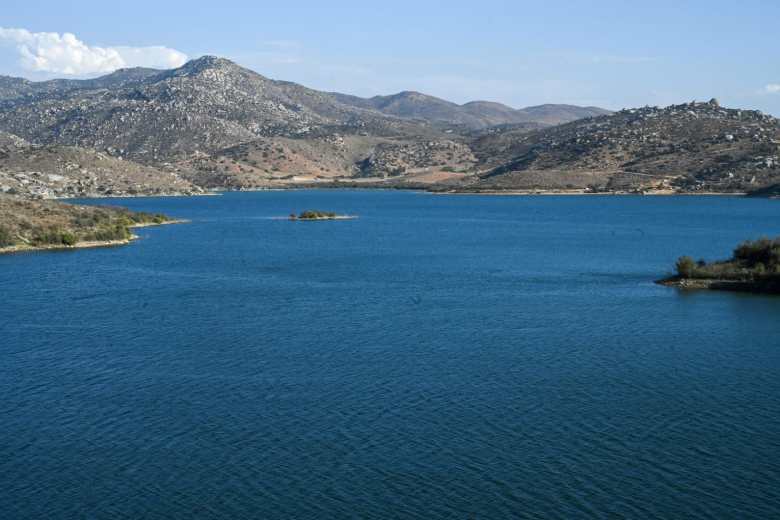
At the end of the line, the Tijuana-Rosarito region is especially vulnerable. The municipalities depend on the Colorado River for 95 percent of their water supply, according to the Baja California Water Commission. Under normal conditions the water is delivered through Baja California’s 78-mile Colorado River-Tijuana Aqueduct to the Carrizo Reservoir outside Tecate.
But there are times when the aqueduct is shut down for repairs, or drought has left the city with few reserves, and supplies run short. That’s when Mexico asks the United States for emergency deliveries through a special connection at Otay Mesa.
These special deliveries are part of Mexico’s allotment of Colorado River water – what’s different is how it gets conveyed to Tijuana. Mexico pays any costs associated with moving it from Parker Dam on the Arizona-California border through southern California’s conveyance system to the Tijuana border, said Sanchez. “It’s not as though the United States is giving something to Mexico,” he said.

Quiet collaboration: Until this month, this arrangement has taken place with little fanfare for more than five decades.
The special deliveries were conceived at a time when Baja California’s existing Colorado River-Tijuana aqueduct had yet to be built (construction began in 1975 and was completed in 1982). At the time, the region was suffering from drought even as a boom in the maquiladora industry was drawing new residents and investments to the city.
The initial deliveries at Otay Mesa took place in 1972 under a five-year agreement negotiated through the International Boundary and Water Commission Minute 240. The agreements have been periodically renewed ever since. The latest agreement, Minute 327, expires in 2027.
To receive the special water deliveries, Baja California must normally present its request by Sept. 15 of the previous year, according to the IBWC. The agency’s recent records show deliveries took place in 2020, 2022, 2023 and 2024.
“The frequency of these requests varies from year to year depending on Mexico’s actual needs,” the IBWC said in a statement. The specific volumes are typically modified numerous times by the time the deliveries actually occur.
Mexico reacts: During her morning news conference earlier this month, President Claudia Sheinbaum said the issue of water deliveries to Texas is in the hands of Conagua, Mexico national water agency, and CILA, the Mexican section of the International Boundary and Water Commission.
Baja California’s top state water official told reporters last week that the state is in good shape, even without the special water delivery; any extra water the city needs this year would come through the state’s aqueduct.
“It’s a request that’s made to address emergency situations, but for now we’ve taken measures so that a contingency of this nature does not arise,” said Victor Daniel Amador Barragan, Baja California’s Secretary for Water Management, Sanitation and Protection.
Numerous improvements have been made to Tijuana’s water delivery system, and Carrizo Dam is more than 70 percent full, the secretary told reporters who interviewed him outside the governor’s weekly news conference in Tijuana on Thursday.
In December, construction is slated to begin on a future federally funded desalination plant that will address the long-term water needs of Tijuana and Rosarito Beach, Amador said.
This month’s U.S. denial means that water agencies in Mexico must step up their game, said Sanchez of COLEF. “If they made the request, it’s that they’re anticipating a summer with a lot of demand,” he said. “This puts pressure on them to be much more efficient, and be very clear with the public about the situation they are facing.”
In Other News
The return of Leyzaola: After only three days on the job this month, Mexical’s new public safety secretary, Julian Leyzaola, was greeted with threatening narco-messages posted in different parts of the city. Among the names on the banners was that of “El Ruso”, a drug trafficker linked to the Sinaloa Cartel, and wanted by the FBI.
Leyzaola is a retired Mexican army officer who previously led the police departments of Tijuana and Ciudad Juarez during a period of peak violence. He rose to fame for his willingness to take on violent gang members and corrupt police officers. But Leyzaola was also the subject of numerous complaints from human rights groups who accused him of torturing suspects.
Leyzaola had been slated to return to the helm of the Tijuana department last year after a 14-year But in the end, the city named a different candidate favored by Mexican President Claudia Sheinbaum.
Leyzaola was appointed to the Mexicali job on March 18 after winning support from a majority of the city council. True to form, he took the threats in stride, saying they were like “little messages left in elementary school.”
Late last week, Zeta newsweekly reported the arrest of three suspects linked to the four narco-messages. The article noted that they have not been linked to the criminal gang headed by El Ruso.
Fishing leader shot dead: Sunshine Rodriguez, a fishing leader in San Felipe who repeatedly clashed with Mexican federal authorities and international environmental groups in the Upper Gulf of California, was shot to death on March 8 in Mexicali.
Assailants opened fire as Rodriguez was selling seafood from a streetside stand. Moments earlier, Rodriguez had broadcast his location on a Facebook Live posting. Sources told Baja California’s Zeta newsweekly that the criminal group led by El Ruso was likely behind the assault.
Rodriguez had been under investigation previously for trafficking in the bladders of the protected totoaba fish. He was detained by federal authorities in November 2020 on charges of organized crime, but released in February 2023 after he was absolved by a federal judge.
Migrant shelters lose resources: The ending of the CBP One appointment system, and the loss of funding sources is driving down numbers of asylum seekers and reducing capacity at migrant shelters on both sides of the border. San Diego County’s two major sheltering agencies – Catholic Charities and Jewish Family Services – are planning to lay off employees at the end of next month, the San Diego Union-Tribune reported. Tijuana’s oldest migrant shelter, Casa del Migrante, is in danger of closing. The near-elimination of the U.S. Agency for International Development (USAID) has left some of the Catholic-run shelter’s supporters without funds, according to a report by TijuanaPress.com.
Tourism promotion: Mexico’s major tourism promotion forum known as Tianguis Turistico is scheduled from April 28 to May 1 at the Baja California Center in Rosarito Beach. The annual event spearheaded by Mexico’s federal tourism secretariat is taking place for the first time at the country’s northern border. Also a first is the binational flavor, with some events in San Diego. A culinary and cultural event (free and open to the public) is being planned on April 26 and 27 at Liberty Station.
Why did the US not use this bargaining chip long ago to address cross-border pollution from Mexico? It is well-documented that poorly maintained Mexican infrastructure results in devastating, continual pollution on the US side of the border. Why hasn’t the IBWC required Mexico to address cross-border pollution in exchange for water deliveries from the USA? Especially considering that some of the water we deliver comes back to us as sewage?
To borrow from another story, why not sell them some to offset soaring costs in San Diego?
The city of San Diego purchases most of its water from the San Diego County Water Authority. And the Water Authority buys most of its water from the Metropolitan Water District.
Both those agencies have borrowed money to build infrastructure such as pipes, pumps and dams. This creates an enormous demand for electricity to run the whole system. Electricity is much more expensive now.
But San Diego has also itself taken on three huge projects that we’re paying for.
First, we bought a bunch of water from farmers in the Imperial Valley more than 20 years ago at a very high cost.
Second, we built a seawater desalination facility and agreed to buy the water for decades at a much higher price than even the imported water.
Third, San Diego and Los Angeles are both building large sewage recycling facilities. That will eventually lessen the need for imported water but they are very expensive projects now.
The Metropolitan Water District also wants to build an enormous tunnel to help bring water safely from Northern California. That plan could cost $20 billion and the bill would flow to ratepayers in San Diego.
The problem is that Mexico “poor boys” everything. The standard of living is very low by American standards but on a global level, it is middle income second world. But the country itself HAS the resources, the governement HAS the money. They can build Advanced Water Treatment plants like we are doing in Sand Diego. They can pay for their own Waste Water Treatment Plants. Mexico HAS the money. Tijuana/Baja specifically if the second wealthiest region outside of Mexico City. They “choose” to not build infrastructure. WHy? Because American will pay. Their government is corrupt and disfunctional. Buit I fail to see how that is the USA’s problem.
When USA was giving away everything even water for decades. Its not cool anymore we need when we get nothing in return only headaches with all that sewage coming in from Tijuana the same amount of YEARS Sewage coming into our oceans since 1972 and Tijuana officials done nothing to fix.