

The origin story of San Diego’s LGBTQ community isn’t quite what you might expect. Queer life didn’t start in Hillcrest, one of the most vibrant “gayborhoods” in the United States, nor did it even begin in modern times.
Gay men, lesbians, and even transgender people were prominent members of local society long before anyone ever flew a pride flag or marched in a pride parade.
“Sexual and gender diversity has always been with us. It’s important to know that they were there, that we didn’t invent this. It’s just within the human spirit,” said La Jolla historian Lilian Faderman.
There’s plenty more unexpected history in our city’s LGBT past. In honor of San Diego Pride, here’s a look back:
Early Same-Sex Couples Left a Big Legacy
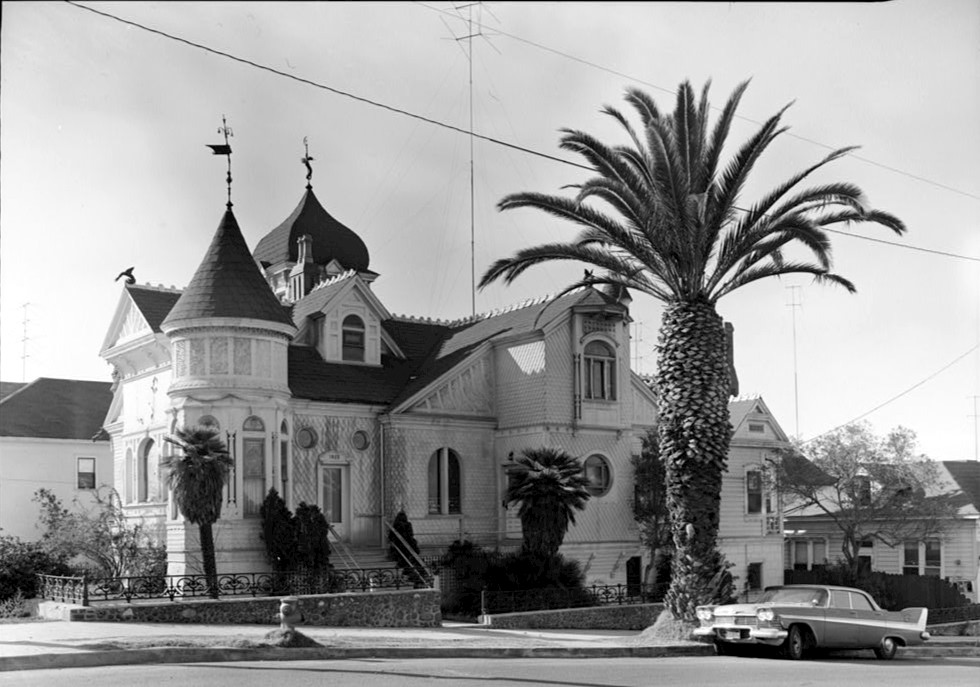
The legacies of a pair of Victorian-era same-sex couples live on in our public beaches and the landmark Villa Montezuma house.
A internationally known spiritualist/musician named Jesse Shepard and his “secretary” Lawrence W. Tonner landed in San Diego in the late 1880s and built Villa Montezuma, a grand Queen Anne-style house in Sherman Heights that was intended to be a “Palace for the Arts.” The home is now owned by the city and offers tours.
Later, around the turn of the 20th century, a pair of progressive, upper-crust women lived together on the edge of Balboa Park. They were Alice Lee, a second cousin of President Theodore Roosevelt’s first wife, and Katherine Teats, described as Lee’s “partner” on a census form.
Lee was a prominent Progressive activist who advocated for public playgrounds and public beaches. Notably, the couple played host to Roosevelt and his second wife Edith after his presidency.
“I just find these late 19th- and early 20th-century women so awesome… They’re our foremothers,” said Faderman, a retired professor who’s considered “the mother of lesbian history.” (I profiled her in 2021.)
As for transgender people, national headlines in 1936 blared the news that the death of La Jolla physician Dr. Eugene Perkins, married to his wife for 28 years, revealed he was actually a biological woman.
One La Jolla resident told a historian about breaking the news to her uncle, who knew the couple: “I told him, first of all, that Dr. Perkins was dead, and my uncle was shocked. Then I said, ‘I have a still greater surprise for you — Dr. Perkins is a woman.’ I repeated it three times, and Uncle Arnold said, ‘Well, there is something wrong with this telephone.’”
And in the 1920s, Alpine was home to the first worldwide drag queen superstar, a stage and film performer named Julian Eltinge. For more on Eltinge and the remarkable early years of drag performance, check my 2023 profile for The Washington Post.
Learn more about local LGBTQ pioneers.
World War II Spurred the Growth of the Gay Community
“Hello sailor” indeed! San Diego became a military powerhouse during World War II, and gays and lesbians flocked here to work for the Navy and the defense industry.
“World War II may be considered the birth moment of modern gay and lesbian history. Young men and lesbians came to discover their sexuality and, after the war, they helped build the urban communities that we have inherited today,” write two historians in the introduction to the 1990 book “Coming Out Under Fire: The History of Gay Men and Women in World War II.”
A veteran described finding camaraderie with other gay sailors at the San Diego Naval Training Station. “It was simply accepted that there were certain people who paired off,” he said in the book.
A few years later, a 1957 book called “USA Confidential” claimed that dozens of “fairy dives” in San Diego catered to gay men. “Coming Out Under Fire” says some local gay bars “catered to enlisted men of many races, gay civilians and ‘trade’ (enlisted men and working-class civilian men willing to go with gay men).”
Learn more about the military’s role in local gay life.
Hillcrest Didn’t Go Gay Until the 1970s
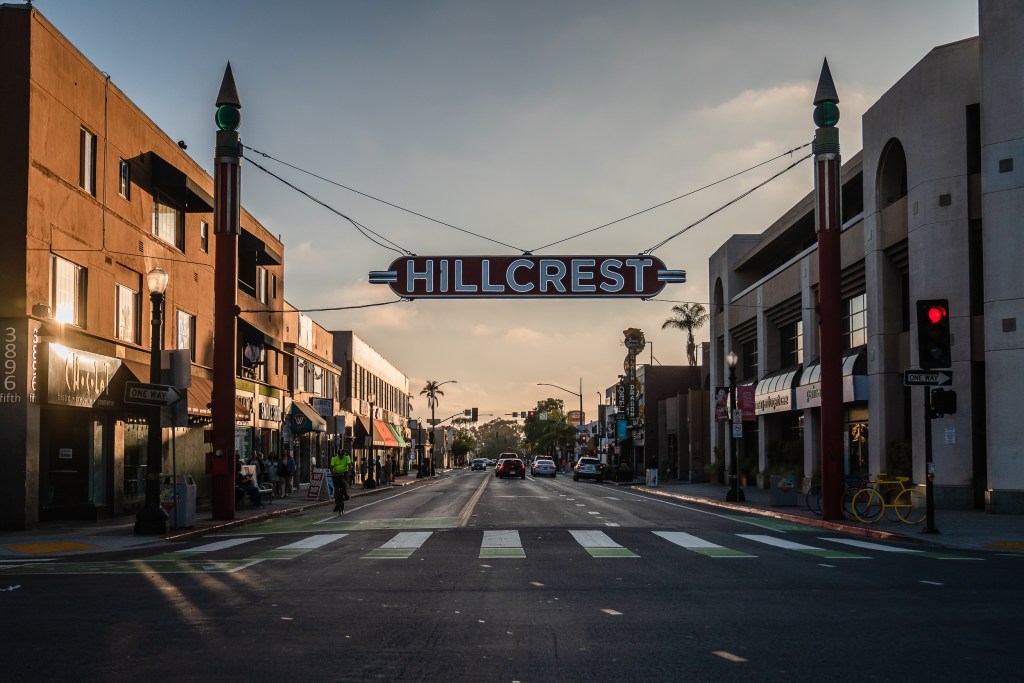
In the 1960s, Hillcrest was known for its working-class residents, senior citizens, and medical facilities, a “Pill Hill” if you will. Gay-friendly bars and restaurants were clustered in downtown.
And then two things happened, First, a gay restaurant called The Brass Rail moved from downtown to Hillcrest and became a bar.
The Brass Rail was unique since it tried to be classy, local LGBTQ historian Frank Nobiletti told me, instead of a typical gay dive where “the drinks were watered down, and the places were not attractive.”
Then the rise of gay liberation catalyzed members of the LGBTQ community to live more openly and started running shops and restaurants in Hillcrest.
“Gayborhoods allow gays and lesbians to find one another for friendship and fellowship, sex, dating, and love, despite the ascendance of dating apps,” Amin Ghaziani, author of the book “There Goes the Gayborhood?”, told me. “They help us answer the question, ‘Who are my people?’ and they offer a renewed sense of our roots.”
My analysis of 2010 census data found that gay male couples were still clustered around Hillcrest and other mid-city neighborhoods while lesbian couples lived all over the county.
Learn about historic sites for the local LGBT community in Hillcrest and beyond.
SD Police and Gays: Foes then Friends then Foes Then…?
For much of the latter half of the 20th century, the San Diego Police Department was no ally of the queer community. Cops often raided gay bars, often in search of sailors and soldiers “who could be dishonorably discharged just by being seen within them,” and patrons learned to not hug, hold hands, or even use their real names to avoid arrest.
Then came a department store sting operation that galvanized the gay community.
In 1974, police offers peered into the May Company restroom in Mission Valley through a vent and arrested more than 20 men on charges of “perversion” and lewdness. The San Diego Union reported the names of the men, including an El Cajon obstetrician who’d been President Richard Nixon’s national campaign director and chairman of the state Republican Party.
Some of the men plead guilty, but others fought back in court as picketers protested with signs saying “SDPD Watches While You Pee!” and “I Prefer Gay Company to the May Company!” Ultimately, charges for several men were thrown out when a judge ruled the cops entrapped them.
Then tolerance set in. In 1979, the police department said it would hire openly gay officers. By the early 1990s, the police chief joined the Pride Parade and officers marched openly.
But the relationship between the gay community and the police has frosted over in recent years in the wake of George Floyd’s murder. Parade organizers even temporarily banned uniformed officers from marching.
In 2021, Faderman told me that the ban was “very sad” and “just such a negation of the progress that we’ve made.”
However, she added, “having said that, I know that each new generation has to do it for themselves. The younger generation does not see through the same lens because they didn’t live through what I lived through.”
Learn more about the 1974 restroom sting and its impact.
Lesbians Ushered In Local LGBTQ Political Power

There appear to be more gay men than lesbians in the United States, and survey data suggests San Diego County isn’t any different. UCLA’s Williams Institute estimates there are about 3,800 lesbian couples here; 28 California counties have higher rates per 1,000 households. In contrast, we’re home to about 5,000 gay male couples, and only seven other counties — led, not surprisingly, by San Francisco County — have higher rates per 1,000.
Still, it was lesbians who first gained power in San Diego politics. They were the first openly gay people here to be elected to the San Diego City Council, to county district attorney, and to the state Assembly and Senate.
The AIDS pandemic may be partially responsible for this. “We lost so many prominent leaders. On the other side, it awakened a lot of people to the fact that there had to be political support and action…,” activist Jeri Dilno told me. “In the late 1980s and early 1990s, almost all of the major (gay) organizations were run by women. That was probably a result of the fact that a lot of the men were ill, taking care of partners or involved in some kind of AIDS activism.”
In recent years, gay men have been elected to top positions in local politics, notably San Diego Mayor Todd Gloria. But it’s a lesbian — Toni Akins, a former San Diego councilwoman, state assemblymember, Assembly speaker, state senator and state Senate leader – who her eyes on an even higher position. She’s running for governor.
Thank you for this article. I look forward to one day seeing our queer community accomplishments featured on “About San Diego”. It’s such a great show!
(The 2nd to last sentence would read better with a “has” after who. who her eyes on an even higher position. She’s running for governor)