
Normally this newsletter is dedicated to local San Diego issues. But allow me, for a moment, to fixate on members of Congress.
They’re actually doing something – though how good it will be, on the whole, is up for debate.
A contingent of Democrats and Republicans just wrote the country’s biggest set of permitting reforms in years, and they’re trying to pass it before Democrats take over, following the “blue wave” midterm elections. The reforms would accelerate permitting for energy and transmission projects while also limiting environmental review, and put the onus on data center developers to pay for all their own energy costs.
The Senate got enough votes Monday to limit debate on the so-called BAAJA or Bipartisan American Affordability and Jobs Act and move it forward for a final vote.
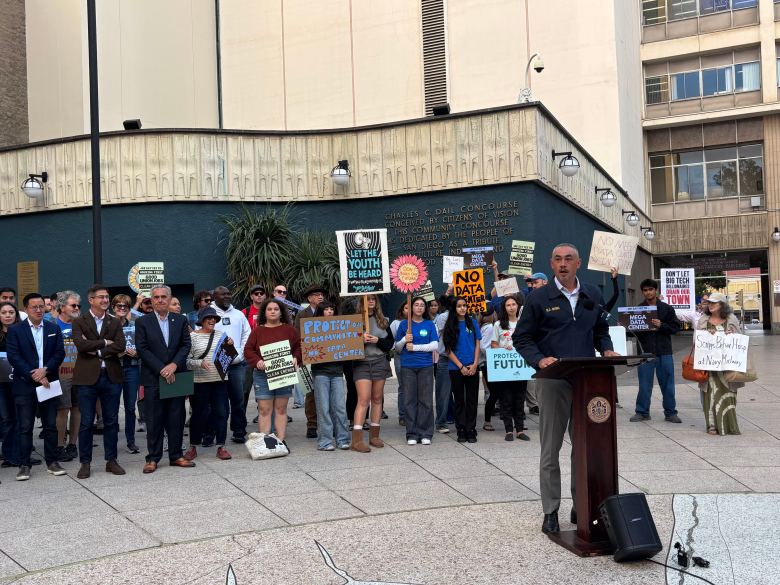
The bill could have big implications for the data center proposed on U.S. Navy land near downtown San Diego. This 400-plus-page law would force data centers, rather than taxpayers, to pay for all their costs – both the power and the upgrades to the local power grid to keep it running.
While California lawmakers passed similar laws on data centers this last session, they don’t apply to San Diego’s proposed project. The state doesn’t have jurisdiction over land owned by the U.S. Navy.
For that reason, among others, San Diego Rep. Scott Peters, along with clean energy proponents and developers and labor leaders, urged fellow Democrats to support the bill generated by the currently Republican-controlled Congress.
“Democrats say they want to lower utility costs and combat climate change. Research shows the bipartisan permitting package would do both,” Peters told Politico recently.
If you’d like to go deeper, David Roberts, a clean energy journalist and host of the Volts podcast, spent two hours unpacking its main reforms, chief among them allowing both electric transmission lines (the biggest powerlines carrying energy across state lines) and natural gas pipelines to be built much faster.
Electricity demand by Americans had been stagnant until the recent business of building data centers to fuel artificial intelligence coupled with electrification of cars and buildings exploded. But it takes 10 to 15 years to actually build a new transmission line, the highways of the power grid that can carry power from state to state.
Whole regions of the country are beginning to hit their limit in terms of how much power they can get to customers during heat waves, for example. The culprit? Many backers of the bill say it’s long, arduous permitting processes making it difficult to expand energy grid infrastructure.
Without transmission lines, it’s a lot harder to bring new clean energy projects online, dispatch their power to places that need it and really transition the grid off of fossil fuels.
The kicker is, BAAJA also makes it easier to build things like natural gas pipelines which are not good for the climate. (That’s because natural gas is a fossil fuel burning as almost pure methane, a huge climate heater-upper).
But that’s how lawmakers were able to make this a bipartisan deal. In any good compromise, neither side is happy.
The bet, as Roberts put it, is that both energy sources (Republicans favoring fossil fuels and Democrats favoring clean energy) would be on more equal footing to compete for energy proliferation. To speed up their permitting, both would get to bypass, in large part, the National Environmental Protection Act, which requires an analysis of a project’s environmental impacts. (Projects would still be subject to laws like the Clean Water Act, however.)
Environmental groups like the Center for Biological Diversity have decried this law for that reason.
Daniel Palken, Roberts’ guest who works for the oil-exec-owned Arnold Ventures, says that if this bill passes, it would allow a fair amount more drilling for oil and gas especially on federal land.
The Rhodium Group, an independent research think tank based in New York City, did a bunch of modeling on what the outcome of the bill reforms might be – and the conclusion was to take some bad with the good. The researchers’ paper said that the bill would allow for up to 249 gigawatts of clean resources to be built through 2040 – a 50 percent increase to average U.S. electricity demand now. Liquified natural gas production, mainly to be exported outside the U.S., would increase by up to 15 percent.
They estimate that tradeoff, in the best case scenario for the climate, would reduce economy-wide greenhouse gas emissions by 149 million metric tons by 2040. That’s like taking 32 million cars off the road for one year. But it’s not as astounding as it sounds.
Humanity as a whole needs to reduce greenhouse gas emission by 1,350 billion metric tons to have a 50 percent shot at reducing global warming by 2 degrees Celsius – a level of warming the United Nations predicts will still cause near total destruction of the world’s coral reefs and intensify drought, sea level rise and extreme heat on millions. The U.S. is the biggest emitter, especially if you include our offshoring of much of our manufacturing demand.
But it’s a start, I guess.
In Other News
- Rep. Mike Levin says that Congress has taken another step toward getting nuclear waste off of the San Onofre power station site on the coast. (Union Tribune)
- If you’re going to the beach in the next few days, make sure you check the tide. The National Weather Service issued a warning beginning Sunday at midnight through Tuesday evening for all San Diego County coastal areas that coastal flooding is expected due to high surf and high tides. (Sac Bee)
- A local theater group is putting together an all-indigenous cast for a play about protecting the Tijuana River Valley. (Union-Tribune)
- Californians rejected a push by business groups to pass sweeping changes to how California’s landmark environmental law works. (CBS)
- Bernie Sanders-backed state insurance commissioner candidate Jane Kim declared victory last week with at least 53 percent of the vote. (LA Times)
- Thank you to the Water Education Foundation for awarding me its annual recognition of outstanding coverage of water resources in California and the West.