
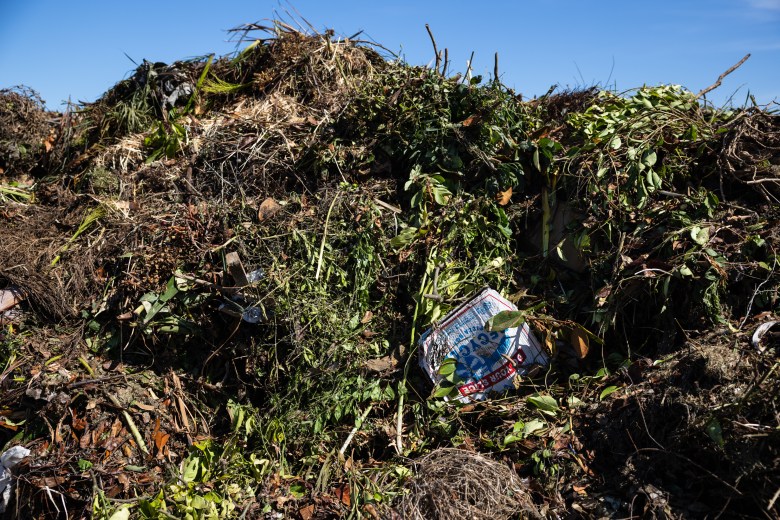
A photo of a pizza box from Tuesday’s article about trash contamination in the compost at the Miramar Greenery sparked a hot and fresh debate.
Does the pizza box belong in the green bin? That depends on who picks up your trash.
Cardboard is a heavy paper product so it is, technically, made of organic materials that will turn into compost. But if the city of San Diego is your trash hauler (look at your actual bins to identify this), no part of your pizza box should go in the green bin.
“When it comes to pizza boxes, if the top of the box is clean, it can go in the blue bin. If the rest of the box is soiled, we ask that you put it in the trash bin because cardboard doesn’t break down well at the Greenery,” wrote Kelly Terry, spokesperson for the city’s Environmental Services Department.

Too much fat and grease in the organic waste can slow down decomposition, attract pests, and increase odors during composting, Terry said. But you can compost other paper products soiled by food — like napkins, paper towels and coffee filters – with the city.
The city heard from enough confused citizens, its staff produced an Instagram reel on pizza boxes to educate.
Dirty pizza boxes can go in green bins picked up by Republic Service, a private trash hauler that operates the Otay Mesa landfill and serves places like Chula Vista and parts of San Diego, confirmed Miranda Mitschke, a spokesperson for the hauler.
EDCO, another private hauler, allows food-soiled cardboard and paper in green bins, according to materials on its website. They even have a nifty search engine where one can look up which bin to use by item.
Even the county of San Diego has similar guidance. Recycle the clean pizza box top, but the soiled part goes in the green bin, confirmed spokeswoman Donna Durckel.
“Materials collected by unincorporated county area haulers use facilities that are able to accept pizza boxes for composting or anaerobic digestion,” Durckel said. “That said, the decision to accept this material is facility dependent, and other facilities may or may not accept pizza boxes based on concerns that the material may not break down adequately.”
Jessica Toth at the Solana Center for Environmental Innovation said the fate of a pizza box depends largely on where each hauler takes the product for compost processing. EDCO, for example, also composts via an anaerobic digester, large contained vessels that allow material to break down without oxygen. The end product is reusable biogas or digestate, a kind of semifluid material that can be made into fertilizer or other products.
The city composts in a different way. The waste is piled into large rows where microbial activity heats up the center which helps break down the material. Some of the rows are capped to make that process go faster. But the end product is either compost, which is like rich black dirt or erosion material, larger pieces of green waste often contaminated by plastics and trash.
CalRecycle, the state agency that regulates waste management, offers customizable model signage for green bins which featured pizza boxes. But Lance Klug, a spokesman for CalRecycle, said California law does not require soiled pizza boxes to be included in local organic waste collection.
“It’s up to cities and counties to determine what materials they include in their local organics recycling programs based on what the processing facilities can handle,” Klug said.
Case closed.
This post has been updated.

Thanks for that slice of clarity. We pay a lot of dough to EDCO so we expect a little extra on top of their regular menu of services. City of SD should take note as a little sausage, pepperoni or even pineapple might give the landfill some flavor and help the city deliver a better product!
Our pizza boxes come with a parchment or light cardboard insert to keep the box from getting greasy. We put the insert in the green bin, the rest of the box on the blue bin.
City of SD says food-soiled paper is okay (sticker on top of our greenery bin). Isn’t cardboard made of the same stuff as paper?
Now do those “compostable” produce bags that all the grocery stores starting using recently. They do NOT go in the green bin according to the city of San Diego website, but the bags all say “compostable “ so guess what people do with them.