
This post has been updated.
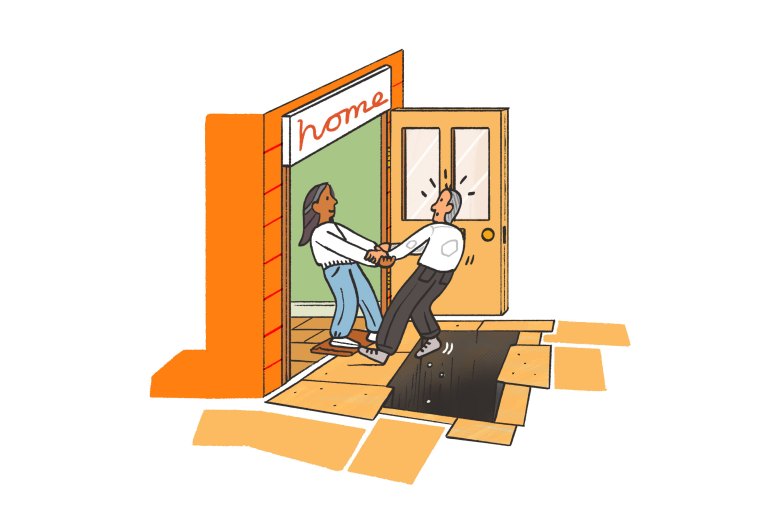
San Diego’s homelessness crisis has spiked over the past decade as hundreds of San Diegans lose their homes each month. The region could step up preventive measures over the next two decades and significantly reduce that suffering.
What the region likely can’t do: fully stem the tide of people falling into homelessness without drastic changes to the housing market and federal policies outside the bounds of local control.
The past several years, the city and county of San Diego have ramped up programs that offer subsidies to keep people from losing their homes, collectively serving hundreds of seniors and families each year.
These programs, for example, might pay landlords $500 a month to keep a vulnerable tenant in their rental and also support that resident with case management and referrals to other programs.
In the process, officials and researchers have gotten a better handle on how prevention programs work and what they cost. Yet, for most of the last three years, the number of newly homeless San Diegans has eclipsed the number of newly housed ones.

To change that trend and visibly reduce homelessness, San Diego would need to keep hundreds more people from falling into homelessness each year. Experts agree that San Diego could do that – with more money and analysis that helps the region target that money to those most in need.
The Housing Commission projects that it would cost about $12.8 million a year to help city residents who might otherwise become homeless for the first time avoid that outcome. This total includes both financial support and services.
The team behind the city’s homelessness plan, which was updated in 2023, estimated at the time that the city could help a third of newly homeless people avoid homelessness with prevention, which translated to about 1,425 people and 60 families.
In the past couple years, public support for prevention programs – including among politicians and philanthropists – has spiked.
The funding for those programs, however, hasn’t kept up.
The city’s existing homelessness prevention programs served 740 people and families last year, far shy of what was recommended in the city’s homelessness plan.
“I think the political will is very high, but the financial resources aren’t there yet,” Housing Commission Senior Vice President Casey Snell said.
Most traditional government funding for homelessness programs don’t support prevention ones due to longstanding policies so city and county leaders have looked to philanthropists to help.
The county is doing a deep dive into the results of a county program serving seniors on the brink of homelessness with an eye toward increasing political will and philanthropic support.
The program focused on low-income seniors provides $500 a month in rental assistance for 18 months and the county estimates it would cost about $3 million annually to continue.
Spencer Katz, a spokesperson for County Board Chair Terra Lawson-Remer, said county officials are studying how its 382 participants fared compared with a random group of applicants who didn’t get subsidies. They are especially focused on whether those who got aid maintained stable housing at higher rate the year after they stopped receiving them.

Katz said Lawson-Remer pushed the study with the hope the results will build support to expand the program. After all, he said, about 2,400 households expressed interest in the program – far more than the 382 who got into it.
“The theory of change here is that we have to be able to demonstrate to potential funders and taxpayers that these are effective solutions,” Katz said.
The results could also guide potential adjustments to the program.
Regional Task Force on Homelessness CEO Tamera Kohler, whose organization’s monthly reports have highlighted the monthly flow of San Diegans into homeless services, thinks technological advances now and over the next 20 years could supercharge prevention efforts.
A key challenge with existing prevention programs is that it can be difficult to predict who is most in need. Some who seek prevention funds might stabilize on their own while others in dire need might never tap in.
Liz Drapa of the Corporation for Supportive Housing, who worked on the city’s homelessness plan, said that’s just one dynamic that makes prevention – and meeting the need for it – especially tricky.
“How do you target it? How much actually helps someone get back to a stable landing?” Drapa wrote in an email. “How flexible can the prevention be and what are the market forces that impact how much you need — increasing rents, lack of access to services, health care access, etcetera?”
Drapa argued that resolving these questions and right-sizing prevention and diversion services that help people avoid the homeless service system can help ensure people don’t get stuck waiting for housing in shelters and allow regions to better calibrate the number of shelter beds they provide.
More communities are trying to better target and tailor their resources for all of those reasons.
For example, the California Policy Lab has teamed with Los Angeles County on predictive modeling to identify Angelenos most at risk of homelessness. This approach helps that county’s prevention team target its services to people who aren’t linked with homeless services and prioritize who is most in need.
Kohler argued that artificial intelligence could supercharge predictive modeling efforts like the Los Angeles one to make prevention programs in San Diego more effective – and more likely to reach people who would otherwise fall through the cracks and into homelessness.
She noted a 2019 2-1-1 San Diego report that showed why more targeted assistance can be important. The study found that just over a quarter of people who reached out to 2-1-1 reporting housing instability were homeless four months later – and that certain characteristics including unemployment and a high school education were correlated with an increased likelihood of homelessness.
Kohler said the San Diego region could “aggressively use AI” to explore these and other dynamics that increase a person’s likelihood of homelessness. Doing so could help San Diego cut through bias and data-sharing concerns that have long plagued the service system.
“I do believe that reducing the trauma of homelessness by focusing on prevention in a targeted way could have substantial impact,” Kohler said. “We just have not had the tools to know what we’re targeting.”
But Kohler emphasized that prevention programs likely can’t address the root of the state’s homelessness crisis – even with 20 years of innovations.
“Our greatest prevention is having more housing stock and will always be,” Kohler said.
Dr. Margot Kushel of UC San Francisco, who led a groundbreaking survey of California’s homeless population, agreed.
Kushel said dramatically attacking the problem would mean dramatically reducing the housing cost burdens and easing access to housing subsidies and social services that lessen the burden on low-income Californians.
“A program is really important but scale is actually decreasing rental prices at the low end so people aren’t on the edge all the time,” Kushel said.
Aug. 21 correction: An earlier version of this post misstated the scope of the county’s study of its prevention program. The county is assessing how all its 382 prevention program participants fared and comparing their experience with a control group of people who applied but didn’t get the subsidy.
I agree!!! Prevention is the most effective and least expensive way to make an impact on the number of homeless. To use the example in the article, a $500 per month rental subsidy would keep a family of 4 in their apartment when they have trouble making rent. That is $6000 per year. One trip to the ER for a street homeless person could easily be $20,000. That is over a 300% savings, I’ll make that investment all day every day.
In an era of deficits and budget cut backs we need to put our efforts and money in areas where they have the most impact. Prevention is one of the best areas; chasing the homeless around the streets, freeways, river beds throughout the county is NOT.
As always, you are believing the oversimplified BS that is thrown around. Get a grip. Those of us with our heads outside of our sphincters know that if you resolve the laziness, mental illness and drug problems that are rampant among most of the homeless then the rest will fall into place. The small number of homeless people who have genuinely fallen on hard times don’t stay homeless for long and they take care of themselves eventually, sometimes with a boost from a poverty pimp like Father Joe’s.
For quite a few years, drugs wwere the scourge of downtown San Diego. Although it is definitely still an issue, much less so. The obvious issue with the homeless downtown today in 2025 is mental incapacity.
There is one single major mental health facility “in all of Southern California”! Patton in San Bernadino. Back on the east coast, there can be multiple for just one city. Why is there only one? The obvious answer is that no one wants to pay for it. But you have to ask, if this is the wealthiest state in the country, also with the highest taxes, where is all the money going?
Pensions and government beuracracy. I would really like to have a pension but that is not offered anyhwere in the public world. Why not? Because they dont work fiscally!
State and local beuracracy need to be reformed. The agencies need to be shrunk and made more efficient. It is regulation on top of regulation and it is obvious. The local politicians wont stop this becuase – they want their pesnions too!
Once this finally gets figured out, there will be plenty of money to build large, humane, mental health facilities. Until then, expect more of the same.
Mike, I am interested in what you are saying about the major, major difference in scope of public psychiatric hospitals between the East and West Coast. Would you consider looking into the reasons and writing more about this? This is a topic that never seems to get discussed in California. And I think it should be.
Don’t count on that Mike fraud to give you any meaningful information. He’s not an expert and he’s just blowing hot air.
If you think mental illness is the main problem with the bums, especially in downtown, then you don’t have your eyes open. All you have to do is spend some time downtown and watch a group of bums for more than an hour. Eventually the pipes, the foil and the lighters all come out.
For more than ten years now, Halverstadt has been shilling for the homeless-industrial complex.
In 2015, she told my neighbors she was going to “end homelessness now.” How’s that working out?
It never stops, she never learns.
Shame on this person for calling herself a “journalist.”
All of the poverty pimps like Father Joes and Alpha Project need “journalists” to keep their paychecks coming. This won’t end any time soon.
Thanks for weighing in, Petey. For the record, I don’t ever recall committing to “end homelessness now” and would be interested in hearing exactly where I apparently said that. Perhaps there was a misunderstanding. I’d agree that that isn’t the sort of statement a journalist is qualified to make. What I’ve endeavored to do for years is to report on our homelessness crisis equipped with the idealism to believe that we can do better. Along the way, my investigative reporting has at times frustrated leaders at the city, county and homeless-serving nonprofits so I’m also not sure it’s accurate to say I am a shill for the homelessness industrial complex.
Sherman Heights Community Center
Your exact quote: “I am going to end homelessness now.”
Remember?
how about simple accountability for 80% of the homeless people (Veterans who are homeless and disabled mentally or physically excepted and SHOULD be helped) who are just lazy entitled drunks and drug addicts without the least bit of inclination to obtain a job and contribute to Society.. many homeless people love to claim they are “Victims” but if you are trashing our neighborhoods and brazenly shoplifting you aren’t a “VICTIM” just a vile shiftless slob without any pride in yourself