
From immigration to AI regulation, the Legislature addressed an array of hot-button issues ahead of a key Friday deadline.
That included advancing a bill to make it harder for federal immigration agents to operate in California and another to strengthen privacy protections for immigrant service providers.
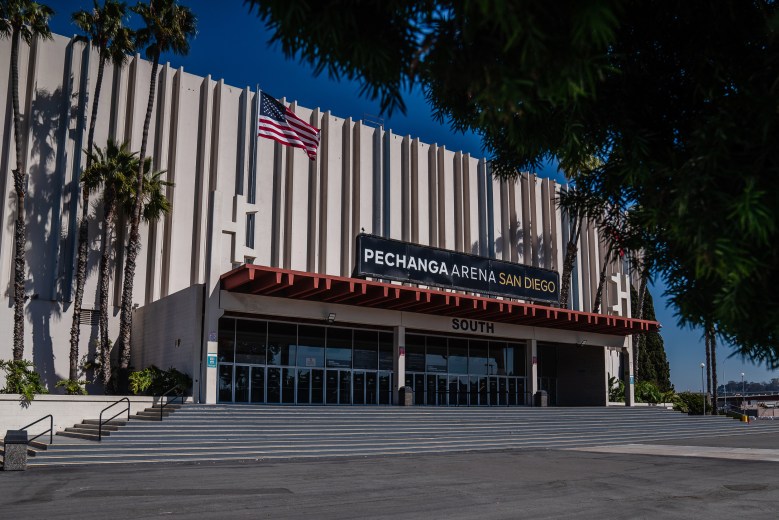
In San Diego, it meant pushing plans to make it easier for developers to build a downtown sports arena and another to make it easier for people with severe mental illnesses into conservatorships.
Here are some of the biggest developments for San Diego out of the Capitol this week.
Midway Rising Project Gets ‘OK’ from Senate
Environmental groups and activists have paid little attention to a city-backed bill to cut green tape from planned construction of a stadium in San Diego’s Midway District.
That trend continued this week as the bill cleared its biggest hurdle yet to mere buzzes and murmurs on the Senate floor.
Senate Bill 958, authored by Senator Akilah Weber Pierson, would allow the city to circumvent the district’s zoning laws to build the 165-foot-tall arena.
Although voters approved two ballot measures to lift the neighborhood’s 30-foot limit on building heights, a January state Supreme Court ruling overturned the measures, saying voters weren’t fully informed about how taller buildings could affect noise levels, air quality and nearby wildlife.
SB 958 says a building’s height doesn’t have a big impact on the environment, which would allow the project to override the court ruling.
An earlier version sought to exempt the entire project from review under the California Environmental Quality Act, which requires any new development to be studied for its potential effect on the environment. Last year, California lawmakers approved exempting most new housing from CEQA, which can lead to costly, yearslong construction delays for developers to be in compliance with the law. Lobbyists and bill consultants say SB 958 would similarly make it easier for developers to build by not letting environmental rules get in the way of building height.
“The goal is to allow for development to happen in California without having these things that you can’t even test for,” Weber Pierson said of environmental rules requiring developers to study a project’s environmental impacts decades into the future. “I can’t predict what kind of potential wildlife might come in 10, 15 years, which was part of the ruling. And nor should that be a part of anything else in the future if you’re dealing with height.”
The California Conference of Carpenters union, which supports the bill, is an influential force in the state’s housing and development politics, and is one of the main interest groups lawmakers are working with on SB 958.
The United Brotherhood of Carpenters and Joiners of America, the national umbrella that includes the California conference, gave at least $28,800 in campaign contributions to Weber Pierson from 2021 to 2024, according to CalMatters’ Digital Democracy database.
One local environmental group has been at the center of opposition to the project and remains its biggest critic.
Save Our Access, a nonprofit dedicated to coastal protection, sued the city after the 2022 ballot measure passed, arguing that it failed to study all the environmental impacts from height increases. It opposes SB 958.
Otherwise, city and state officials adamant about getting the 16,000-seat arena up have faced little criticism.
The legislation passed with bipartisan support in the Senate. Two Republicans — Sen. Megan Dahle of Redding and Sen. Roger Niello of Roseville — did not vote, as well as Long Beach Democratic Sen. Lena Gonzalez. It awaits a floor vote in the Assembly.
CARE Court Changes Advance
Despite the county being an early adopter, a 2022 program to help get the state’s most severely mentally ill off the streets and into treatment has largely been ineffective in San Diego and elsewhere.
In the years since Gov. Gavin Newsom’s CARE Court rolled out, which allows families to volunteer a loved one to receive mental health services, local officials have claimed it doesn’t do enough to help those with the most severe mental illnesses. Those people often don’t want treatment, they say, which leaves counties with few options but to release people back onto the streets.
Mayor Todd Gloria has lobbied for bills in the past that would make it easier to force people into treatment.
An oft-given solution is to allow family members or court-appointed officials to handle the life and treatment decisions of an individual in what’s called a conservatorship.
This year, San Diego-area Democrat Catherine Blakespear is pushing Senate Bill 1016, which would allow judges to order mental health evaluations of people who are unwilling to participate in CARE Court or struggle in the program. Senate Bill 989 would make it easier to file CARE petitions.
The proposals have reignited a debate about how or when to force people into involuntary treatment. Many families and advocates see the bills as a lifeline to getting more people into the program.
Democrats are split.
Weber Pierson and Chula Vista Sen. Steve Padilla did not vote for SB 1016, a tactic lawmakers often use to avoid voting against bills they don’t support.
Weber Pierson said there’s not enough evidence the current program isn’t working and that any new changes would be burdensome for counties to implement. Padilla refused to explain why he doesn’t support the bill.
Races to Watch
With the primary election on Tuesday, some Republicans are worried that intra-party fighting will get in the way of the party’s chances of re-electing a Republican in the Escondido state Senate district currently represented by Brian Jones.
Earlier this month, the state Republican Party sent a cease-and-desist letter to Assemblymember Carl DeMaio for using official party branding on mailers for his political group, Reform California.
The condemnation came, in part, due to heightened frustration that DeMaio was misrepresenting who the party endorsed, according to former San Diego County GOP Chair Corey Gustafson. Most traditional Republicans are supporting San Marcos City Councilmember Ed Musgrove for the state Senate district. DeMaio’s group, Reform California, is supporting Kristie Bruce-Lane. Musgrove is seen as more electable in the competitive district, Gustafson said.
What I’m Reading Now
Chevron remains at the center of California politics as the state works to transition away from fossil fuels, Grist reports.
San Diego County begins public feedback on its $9 billion proposed budget, from KPBS.
After endless twists and turns, many voters are still unsure who to support for governor and are holding onto their ballots, the Associated Press reports.

“Many families and advocates see the bills as a lifeline to getting more people into the program.”
As a family member with someone with a severe SMI.
THIS IS COMPLETE LIE AND THE SYSTEM CONTINUES TO MISTREAT AND NEGLECT PEOPLE WHO HAVE VERY SERIOUS MENTAL HEALTH CONDITIONS
AND THEY WANT TO ADD A FEW HUNDRED THOUSAND PATIENTS WHEN THEY COULDN’T EVEN BE TRUSTED WHERE IT COUNTED THE MOST
AND TREAT THE SITUATION AS A NORMAL MENTAL HEALTH CONDITIONS
MONEY GRABBING FRAUDSTERS