
This post has been updated.
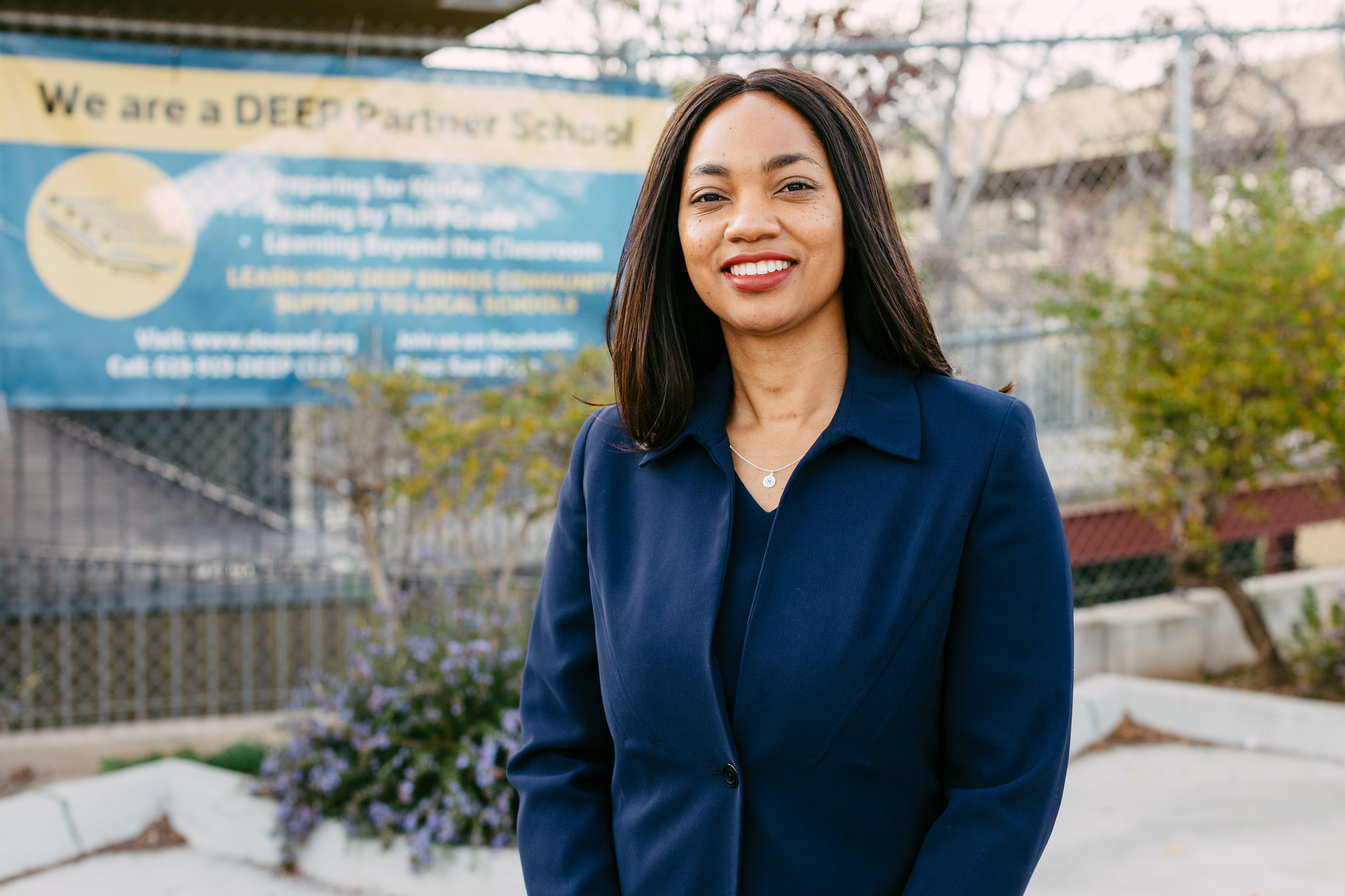
San Diego-area state Sen. Akilah Weber Pierson wants to assign California educators some new homework: screening kids for math competency.
A new bill authored by Weber would require schools to perform math testing for students in kindergarten, first or second grade. It would also require educators to offer extra support to students whose math skills are behind where they should be.
A number of safeguards to more narrowly focus the screenings are also written into the bill. Those include the stipulation that scores could not be used to evaluate teachers or identify students for gifted programs. Students’ math skills are already tested in third grade. But in pitching the bill, Weber Pierson argued that disparities begin even earlier than that.
“By that time, many students who are struggling with foundational math skills have already fallen behind,” Weber Pierson said.
The effort is aimed at evening the incredibly uneven playing field of early childhood education. Some kids who enter the public school system may have already had years of more focused math education. Many of those who start behind, stay behind.
“Unless those students get intervention, the gap will widen. It’ll be harder for them to access higher-level math classes later on, and this will have implications for future job opportunities and the economic future of California. It’s a continual closing of opportunities,” Alice Klein, the research director at WestEd told CalMatters.
But like the reading curriculum reforms signed into law by Governor Gavin Newsom late last year, the new math framework could face some stiff opposition. That signing capped years of a contentious back and forth debate in Sacramento during which multiple bills aimed at changing how we teach kids to read crumble under pressure.
Like some of those earlier literacy bills, the powerful California Teachers Association opposes Weber Pierson’s math bill. In their telling, lawmakers should wait to see how the state’s new math framework impacts student achievement. They also argue that without additional funding to support students who are behind, a screener won’t do much.
In any case, both the literacy bill and this latest math bill are responding to real deficiencies. Statewide, California students still haven’t made up pandemic-era losses in student performance. Only a little more than a third of students met math standards in statewide tests. That number is even lower for Black and Latino students.
Nationwide, the state’s fourth graders were tied for sixth lowest in math proficiency according to 2024’s NAEP tests. In reading, the state’s fourth graders tied for eighth lowest.
“It’s frustrating for people who have worked in the education space and for those who have been looking at these numbers for decades — a generation — and seeing that, as a state, we have not prioritized education,” Weber Pierson told California Black Media at a recent press conference. “But I am grateful that we are taking steps to fix it.”
San Diego Unified’s New Motivation Meter Shows Modest Gains, Big Gaps
As San Diego Unified continues to embark into the unknown in its attempts to measure student wellness, district officials on Tuesday presented the second results of a survey intended to measure student motivation.
The survey measured a handful of school-related factors. Those included things like how safe kids feel at school and how good their relationships with teachers are. It also asked about more personal attributes, like whether students demonstrate things like grit or a growth mindset.
The results showed modest district-wide gains across almost all of the domains, with students’ ability to manage stress and calm themselves seeing the highest increase. Still, the percentage of kids who answered positively in each of the categories lingered in the 50s and 60s.
More worryingly, though, Black, Latino and English learner students saw marked decreases across almost all categories surveyed. At Trustee Shana Hazan’s prompting, district officials said they would come back with strategies to turn that trend around.
Along with the standard survey, the district collected recorded testimonies from students. Officials then turned to a new tool in the district’s toolkit to make sense of the voice recordings at scale. The AI-powered program, called Impacter Pathway, analyzes student responses to prompts and identifies attributes, characteristics or trends that may have been expressed, but not stated outright.
District data guru Roman del Rosario and Area Superintendent Erin Richison walked board members and attendees through the system’s analysis of one boy’s statement. In the statement, the boy said he came from a family that had struggled and that he wanted to succeed to prove himself. To do that, he sometimes takes on challenges he knows may be too big for him. The program identified the statement as expressing grit and a desire to be pushed.
It was an interesting exhibition that clearly resonated with board members, for whom finding ways to divine data from the squishiness of wellness monitoring has been a primary challenge.
Trustee Cody Petterson acknowledged there will likely be concerns about student privacy, and admitted to being icked out by the prospect of AI in this context. Still, he said he was “deeply moved.”
“I always go back to three years ago when we started this process and our consultant said ‘Hey, you really shouldn’t do this, no one in the country is doing this, we don’t have metrics yet,’” Petterson recalled. “You are creating the tools to hold ourselves accountable to creating this space of wellness.”
Pooch Poo Soils School Fields; Budget Cuts Curtail Caca Cops
San Diego Unified’s long-running joint-use program has opened up school facilities all over the district to the public. One of the most popular examples has been the district opening fields to community members after school hours.
But the program hasn’t been all sunshine and roses. It’s also featured some holes and a whole lot of poop, courtesy of community members who let their pooches roam the fields off leash and don’t pick up after them. The problem got so bad at some joint-use fields that kids were tumbling into doggy-dug holes and doggy-dealt doodoo. The district even closed some joint-use fields to the public to curb the crappy behavior.
Now, citywide budget cuts are taking a bite out of what little enforcement existed.
The city of San Diego used to contract with the Humane Society to patrol the parks, but that partnership ended last year. Officials confirmed to Axios their officers no longer responded to calls reporting off leash dogs at local school fields. And while the city is adding stickers at some school fields directing residents to report bad behavior on the Get it Done app, there’s still no function that allows such reports.
Related: A new analysis from Mayor Todd Gloria’s office projects that the city will need to make deep cuts to its libraries and rec centers to fill its yawning deficit. The cuts, which will include significant reduction in hours and potential closures, would amount to nearly $8 million in savings. The current deficit stands at nearly $150 million.
One More Thing: Just FYI, San Diego Unified’s Board Opposes Iran War
In case you were wondering, San Diego Unified trustees are against the Iran war.
The board voted 4-1 on Tuesday night to pass a resolution, authored by Petterson and Trustee Richard Barrera, that condemned the American- and Israeli-led conflict. Trustee Shana Hazan was the sole “no” vote, saying from the dais she felt the district should focus its advocacy on things more directly related to its students, like school funding.
The resolution – which decried the war’s negative impact on civilians and children in the Middle East, the worldwide economy, local military families and democratic norms – also called on local congressional representative to do everything in their power to bring an end to the war.
Even AI caught some fire, with the trustees writing: “The use of AI in the targeting of munitions – and the corresponding reduction of human oversight, judgment, and decision-making in the ‘kill chain’ – has introduced profound and unlegislated risks to civilian populations and, in particular, children.”
During an emotional speech from the dais, Petterson, the self-professed John Boehner (another frequent crier) of the district’s board, tearfully spoke about his anti-war convictions. To Petterson, a straight line could be traced from the “forever wars” in Iraq and Afghanistan, which he said have contributed to the slow decline of America’s prosperity and opportunity, to the war in Iran.
“I oppose all wars of aggression,” Petterson said. “I am a secular person, but I was raised in the church and in spite of no longer being a believer, per se, God is still watching.”
Correction: This post has been updated to correct that Akilah Weber Pierson is a state senator.
The last thing the teacher’s union(s) want is data about the performance of the education system. After all, the union(s) always want more money with no expectation of improved performance, only more union dues paid.