
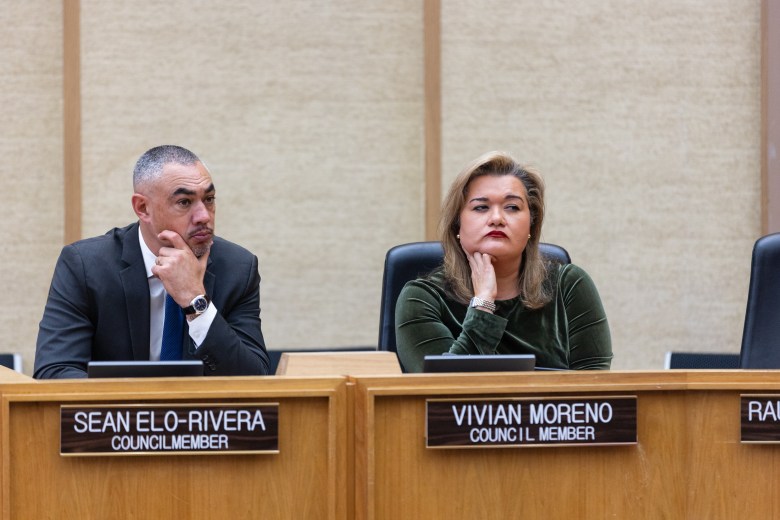
The City Council on Monday rejected a deal that would have stopped the effort to repeal the trash fee by lowering it. If the trash repeal fee repeal is successful, it will crater the city’s finances.
The deal on the table would have rolled back the fee to $29 per month from its current high-end range of $43 per month.
“It was a good deal that allowed the city to keep a chunk of the money,” former City Attorney Mike Aguirre, who is representing residents suing over the trash fee. “By not willing to compromise, [the Council] may have set it up where they create an existential hit on the budget.”
Councilmember Sean Elo-Rivera didn’t comment on the specifics of the vote, which was held in closed session. But he panned the repeal effort, calling those behind it “civic arsonists.”
“The same group that has spent years defending the rich and powerful at the expense of everyday San Diegans is now working to blow a more than $120 million annual hole in the city’s budget. That would mean massive layoffs across every city department,” Elo-Rivera wrote.
Environment Report: We (Almost) Tried Plug-in Solar
We attempted to try balcony solar. Here’s what happened.
Several weeks ago, our MacKenzie Elmer wrote about a proposed bill by Democratic State Sen. Scott Weiner that would allow San Diegans to use so-called “balcony” solar to generate power. Balcony solar is a plug-in solar panel that goes on your balcony, allowing renters who don’t own their roof to generate power.
Elmer got her hands on one of those plug-in solar panels, but she never actually got to test it out. That’s because it’s illegal, according to the California Public Utilities Commission.
The Commission has something called Rule 21, which regulates privately owned energy-generating resources like solar panels. And it requires people to pay fees, submit applications, acquire permits and more before plugging in anything that could generate power … or else.
Read the Environment Report here.
The $100 Million Question at the Housing Commission
At his final meeting as a San Diego Housing Commissioner, Ryan Clumpner didn’t just say goodbye, he posed a massive “what if” question to senior staff.
If the agency had an extra $100 million a year with zero federal or state strings attached, what would they actually do with it?
The question came from Clumpner’s growing frustration with decades-old housing programs like Section 8. While they are the biggest tools available, he argued they are “more or less unchanged” and fundamentally outdated.
Four senior staff members answered the question, focusing on flexibility, early intervention and long-term support:
- Casey Snell proposed “permanent shallow subsidies” for seniors and families with disabilities. These wouldn’t have a time limit, because for those in the lowest income brackets, “the runway is really difficult for them … they’re never going to catch up to market rate.”
- Azucena Valladolid suggested flat subsidies for aging populations and families with young children to help them move into “areas of opportunity” where they can access better resources and education. She also pushed for more mixed-income properties to help families break the poverty cycle.
- Christelle Van Der Windt focused on supply, arguing the city needs more low-rent units so people can “rely less on subsidy.” Income from those rental properties could then be reinvested in other programs, she said.
- Debra Fischle-Faulk highlighted the “stably housed” people who are one medical bill or job loss away from the streets. “I don’t want us to forget those people… that could turn into a whole cycle where they end up being evicted.”
Clumpner noted that no one suggested putting that $100 million into the traditional programs we use today, like Section 8.
“I think that’s just a reflection of how out of date those policies have become,” Clumpner said. “They’re so limited in their ability to address the problems we have in 2026 and to adapt to the changing environment.”
DA, Sheriff and Recorder-Clerk Back Rival County Reform Pitch
Three countywide elected officials are endorsing County Supervisor Joel Anderson’s competing governance reform measure.
Anderson announced Monday that Sheriff Kelly Martinez, District Attorney Summer Stephan and Assessor-Recorder-County Clerk Jordan Marks are backing his proposed reform measure over Board Chair Terra Lawson-Remer’s proposal. They argue that Lawson-Remer’s measure appears to set term limits for their posts if approved by voters in November. Yet those term limits can’t be added without changes to state law.
Anderson’s reform measure deletes language giving county supervisors including Lawson-Remer a potential third term and suggesting that identical term limits could be set for countywide elected posts, among other changes.
Now the three countywide elected officials have put their thumb on the scale ahead of May 19 board votes on which proposal to send to voters.
“Supervisor Anderson’s proposal strikes the right balance: it respects the authority already established in the state constitution for independently elected officials including the sheriff, district attorney, and assessor‑recorder‑county clerk, while ensuring that political considerations do not overstep into county operations and good governance,” Martinez wrote in a statement.
Lawson-Remer argued that Anderson’s proposal guts reforms she crafted with a broad coalition to make county government more responsive. Her office also argued voters should get a chance to say whether countywide elected officials should “eventually follow the same 12-year term-limit standards as other county elected officials, once state law permits.”
“These amendments keep the title of reform, but hollow out many of the parts that would actually make government answer to the public,” Lawson-Remer wrote in a statement.
Keep It Cozy Through May Gray
Our gray Voice of San Diego merchandise features cozy pieces made for cool mornings, cloudy afternoons and layering through May Gray season. Comfy, classic and designed to show your support for local journalism wherever you go.
Shop the May Gray collection today.
In Other News
- San Diego Mayor Todd Gloria signed an agreement Monday with the San Diego Community College District to begin evaluating a possible redevelopment of San Diego’s aging Golden Hall venue and replacing it with a museum, educational building and, potentially, student housing. (Union-Tribune)
- San Diego leaders will consider ways to make the city’s street paving program more equitable after streets in lower income neighborhoods were neglected in favor of streets in wealthier neighborhoods during the program’s first couple of years. (KPBS)
- Two members of San Diego County’s congressional delegation, Rep. Mike Levin and Rep. Sara Jacobs, made another surprise visit to the Otay Mesa Detention Center on Monday, their first visit back since they were denied entrance into the facility the first time. Although they were let in, ICE officials told them they now have to identify the immigrants they want to speak to two days before visiting. (inewsource).
The same group that has spent years defending the rich and powerful at the expense of everyday San Diegans is now working to blow a more than $120 million annual hole in the city’s budget.
What is this victim gibberish from Elo? The city shift of 360 positions and 140M in costs, much to do with replacing already good trash bins, is the elephant in the room. The city knew with their failed sales tax they were pushing costs up and this is their cover. Open the books and make these people testify.
“Keep It Cozy Through May Gray”
no, no, no: it’s ‘June gloom’ but ‘gray May’!!
(it’s a different part of speech: gloom is a noun but gray is used as an adjective describing the month.)