
Just a few months ago, Chula Vista leaders seemed almost in competition with one another to heap praise on their city’s police chief.
Discussing a unanimous Jan. 20 vote to raise police officers’ salaries, members of the Chula Vista City Council grew emotional lauding officers’ close ties to the community and crime-fighting success.
Councilmember Carolina Chavez singled out Police Chief Roxana Kennedy, quoting one of the chief’s oft-repeated refrains: “There’s a heart behind the badge.”
“Thank you for all you do for us,” Chavez said of Chula Vista’s cops. “We’re always going to support you.”
Three days later, Kennedy, a lifelong Chula Vista police officer who became the city’s first female chief in 2016, abruptly went out on medical leave.
Two months later, she filed multiple claims against the city, alleging those same city councilmembers were conspiring to oust her. Last month, she took her case to court.
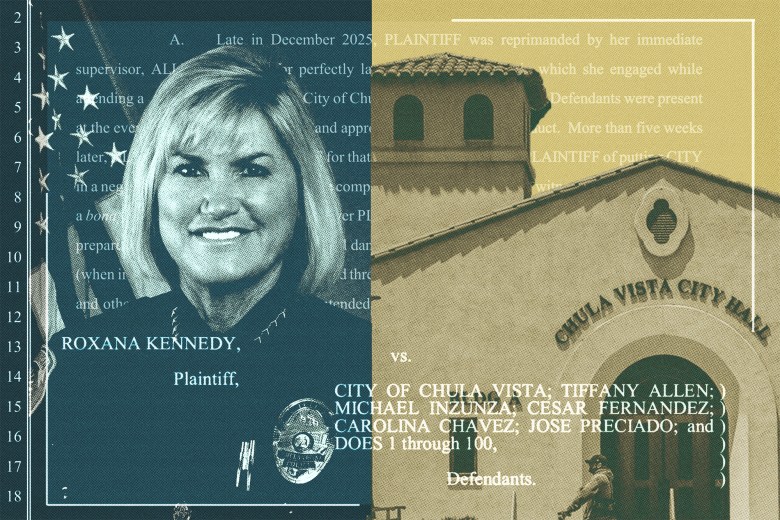
In a May 12 lawsuit, Kennedy, who is White, accused city leaders of secretly plotting to make her workplace conditions so miserable, she would leave so they could replace her with a younger, Latino police chief.
Kennedy “loves her job and the community she serves,” the lawsuit said. “But the illegal pressure put on her by [the] city is excruciating.”
The sudden departure of a popular and well-regarded police chief has thrown City Hall into turmoil. Prominent community members accuse city leaders of managerial malpractice. Officials have scrambled to contain the fallout. City Council meetings have turned tense as supporters of the chief, including San Diego County District Attorney Summer Stephan, rally to criticize the city’s conduct.
Everyone in Chula Vista seems to have a theory about Kennedy’s last days on the job. No one seems to know what really happened.
Voice of San Diego talked with multiple sources in and outside of Chula Vista and reviewed emails, text messages and other documents related to Kennedy’s departure from the city.
The forces that drove a wedge between Chula Vista and its veteran police chief turn out to be more complicated, and stranger, than anyone has expressed in public so far.
Here’s what the available evidence shows.
A Lauded Career
Kennedy joined Chula Vista’s Police Department as a rookie officer in 1992. She rose to become captain in 2013 and chief three years later. She was the department’s first female lieutenant, captain and chief.
Under her leadership, the department weathered Covid lockdowns, post-George Floyd tensions over policing and the ups and downs of city budgeting.
Kennedy won praise as an early adopter of law enforcement technology, including sending drones on emergency calls and using AI to help officers write reports.
City officials often boast Chula Vista is the safest city of its size in California. According to FBI statistics, crime in Chula Vista has declined in recent years. But the city does not obviously stand out compared to its peers. Its violent crime rate is lower than some comparably sized cities’ but higher than others’.
Still, Kennedy was broadly respected in Chula Vista and in the community of law enforcement professionals. In recent years, she had mused about retiring and spoke of positioning a promising younger officer to succeed her.
Late last year, as the 10th anniversary of her tenure as chief approached, Kennedy appeared at a career high point. Whenever she ultimately chose to retire, she could have done so to widespread acclaim.
Holiday Party Dance-Off
On Dec. 13, the Chula Vista Police Officers Association, the labor union representing the city’s police officers, held its annual holiday party at a waterfront hotel in San Diego.
The party is a popular event on the city’s holiday calendar. Much of the police department’s rank-and-file attends, along with department leaders, top city officials and retired officers. There is food, dancing, a fundraising raffle and, in recent years, a no-stakes casino night.
Midway through the party, it came time to raffle off two giant-screen TVs. Audience members seated around dinner tables encouraged the two officers who won the TVs to engage in a mock dance-off. With music blaring, the officers boogied down to the delight of the crowd.
Kennedy was seated at a table with Chula Vista City Manager Tiffany Allen, Assistant City Manager Courtney Chase, Director of Human Resources Tanya Tomlinson and City Councilmember Cesar Fernandez.
In the middle of the dance-off, Kennedy got up, sashayed onto the dance floor and came face to face with one of the dancing police officers. Caught up in the spirit of the moment, the officer had taken off his shirt and was waving it around.
Dancing along with the officer, Kennedy pulled out a pair of dollar bills and stuffed them into his trouser pockets. She turned, bowed and walked back to her table. The crowd roared with approval – including, according to Kennedy’s lawyer, Allen and some other city leaders present at the party.
Despite the crowd’s audible delight, Fernandez, in a recent interview, recalled feeling awkward.
“I was surprised the chief would participate like that,” he said. “It’s something I wouldn’t have done…When you’re the police chief, you can’t take the hat off.”
Fernandez said Kennedy herself seemed to recognize the moment might be open to misinterpretation.
“She started explaining herself and said, ‘That’s no big deal, I’ve known him since he was a kid,’” Fernandez recalled. “I was like, okay.”
Moments later, the dance contest ended, tables cleared and attendants began bringing out gambling equipment. Fernandez said he looked around and realized most other city officials in attendance had left following the dancing.
“That was different from the previous year,” he said. “Last year, we stayed the duration of the event…I took that as my cue that I should get out of there.”
‘Multiple Complaints’
The holidays came and went. City staff busied themselves preparing to take the proposed pay raise for Chula Vista police officers to the City Council. The Police Officers Association party faded into the background.
On Tuesday, Jan. 20 – the same day the City Council was scheduled to vote on police raises – Kennedy arrived for her weekly meeting with City Manager Allen. Unusually, the city’s human resources director, Tanya Tomlinson, was present.
According to Kennedy’s lawsuit, Allen told Kennedy that Kennedy’s conduct at the holiday party had elicited “multiple complaints” and cast the “city in a negative light.”
Allen told Kennedy she needed to “prepare a written plan to correct the alleged damage,” the lawsuit said.
According to city spokesperson John Cihomsky, Allen also reminded Kennedy of an upcoming audit of the police department. Cihomsky said the audit dealt with an unrelated issue that had arisen the previous year and had nothing to do with the Dec. 13 holiday party.
Cihomsky declined to specify the focus of the audit. He said Allen first discussed it with Kennedy at an earlier meeting on Dec. 2.
Roxana Kennedy’s attorney, Cory Briggs, said Allen’s demand for a remedial action plan took Kennedy by surprise.
Up to that point, he said, Kennedy had received “nothing but praise from the elected officials. The city manager has never done this before. This is all weird.”
Allen declined to comment, citing pending litigation.
Kennedy, through Briggs, initially agreed to an interview with Voice of San Diego. The day before the interview, Briggs canceled for scheduling reasons then canceled a follow-up interview one week later. Kennedy did not respond to a list of questions sent by email.
A Voice from the Past
The meeting with Allen was not the only unusual event for Kennedy that month. Six days before she walked into Allen’s office, Kennedy received an email from a person she had not interacted with in more than 30 years.
“Dear Roxana, I hope this message finds you well,” wrote a woman named Shawn Shuman. “Writing this has taken a lot of courage for me, and I hope you can appreciate that. For decades, I’ve lived in the shadows of what you and your ex-husband did to me, and I want to take a moment to share my story.”
Shuman, 49, is a small business owner living in Atlanta. In the early 1990s, she was a teenager in El Cajon, where her mother worked as a clerk in the El Cajon Police Department. Shuman, who was 16 at the time, occasionally babysat for Roxana Kennedy and her husband, Michael Kennedy, who was an El Cajon police officer.
According to court records, in 1994, Michael Kennedy pleaded guilty to statutorily raping Shuman shortly after she turned 16 years old.
In a June 20, 1994, indictment, prosecutors alleged Michael Kennedy had sexual intercourse with Shuman on at least four separate occasions. They charged him with eight counts of statutory rape and oral copulation of a minor. All but one of those counts was dismissed following Michael Kennedy’s guilty plea.
A friend of Michael Kennedy’s, who also was an El Cajon police officer at the time, pleaded guilty to raping one of Shuman’s friends.
In her email, Shuman recounted the fear she felt during her encounters with Michael Kennedy and the threats he used, including showing her his gun, to prevent her from telling anyone.
“To make matters worse, you [Roxana Kennedy] called me names, referring to me as a ‘slut’ and a ‘whore,’” Shuman wrote in her email. “While I don’t blame you for what [Michael Kennedy] did, I can’t help but wonder how you feel now, looking back on how you treated me. I was just a child.”
In a recent interview with Voice of San Diego, Shuman said she reached out to Roxana Kennedy in January after hearing from a friend that Kennedy had become a police chief.
Shuman said Roxana Kennedy, who had started working as a Chula Vista police officer two years earlier, attended pretrial hearings in her husband’s case with a group of El Cajon police officers.
“She was calling me names, intimidating me,” Shuman said of Kennedy’s conduct at the courthouse. “When I would take the stand, I had to walk past her…and she would say, ‘You’re a slut’ as I walked by.”
Shuman said sheriff’s deputies began escorting Shuman’s family into and out of the courtroom.
“I remember a time we were standing in the [courthouse] hallway early on, waiting to go in, and I had a support person there for me from my church,” said Theresa Moore, Shuman’s sister. “We were standing around my sister praying, and Roxana walked by and said, ‘You lying slut.’”
In her email, Shuman wrote: “I want you [Roxana Kennedy] to understand the pain your actions caused me. Your behavior impacted my life for years. I never wanted to be a victim of your ex-husband’s abuse. I was just a young girl trying to find my way in a difficult situation.”
“I don’t expect anything from you,” Shuman wrote. “But I hope that as a police chief, you advocate for young girls, believe them and help change the culture that excuses harmful behaviors. I want young female victims to feel safe coming to you, knowing they will be treated with compassion and respect.”
Shuman said she wrote to Kennedy as part of an effort to come to terms with what happened to her as a teenager.
“My letter came from a place of, ‘I hope she has evolved,’” Shuman said. “If she would have responded to me and said, ‘I’m so sorry for my behavior at that time,’ I’m a very forgiving person and I would have forgiven her.”
Shuman said she sent copies of the email to other city leaders.
Police Investigation
Two El Cajon police officers, Kevin LaChapelle and Todd Moore, investigated initial reports about Michael Kennedy’s sexual relationship with Shuman. One of those officers, La Chapelle, later published a memoir that included his recollections of the case.
In the 2006 memoir, titled “Please God, Don’t Let My Badge Tarnish,” LaChapelle wrote that, following Michael Kennedy’s indictment, a colleague of Roxana Kennedy’s at the Chula Vista Police Department appeared to try to derail the case against Michael Kennedy by sending a letter to the District Attorney’s office calling into question LaChapelle and Moore’s investigative methods.
In a copy of the letter included as an appendix in LaChapelle’s memoir, a Chula Vista Police Department sergeant enumerates a series of alleged errors in the investigation and concludes that, “As a result of using improper techniques, the truth and facts of this case may never be determined.”
“The District Attorney was stunned and faxed me a copy [of the letter], wanting me to know that they were rallying other officers on Kennedy’s behalf against me,” LaChapelle wrote in the memoir.
LaChapelle, who eventually left the El Cajon Police Department, did not respond to a request for comment.
Michael Kennedy, who left the El Cajon Police Department following his conviction, could not be reached for comment.
In a statement, Roxana Kennedy’s attorney, Briggs, said, “The chief (i) had absolutely nothing to do with her ex’s statutory rape against the young woman who had sex with him and (ii) was thereafter fully exonerated by a police investigation for everything you’re now alleging.”
Briggs did not respond to follow-up questions about the police investigation he referred to.
Kennedy filed for divorce from Michael Kennedy in 2007.
Medical Leave
It is unclear what role, if any, Shuman’s email played in Kennedy’s decision-making following her Jan. 20 meeting with Allen and Tomlinson.
Three days after that meeting – and nine days after receiving Shuman’s email – Kennedy announced she was going on medical leave for unspecified reasons.
Days later, she hired Briggs, who had sued the Chula Vista Police Department in 2021 on behalf of La Prensa publisher Art Castanares for not releasing public records. After Castanares prevailed in that case, a judge ordered the city to pay Briggs $530,000 in attorney fees.
On Jan. 29, days before Kennedy hired Briggs, Castanares posted a brief item on X claiming that Kennedy was on administrative, not medical, leave, “and will not return to work.” The post seemed to suggest Kennedy had been relieved of her duties because of a disciplinary problem.
The day after Castanares’ post, Cihomsky, the Chula Vista spokesperson, issued a statement calling the post “incorrect.”
“Chula Vista Police Chief Roxana Kennedy is currently on approved leave, not administrative leave,” Cihomsky said in the statement.
Public agencies often place employees on administrative leave when the employee faces disciplinary sanction. In a follow-up statement, Cihomsky stressed that Kennedy herself had requested to go on personal leave and had not been placed on leave by the city.
“This was not a city-directed action,” Cihomsky said.
In an interview with Voice of San Diego, Briggs further clarified that Kennedy’s medical leave was due to an unspecified health issue and was not related to the meeting with Allen.
In a statement accompanying Cihomsky’s, Kennedy added she had “made no plans for retirement. It’s unfortunate that false information was shared without anyone first reaching out to me directly. I have proudly served the Chula Vista Police Department for 33½ years, including the past nine years as Chief. My commitment to protecting the Chula Vista community, and to this department, remains strong and unwavering.”
Behind the scenes, however, Kennedy wondered whether city officials intent on sullying her reputation had planted the story that they were disciplining her.
“We started putting things together,” said Briggs.
In a follow-up story published on Feb. 6, Castanares wrote that he received the information about Kennedy’s supposed administrative leave from “several internal sources that predicted the outcome” of what Castanares described as a plot to remove Kennedy from her job.
That same day, Briggs sent a letter to Chula Vista officials demanding they preserve evidence related to what he called “allegations that the Chief has been subjected to improper discipline, retaliation, discrimination and/or a hostile work environment.”
Briggs’ letter singled out what he called “a majority of the City Council.” Briggs said the unnamed councilmembers had engaged in “subterfuge…to force the chief into an early retirement and replace her with a Latino.”
“The city concocted bogus reasons for getting rid of the chief and in the process completely sullied her reputation,” Briggs said. “That’s discrimination.”
‘Proposed Resolution’
Before Briggs sent his letter, city officials appeared to have been working toward resolving the situation with Kennedy. A former city manager, David Rowlands, had gotten involved.
In a series of text messages between Allen and Rowlands, Rowlands wrote on Feb. 3 that he had spoken with Kennedy about a “proposed resolution.”
The five-point resolution, summarized in Rowlands’ text, would have the city publicly confirm that Kennedy’s medical condition prevented her from working and agree to a “disability retirement” for Kennedy, including paying roughly $100,000 in medical disability costs. The city would announce Kennedy’s retirement and Kennedy would receive what Rowlands called “a walk-out ceremony.”
In a Feb. 6 text, Rowlands called the proposal “her 5 points,” referring to Kennedy, and said Kennedy wanted Allen to contact Kennedy’s attorney.
But the proposal apparently wasn’t acceptable to Kennedy.
“The chief never agreed to anything with this guy,” Briggs said, referring to Rowlands. “Why is he trying to negotiate some kind of deal if Tiffany [Allen] is not trying to get the chief out?”
Three days after Rowlands sent the text outlining a possible resolution, Castanares published his story about the alleged plot to oust Kennedy and Briggs sent his evidence-preservation letter.
The text exchange between Rowlands and Allen ended the same day.
Neither Castanares’ story, nor Briggs’ letter, included or linked to any evidence substantiating the claim that city officials conspired to oust Kennedy.
Nevertheless, both the story and the letter caused an immediate firestorm.
Supporters of the chief packed a Feb. 10 City Council meeting to praise Kennedy and decry what they characterized as an inexplicable and unfair effort to force her out.
“She deserves better,” said Pastor Ruben Rodriguez, president of the South Bay Clergy Association. “She was loyal and faithful to everyone here today.”
On Feb. 24, more than two dozen Kennedy supporters, including at least two candidates for City Council, protested outside City Hall then filed inside to lambaste city officials for their alleged mistreatment of the chief.
On April 21, both San Diego County District Attorney Summer Stephan and former San Diego U.S. Attorney Robert Brewer addressed the Council to praise Kennedy and urge the city to reconsider its actions.
On March 17, Kennedy filed a formal legal claim against the city, accusing city officials of retaliating against her and seeking to make “her job so unpleasant that she would resign under pressure.”
A month and a half later, Kennedy sued the city, alleging officials invaded her privacy, defamed and harassed her and inflicted emotional distress in their efforts to force her out of her job.
Internal Investigation
On April 10, the city sent Kennedy an email informing her she was under investigation for at least 21 incidents of possible workplace misconduct.
Some of the allegations in the April 10 email appeared serious, including a claim Kennedy instructed her command staff to delete text messages and emails to ensure people could not make public records requests for them.
The email also accused Kennedy of openly questioning a senior officer’s loyalty to her and ordering her command staff to create a WhatsApp group to further avoid records disclosures.
The email also said Kennedy used the word “faggot” when discussing a 2024 commemoration of slain gay rights activist Harvey Milk.
Other accusations seemed less serious. The email said Kennedy described one Chula Vista police officer as having a “Dad bod” and poked fun at another officer’s generous use of personal leave time by displaying a cutout of the officer at a meeting during his absence.
Other accusations lend substance to rumors that relations between Allen and Kennedy were already tense before the Dec. 13 holiday party.
The email said Kennedy sometimes referred to Allen and her staff as “mean girls” and, on one occasion, asked, “Why would anyone want to work with anyone in the City Manager’s office because the people in that office are not even Christians, they’re liberals who hate Christians?”
Ongoing Controversy
Kennedy’s supporters continue to speak at City Council meetings. Tensions over the chief’s situation have divided councilmembers and spilled into the city’s mayoral campaign.
Mayor John McCann and most members of the City Council declined to comment on Kennedy’s dispute with the city.
In late April, Dan Stanford, a San Diego attorney who had served on the Chula Vista Police Foundation board of directors, resigned from the board in protest of what he called the city’s “unethical and perhaps illegal” treatment of Kennedy.
In a blistering resignation letter, Stanford singled out Allen’s treatment of Kennedy and said he was especially angry about what he described as Allen’s “intentional intrusions into the independent operation of the [Police] Foundation.”
Stanford was referring to a recent city-initiated review of the foundation’s donations policies. The foundation, an independent nonprofit, raises outside funds and uses them to donate equipment and provide other forms of support for Chula Vista police officers.
In his letter and a subsequent interview with Voice, Stanford repeatedly referred to the city’s inquiry as a full-fledged audit that the city had no right to conduct because the foundation is not part of city government.
City records show that the inquiry into the foundation’s operations was part of a citywide internal audit initiated in 2024 under Allen’s predecessor as City Manager, Maria Kachadoorian.
One part of that audit included ensuring that outside organizations that donate money to the city are aware of and follow the city’s guidelines for receiving donations.
The city’s inquiry was not meant to be intrusive or hostile and was not connected to Kennedy’s employment situation, said Cihomsky, the city’s spokesperson. Cihomsky noted that other donations to the city received a similar examination.
‘Tijuana-Style Politics‘
The ultimate fallout of the rupture between Kennedy and city leaders remains hard to predict. Most observers say it is difficult to envision Kennedy returning to Chula Vista’s police department.
Her departure has become yet another flashpoint in an ongoing debate in Chula Vista about the city’s identity and future.
Part of what has made Kennedy’s employment status such a lightning rod is the accusation that at least some of the City Council’s four Latino members conspired to oust her so they could replace her with a fellow Latino.
That claim dovetails with an abiding fear among some in the city that Chula Vista, which prides itself on being a well-run exception to South San Diego County’s reputation for political dysfunction, is just a step or two away from descending into what detractors call “Tijuana-style politics.”
Even before Kennedy filed her lawsuit, critics of the City Council were echoing a claim in the suit that “at least one of the [City Council’s Latino] members (with the tacit if not explicit consent of two or more of his colleagues) had been secretly vetting a younger, Latino law-enforcement official in a nearby jurisdiction to replace [Kennedy].”
No written or other form of concrete evidence has surfaced publicly yet to prove that claim. That hasn’t stopped people from repeating it. Kennedy’s supporters say the lack of evidence doesn’t bother them because they are certain Kennedy’s lawsuit will bring the truth to light.
All four Latino City Council members categorically deny conspiring to oust Kennedy.
One councilmember, Cesar Fernandez, said he feels blindsided by the claims made about him and his fellow councilmembers.
“When I was first introduced to Chief Kennedy as a councilmember, she struck me as someone who enjoyed her job greatly and the department was doing a great job,” he said. “It never crossed my mind to change the leadership of the police department. It works very well for our residents.”
Fernandez said he believes the evidence will show accusations about a conspiracy to oust Kennedy are false.
“What concerns me is how casually these race-based accusations are being made against me,” he said. “I’m a real person. My family reads this and asks questions. I’ve participated in no wrongdoing.”
Norma Toothman, a longtime Chula Vista resident who has helped to bring speakers to City Council meetings to support the chief, said she, like many residents, views what has happened to Kennedy as a bewildering tragedy.
Toothman said she first met Kennedy in 2006, when she went to the police department in search of materials she could include in a series of talks she planned to give to local high school students about the issue of date rape.
“She was so sweet and so helpful,” Toothman said. “She met me at the front desk and … was like, ‘I’ll find someone for you and get you what you need.”
Toothman said other interactions with Kennedy over the years only increased her admiration.
“She carries a lot of professionalism,” Toothman said. “When this [situation with the city] happened to her, it broke our hearts.”
“The way they handled this with the chief of police really has made people look at the City Council differently,” she said. “They’re asking, what is going on here? What is happening?”
The Chula Vista city council has turned into Mexican mafia
What the police chief did is wrong, well documented, and demonstrated poor judgment.
However, it doesn’t raise to the level of termination. The chief and the city need to make peace and move on.
City taxpayers will suffer the most from continued litigation. If both parties truly care for the residents they should both move on.
Cory Briggs is her attorney. Therefore, she is full of it. He’s the biggest grifter in Southern California.
How many times does city management need to be accused of this t o x i c environment before council and public listens? Staff is suffering under this tyranny.
Her ex-husband is now a nurse at Rady Children’s Hospital.
An audit needs to be done the their non-profit
The serious allegations of shaming an underage rape victim without an apology, outweigh 30 years of dedicated service, especially when you race-bait the entire city of Chula Vista on your way out the door. Keep shedding light VoSD, Bravo!
Having experienced the way municipalities find ways to separate people that they no longer want in their employ.
This “smoke and mirrors” method has been perfected over the years. What I find interesting is they are relying on the expertise of a former city manager who is well versed in this process.
Make no mistake if they want her gone they will find a way and it will unfortunately will be very ugly and very expensive for the taxpayers of Chula Vista. Let’s revisit what the administration of the CVPD looks like a year from now. Q
Dude — this is journalism! Amazing JOB.