
Sacramento Report Countdown
37 days until the legislative session ends
102 days until the November election
This post has been updated.
San Diego officials are moving full-steam ahead to get one of their chief policy priorities to the finish line before the legislative session wraps up next month.
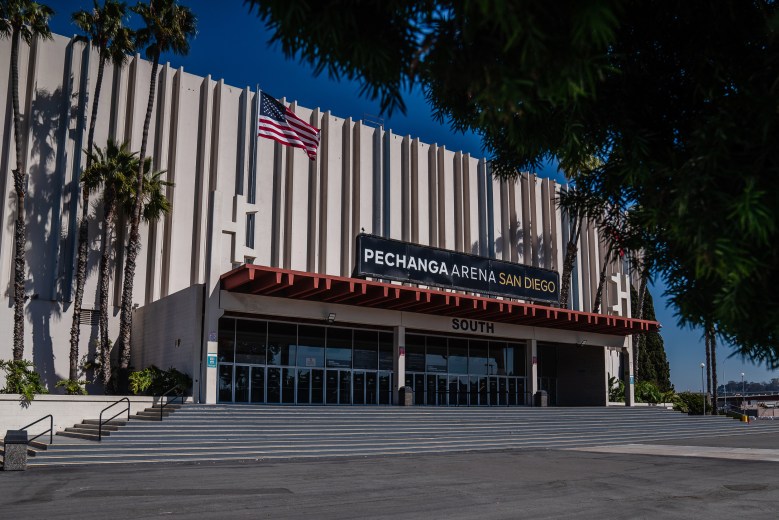
Senate Bill 958 would make it easier to build a 165-foot-tall sports arena in the Midway District neighborhood by giving broad exemptions to building height restrictions in the California Environmental Quality Act, the state’s preeminent environmental law.
It allows the lawsuit-ridden Midway Rising project, which includes housing and the arena, to skirt the neighborhood’s 30-foot height limit for buildings near the coast.
Sen. Akilah Weber Pierson, a Democrat who represents Midway District, is authoring the bill.
Business and housing groups lobbying for the bill expect smooth sailing from here: It cleared a June hearing in the Assembly Committee on Natural Resources with unanimous support. That came after the bill was changed from its initial, more ambitious version introduced in February, when city officials sought to exempt all parts of the project from CEQA.
YIMBY Democrats of San Diego helped craft the legislation with Weber’s office. Mayor Todd Gloria’s office has been doing whatever it can to get the 16,000-seat arena off the ground amid yearslong local opposition.
San Diego’s business chamber and Democratic City Councilmember Jennifer Campbell are also backing the proposal.
Audubon California and the California Airports Council are opposed over fears that the taller buildings would affect bird migration patterns and planes landing safely. The Western Electrical Contractors Association union initially opposed the plan but dropped its opposition after labor provisions were added.
But some Capitol watchers are questioning why the bill exists at all.
Some lobbyists have described it as an insurance policy or a backstop in case of any further hitches after years of litigation have slowed down the project.
As we’ve previously reported, the state housing department in an April letter gave the city the legal go-ahead for the project despite a court order rendering earlier attempts by local officials to get around local height restrictions illegal.
That’s because state density bonus laws allow housing projects to get around zoning restrictions if they allot a certain number of affordable housing units. In the letter, state officials said these rules would also apply to the stadium because the arena is crucial to building the project’s housing complex.
The state’s interpretation is already enough to get around the district’s 30-foot height restriction, so the CEQA exemption city officials are seeking isn’t necessary.
But their efforts could be thought of as another tactic in the “Swiss cheese” playbook, said Zack Defazio-Farrell, a policy analyst for YIMBY Democrats of San Diego.
As lawmakers continue to exempt key housing regulations from CEQA, its original framework starts to look a lot more like a slice of Swiss cheese — dotted with holes — that’s much less effective at throttling development.
“It’s called Swiss cheese CEQA because it’s like, well, there’s all these exceptions and eventually if there’s so many exceptions to CEQA, then how effective is it?” Defazio-Farrell said.
What’s at stake: Todd Gloria is staking his mayorship on bringing a brand new stadium to San Diego before he terms out in 2028.
The project’s developer, Brad Termini with Zephyr Partners, LLC, was one of the largest individual donors to Gloria’s 2020 election campaign. He and his wife each gave $50,000 to an independent expenditure backing the mayor.
In 2021, Gloria received backlash after he picked Termini’s company out of a group of finalists, shocking critics who worried the scale of the arena and its planned 4,250 housing units was too large for Termini’s Solana Beach-based company, which has not taken on such a big project before. Gloria also faced criticism for picking a political donor.
It’s now up to lawmakers if they’d like to hand the embattled project another lifeline.
Considerations to be made: San Diego officials are asking lawmakers to sign off on yet another CEQA carveout, and the latest version of the bill is broader and less local. Other California projects would get the same exemption if they’re also more than 40 acres in size, valued at more than $100,000,000 and have labor agreements in place.
So far it’s faced no opposition from lawmakers. But Assembly Democrats wary of further eroding California’s marquee environmental law might need more convincing.
What’s coming: SB 958 awaits a hearing in the Assembly Appropriations Committee, which La Mesa Democratic Assemblymember LaShae Sharp-Collins sits on. It’s expected to be taken up on Aug. 15 and likely won’t be amended before then, as the bill will come at little to no cost to the state because Midway Rising is being financed by a private developer with the city.
Amendments could happen shortly after it leaves the appropriations committee, which would likely narrow the legislation even further to just give Midway Rising CEQA building height exemptions rather than other projects that meet similar criteria.
It’s expected to move to the Assembly floor right after. Aug. 31 is the final day for all bills to pass.
Looking Ahead
Next week, we’ll look at how the San Diego delegation has performed so far this session and take a microscope to the bills they’re pushing, passing and opposing.
What I’m Reading Now
White House officials admitted that they used key words related to diversity, sexuality and gender to identify nearly $2 billion in University of California research grants to eliminate, CalMatters reports.
The Associated Press digs into the data and finds that nearly 150,000 June primary ballots were rejected, a spike from 2024 largely driven by late-arriving ballots. The higher rejection rate comes amid a broader discussion around whether California’s slow-ballot counting process is worth the trouble.
Los Angeles Mayor Karen Bass and her staff text using auto-delete WhatsApp messages, potentially violating state and local transparency laws, from the Los Angeles Times.
Thanks for reading this week’s report! Holler at nadia@voiceofsandiego.org for any questions or comments.
Correction: This post has been updated to correct that YIMBY Democrats worked with Weber’s office on the legislation.

Gut the CEQA and stop being hypocrites
Concerned about planes landing? Wow. While I don’t agree with the overall project, that’s quite a stretch.
Midway Rising – what a complicated issue. Why don’t we ask the voters to decide? Oh, wait. We actually did already do that. Twice. And the voters approved it. Amid all the inside baseball discussion, it seems like an oversight by the reporter to have omitted that voters approved the exemption from the 30 foot height limit twice.