
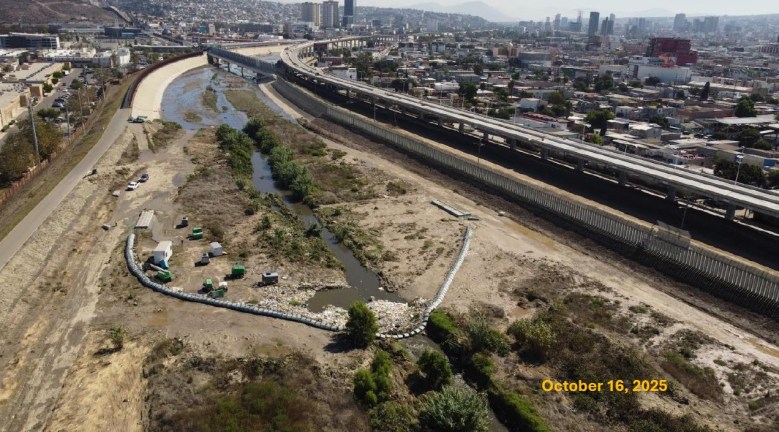
The president appears to be having a harder time cleaning the Lincoln Memorial Reflecting Pool than the sewage-contaminated Tijuana River, even though he used the same contractor for both.
The New York Times revealed over the weekend that Greenwater Services won a $1.7 million no-bid contract to install a water purification system in the pool located on the National Mall earlier this spring. But now that work has come under scrutiny after algal blooms overtook the pool, turning it a vibrant shade of green.
Meanwhile, Greenwater executives claim their treatment of the Tijuana River went extremely well.
Greenwater won a $2.5 million no-bid contract last year to do experimental water treatment on the Tijuana River, which is polluted by sewage and industrial runoff in Mexico and flows into San Diego.
Federal officials hired the company to test so-called “nanobbuble” treatment of the polluted Tijuana River, which involves firing aerosolized ozone into water to purify it.
The science of micro- and nanobubble technology has been around for years, but it has been focused on contained spaces like wastewater treatment plants and aquaculture. Less is known about its use in natural water bodies like lakes and rivers.
In an interview in March, Greenwater executives told me their experiment in the Tijuana River eliminated 91.5 percent of potentially contaminating bacteria.
“What happens is when these ozone bubbles burst … the ozone will attack the biology whether it’s algae or toxins,” Chas Antinone, Jr., the company’s chief operating officer said.
Activists strongly opposed the experiment and said it could have unintended consequences.
“This project had very little transparency and we raised valid concerns about the potential air quality impacts because of chemicals in the river,” said Phillip Musegaas, executive director of San Diego Coastkeeper, an environmental advocacy group.
The experiment didn’t go perfectly. An October 2025 storm swept away their equipment trailers and virtually ended the experiment.
Al George, CEO, said the company has done research with Ohio State University and was in talks with the state of Florida to work on reducing nutrient levels on Lake Okeechobee in south Florida and perhaps the Everglades, the state’s natural preserved wetlands.
“We’re seeking more business,” said George. “All the research that’s been done, …shows it’s very effective at treating hazardous algae blooms and bacteria.”
George said he hoped the International Boundary and Water Commission, the federal agency that granted the no-bid Tijuana River contract, would like to move forward with a larger project.
When asked how they had thought to try their technology on the Tijuana River, they said they attempted to meet with Imperial Beach elected officials in 2022 but “got nowhere.” Federal officials at the IBWC reached out to them in the spring of 2025, George said.
“We went in and met with [Chad McIntosh, the IBWC director’s] team and made a presentation but we didn’t know him before this,” George said.
Investigative reporter David Fahrenthold reported that the company’s ultimate owner is an investment trust owned by John J. Cafaro, a donor to Trump and a neighbor to Mar-a-Lago, the president’s private club in Florida.
The company is based in Ohio where owner Cafaro’s daughter serves in the state Senate. Cafaro’s family business was in developing shopping centers but he later moved into other industries like aerospace. He pleaded in 2001 to conspiracy to bribe Ohio Democratic Rep. James A. Traficant Jr. and later testified against him, according to the New York Times.
Greenwater Services spokesman Dave McKibben said the company had no further comment Monday on the reflecting pool situation. Or why the technology had reportedly done such a good job on the Tijuana River but struggled to clean the reflecting pool.
Fahrenthold reported that the reflecting pool was refilled before Greenwater Services could install a permanent water purification system, which raised the risk that it could become clouded with algae. The National Park Service was planning for years to upgrade the system with technology that could kill algae with tiny bubbles of ozone gas.
Around the Environment:
- Toxic gases could be reduced in South Bay by next summer when the county is expected to finish a temporary fix to Saturn Boulevard, where the Tijuana River spills from pipes causing sewage gas to be released into the air. (Supervisor Paloma Aguirre)
- The San Diego City Council endorsed 10 bills in the state Legislature aimed at lowering utility bills. (KPBS)
- San Diego Gas and Electric requested an 8.6 percent rate hike in 2028 from the California Public Utilities Commission. (NBC 7)
- An Imperial Valley data center developer is suing the Imperial Irrigation District seeking access to Colorado River water for its business. (KPBS)
- Imperial County passed a temporary moratorium on data centers. (KPBS)
- An endangered ram died after getting caught in wire that’s part of the U.S.-Mexico border wall. (KPBS)
- No, the governor did not just give $46 million to the Tijuana River. (Voice of San Diego)
Are they the ones with a proposed cleanup of La Jolla Cove, too? The “Nanobubble” technology sounds familiar.
The algae are not the main problem with the reflecting pool – that has been an ongoing problem. The main problem is that the contractor covered stone with a plastic coating that immediately started peeling from the sides of the reflecting pool.