
Sacramento Report Countdown
24 days until the end of the legislative session
88 days until the November election
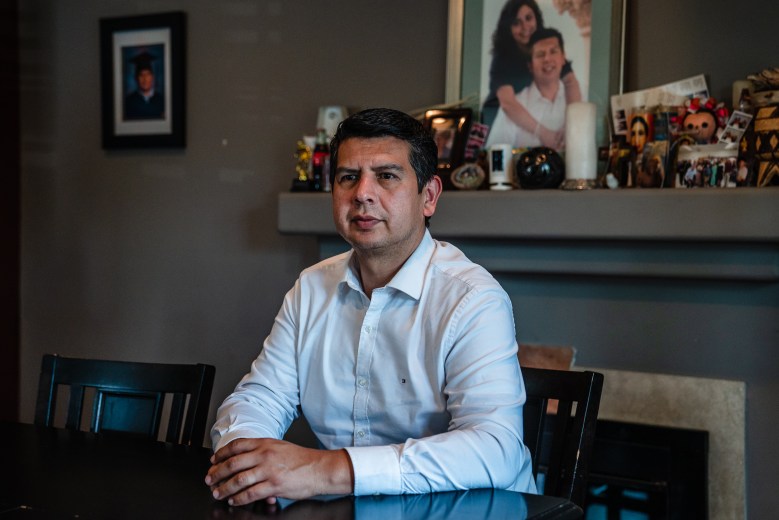
David Alvarez rarely goes out of his way to vote “no.”
Yet, in practice, he has voted “no” by missing or choosing not to vote on more than 400 bills since January 2025, when the legislative session started. That’s more than any of his San Diego colleagues by a decisive margin, especially among other fellow Democrats, according to an analysis of his votes by Andrew Chan, an engineer for CalMatters’ Digital Democracy.
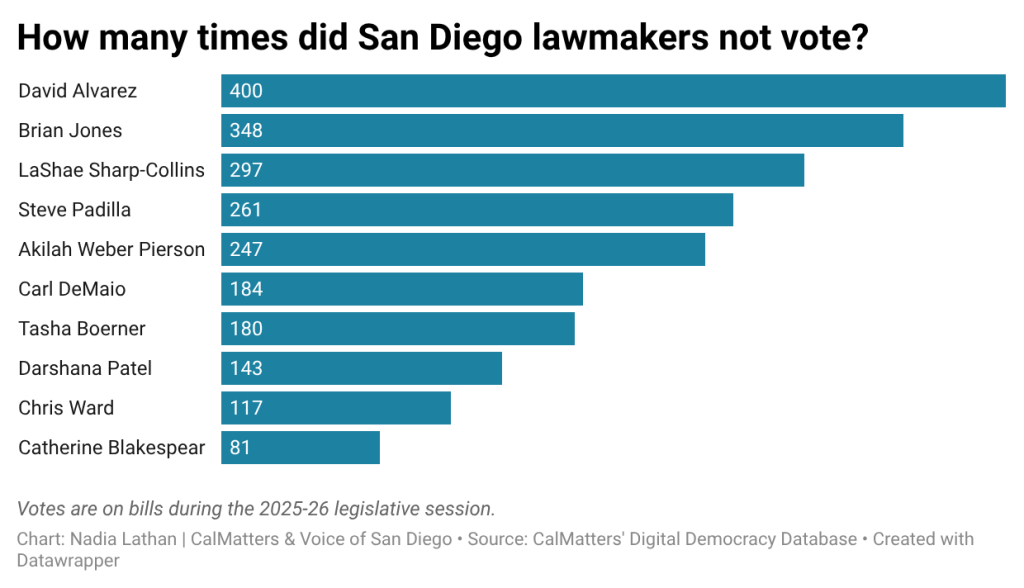
If a lawmaker doesn’t vote on a bill, it counts as “no vote recorded.” The online system doesn’t distinguish between an abstention, an absence or when the legislator is present but doesn’t vote. To add more confusion: Lawmakers typically abstain from voting on fellow lawmakers’ bills they don’t like to not upset their colleagues.
Often, the only way to get to the bottom of why a lawmaker didn’t vote is to ask them directly.
Alvarez said most of his 400 NVRs were because of absences.
“The vast majority of those, I was not in Sacramento. I was in the district or perhaps ill on one of those days,” he said, and that he didn’t know absences counted as NVRs.
Five absences last year account for nearly 64 percent of Alvarez’s missed votes, he said. Alvarez missed a total of 254 votes across five days last year.
On March 20, 2025 alone, Alvarez had 127 missed votes. That’s more in a single day than Assemblymember Chris Ward or Sen. Catherine Blakespear, both Democrats, has each accumulated over nearly two years.
Alvarez said he couldn’t remember what he was doing that day, but was likely out of town for a district event.
Lawmakers typically meet mid-day Monday to mid-day Thursday every week, and they just returned from a monthlong break to spend time in their districts.
More recently, on June 18, Alvarez said he was at a graduation at Donovan State Prison. He missed nine votes that day.
He said he frequently returns to Chula Vista during the week for work related to establishing a four-year university in the region.
“I will be absent and go to that because that’s a big priority of mine and in the district,” he said.
Alvarez has only voted “no” outright five times out of his 3,505 opportunities to vote. Nearly 90 percent of all state lawmakers have more “no” votes than him.
Sen. Akilah Weber Pierson, a Democrat, ekes out the top spot for the fewest direct “no” votes among San Diego lawmakers at four. A spokesperson for her office said she could not immediately be made available to discuss her voting record.
Because the Legislature records it the same way whether a lawmaker is absent or present but choosing not to vote, it’s hard to differentiate whether the number of NVR votes a lawmaker has represents opposition to a bill.
Alvarez said he’ll abstain from voting if he can’t clearly communicate to constituents why he voted for or against a bill, and that it’s also a signal to lawmakers that he can be persuaded.
“Sometimes you think bills might actually do a good thing, and if you vote against it, you’re gonna be then labeled as ‘Oh, he did not want to help this group of people’ or ‘He did not want to support this type of business activity,’” Alvarez said. “There are really well-intentioned bills that if you vote ‘no,’ perhaps you could be categorized by folks.”
Critics and Capitol watchers say this lack of distinction allows lawmakers to avoid accountability for opposing legislation and is a way to not upset special interest groups.
“It’s just nonsense,” former Los Angeles Assemblymember Mike Gatto said of NVRs. “Voting is really a binary. You should be tough enough to vote ‘no’ and take the consequences.’”
What’s at Stake
With less than 90 days to the midterm elections, members up for re-election are weighing whether opposing certain bills could affect their political careers. And missing votes allows lawmakers to evade explaining themselves on the campaign trail.
This is particularly true for state legislative campaigns in which missing a vote bears little to no consequences because so many legislators do it.
That’s different than in congressional campaigns, where members who skip votes poll far worse and candidates are more likely to face attack ads parading their records.
Leadership in the Democratic-controlled Legislature ultimately decides — and can change — how votes get recorded.
Brief murmurs about changing the practice bubbled up in 2024 during U.S. Rep. Adam Gray’s congressional campaign when a Republican super PAC went all-in on the more than 150 votes he missed. But nothing came of it. Senate President Pro Tem Monique Limón’s office said there are no plans to change how votes are counted.
Special interest groups also sway lawmakers’ votes. Abstaining makes it harder for them to pin down legislators on issues. If absences were tallied separately, it could make it harder for lawmakers to try to appease lobbyists and their colleagues at the same time, Gatto said.
“In the post-Bernie, post-Donald Trump era, what voters really want from politicians is authenticity,” said Gatto, who routinely voted against bills 10 years ago as an assemblymember.
“Fifty percent of the time when a lawmaker abstains from a vote, it’s because they want to have their cake and eat it, too.”
In Other News
An avalanche of bills moved through each chamber’s spending committees this week. More than 50 proposals from San Diego members were up for consideration. Here are the highlights:
- AB 664, a bill to allow Southwestern Community College to offer four-year bachelor’s degree programs. It’s authored by Alvarez, and University of California and California State University officials are lined up against it, fearing it would compete with their degree programs. The bill awaits another hearing in the Senate Appropriations Committee.
- SB 958, a bill to change environmental review requirements for a planned stadium project in San Diego’s Midway District. The proposal by Weber Pierson advanced from the Assembly spending committee and awaits a final floor vote in the Assembly.
And on Sunday, Weber Pierson is hosting an open event with developers for Midway Rising and San Diego Mayor Todd Gloria’s staff to discuss the project with residents. The conversation follows a town hall organized by neighborhood groups last week where many opposed the project over environmental and traffic concerns.
What I’m Reading Now
Supporters of a voter ID initiative reel from two legal setbacks to change how the proposition will appear on November’s ballot, The Sacramento Bee writes.
The San Diego Union-Tribune digs into one former school superintendent’s credit card receipts. It’s not pretty.
Officials in Avenal, California cling to power more than three months after voters in the rural Central Valley town recalled them from office, The New York Times reports.
Thanks for reading this week’s report! Please feel free to reach me for any questions or comments: nadia@voiceofsandiego.org.
Digital Democracy engineer Andrew Chan contributed to this report.

so he is too lazy to show up to work
Does he get paid when absent or like the rest of us only has so many sick days?
As Abraham Simpson once said, “That’s the Democrats for you”!