
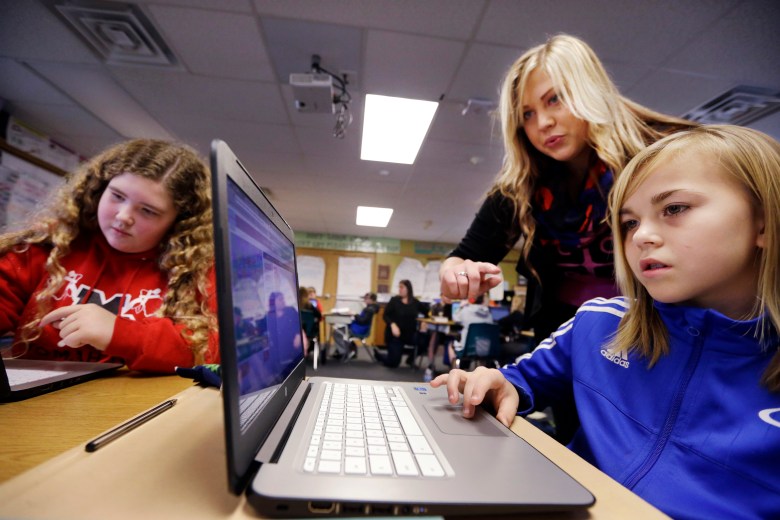
San Diego Unified’s board on Tuesday unanimously passed a resolution that places new limits on screens in classrooms and how students will be able to use district-issued laptops. It also lays the groundwork to restrict the use of AI-enabled software that hasn’t been specifically approved by the district.
By the start of the school year, students will no longer be able to access video-streaming or gaming platforms on district-issued laptops. The resolution also sets a timetable for other changes, like more comprehensive regulations on screen-usage based on grade level. Officials will create a committee to usher in the changes.
But not everyone’s stoked. Los Angeles Unified recently passed restrictions that went even further. Some of the activists who pushed for local restrictions are disappointed San Diego Unified’s action didn’t do more to limit screens.
The new restrictions are the local front of swelling, nationwide pushback against the ubiquity of educational technology in schools.
Americans souring on ed tech has been hard to ignore recently. Over the past year a wave of organizations has cropped up to oppose the proliferation of gizmos and gadgets in classrooms. Parents have filled board meetings to raise hell.
And they’re not necessarily wrong to do so. A growing body of research has found that screen usage can have a seriously detrimental impact on kids’ ability to learn and focus. And yet, classrooms are chock full of devices.
Digital technology’s steady infiltration into classrooms went into overdrive during pandemic. Educators sprinted to get computers into the hands of every American student as distance learning took hold.
But that created a whole new world of issues, and an entirely new degree of access to devices for American children. It’s this problem schools are now trying to fix – how do we untangle a web of wires we created?
For San Diego Unified, it was a complicated question, Trustee Shana Hazan said. The district, she said, hasn’t done enough reflecting since the pandemic about how to leverage devices to get kids where they want to go. It’s all well and good to adopt a new policy, she continued, but implementing it with anything close to fidelity is a whole different ballgame.
So, over the past couple of months district officials like Hazan, fellow board member Richard Barrera and other staff have been meeting with teachers, parents and researchers to try to begin to develop a thoughtful policy.
“We need to be slow and thoughtful and methodical and intentional and collaborative if we want this thing to work,” Hazan said. “This is a really big piece of work, and so we’re just at the very beginning stages.”
What the beginning stages include: With the resolution’s passage, some policy changes will take effect soon. Before the first day of the coming school year, district-issued laptops will no longer allow access to gaming and video-streaming platforms. Carts of electronic devices in transitional kindergarten classes will also be removed, but exceptions will be made for kids who require devices as part of an IEP.
By winter break, a not-yet-created committee is supposed to create guidelines for device usage for different grades, subjects and levels of student need. The committee is also expected to figure out specific times of the day, or even year, to shut off laptops issued by the district and more general bits of guidance on how to use screens to more effectively instruct students.
By the end of next school year, the committee will advance policies that ensure software containing AI is district-approved and all applications are ad-free. It will also create unified procedures by which parents could opt out of taking home devices.
Anti-screeners see “fundamental flaws”: The nationwide group Schools Beyond Screens has been one of the most organized coalitions in the push to ditch ed tech. The local chapter led the charge to pressure San Diego Unified. A petition the organization launched earlier this year has garnered more than 2,100 signatures.
Angelika Oliver is a member of the San Diego branch. For the past couple of months, she’s met consistently with board members Hazan and Barrera, and Deputy Superintendent Nicole De Witt. She said that while there are some things to be proud of, the new resolution has some “fundamental flaws.”
Oliver had hoped for a total ban on screens for kids until at least second grade. Los Angeles Unified also passed a new technology policy on Tuesday – that did just that. Local activists also hoped to see the adoption of a research-backed framework at each grade level and the limiting of laptop usage through middle school.
“We don’t want technology at the center of education, we were looking for them to take a framework for education and mental wellness and say how does tech figure into that,” Oliver said. “The district is saying the right things when speaking to the public, but this leaves a lot open to interpretation and we wanted concrete policy changes.”
What We’re Writing
Haven’t gotten enough of the ed tech frenzy? Here’s a pretty bonkers story I recently wrote.
I found out that a local charter network called Altus Schools purchased two ChatGPT-powered humanoid robots for $500,000. That’s right, half a million dollars. Officials at Altus are still trying to figure out exactly how to use them. They view the robots as a way to get kids engaged and to help them figure out how to use AI. Bit of circular logic there.
Researchers I spoke to panned the purchase.
They said that research has not proven that AI is an effective educational tool. In fact, integrating it into schools may actually be harmful. AI use aside, all of them took special umbrage with Altus’ spending half a million dollars on robots, which they called a waste of funds. One of the researchers called the robots “bullshit.” Y’know, typical academia talk.
I sat in on a lesson taught by one of the robots, wherein it responded as Nikola Tesla to kids’ questions. Even the school official called it clunky.
The whole thing felt something like an educational Rube Goldberg machine: a too-complex substitution for a lesson that could have easily been delivered by a flesh-and-blood educator.
A lil’ tidbit: One of the researchers I spoke to is a guy named Neil Selwyn. He’s a professor at Monash University who has researched AI and educational technology for decades. We got to talking about how often schools bite on dubious educational initiatives.
“Tech companies have always marketed to schools, because schools are kind of easy marks in some ways,” Selwyn said. “The trouble is there’s so much wrong with schools. There are so many problems that schools face. They’re desperate for a fix, they’re desperate for solutions, they’re desperate to try and make things slightly better.”
Our Segregated Present
Katie Hyson over at KPBS wrote about a fascinating report that highlighted just how economically segregated California is. The state’s schools are ranked 10th in the nation in segregation between the rich and poor.
It’s not entirely surprising. You see it every day in San Diego County. Heck, if you drive from the southeastern tip of San Diego Unified to the northwestern tip, it can feel like you’re in entirely separate cities. (Don’t tell La Jolla I said that.) The report is a reminder that this is not normal.
Good news. I’m so pleased to learn the board has been facing this issue. There is so much research now that backs up the excessive use of screens on growing brains has real impacts. I cringe every time I see toddlers in strollers getting addicted to screens.