
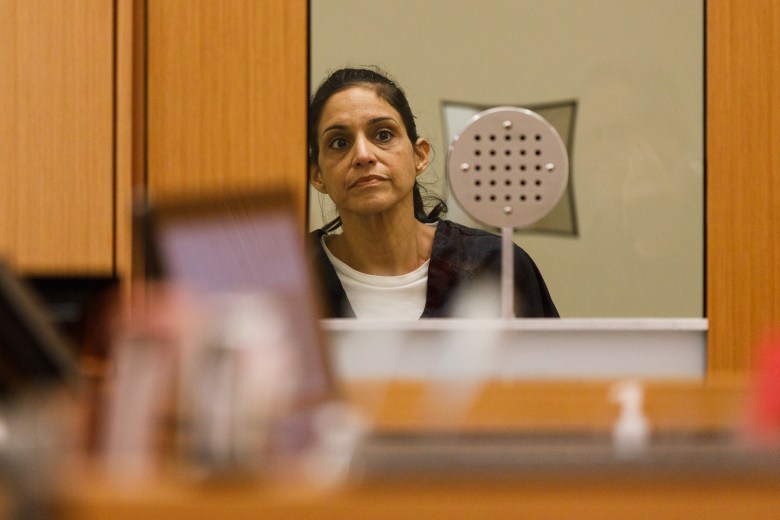
The county automatically deletes most staff emails after two years, making it difficult to trace the events that led to a criminal case against a former county contractor.
The loss of those emails could have impacts on both the criminal embezzlement case and the public’s understanding of what happened.
The county’s two-year email retention policy isn’t an outlier statewide. Yet it’s concerning defense attorneys for the ex-nonprofit COO charged with misappropriation. A county supervisor is also now planning to push for an extended retention period.
Earlier this year, Voice of San Diego sued the county to demand the release of whistleblower complaints. Multiple whistleblowers raised flags before prosecutors charged ex-Harm Reduction Coalition of San Diego COO Amy Knox for allegedly spending public funds on everything from plastic surgery to family vacations. The county ultimately said it couldn’t find whistleblower emails reporting concerns with the nonprofit’s first county contract from 2022 or 2023. It simply had notes documenting a county official’s call with someone who reported Knox had a past embezzlement conviction.
That doesn’t mean such emails never existed.
Voice separately obtained two January 2023 email exchanges a whistleblower had with county officials warning of “unrest and a team breakdown” at the Harm Reduction Coalition and promising “extensive info from beginning of contract” they said could aid a county investigation.
The exchanges came three years before prosecutors filed charges against Knox, meaning the emails were likely deleted a year before the criminal case.
A county lawyer told Voice it had no record of the emails because they apparently weren’t tagged to be saved in the county’s email system and fell outside its two-year retention policy.
Knox’s attorneys fear the policy and the loss of an untold number of emails could impact their ability to defend her. They argue that likely deleted emails would show Knox’s regular past communications with officials about the contract.
Attorney Gary Gibson said Knox’s legal team plans to call county staff to testify about their policy.
“If this case goes to trial, it would be our intention to call county officials into court to explain why they destroyed relevant and necessary emails that are required in criminal cases that affect the substantial rights of criminal defendants,” Gibson said.
A spokesperson for the District Attorney’s Office, meanwhile, declined to comment on the retention policy and said it believes it can “prove the crimes with the evidence we have.”
A county supervisor who previously helped lead the charge to extend the county’s retention policy from just 60 days to two years in 2022 now plans to propose at an upcoming board meeting that the county extend its retention period again.
“Supervisor [Joel] Anderson thought two years would be enough but in light of what has happened at the county in recent years, he believes it should be expanded to five years,” spokesperson Matthew Phy wrote in an email.
A five-year email retention schedule would match the city of San Diego’s policy, which was also set in 2022.
The county’s previous policy update followed a review by a transparency subcommittee that Anderson co-chaired with former supervisor Nora Vargas – and a state Court of Appeal ruling that skewered the county’s onetime policy of deleting most emails after 60 days. The ruling came after the company that owns Golden Door Spa and Wellness Retreat challenged the county’s deletion of emails it sought via a public records request.
The county’s current policy calls for emails to be retained by the county system for a maximum of two years.
“At the expiration of the two-year period, email messages will be permanently deleted from the email system,” the county policy reads.
The county policy says this “reduces the risk of disclosure of sensitive records and information” including personnel details, “law enforcement and security information” or classified data.
County staff themselves are left in many cases to decide whether their emails are so-called official records that should be kept longer to comply with laws and other county rules or retained because they may be relevant to future court cases – or whether they should consult others for guidance.
“Courts have held that there is a duty to preserve emails (and other electronic records) that may be needed as evidence in future litigation and that this duty arises when the user knows or has reason to know that the records may be evidence relevant to probable future litigation,” the county policy states. “Accordingly, if the user thinks an email falls into this category, the email should be preserved, and county counsel consulted.”
It’s unclear whether staffers who fielded emails about Harm Reduction Coalition contract issues consulted county lawyers or department record liaisons about emails from whistleblowers or any of their own internal emails documenting what happened with the contract.
Gibson, one of Knox’s attorneys, said he is concerned that line-level county employees often decide whether emails should be retained.
One of the January 2023 exchanges that was apparently deleted was between a whistleblower and the county Health and Human Services Agency official who later oversaw a special review that led the county to cancel its two contracts with the Harm Reduction Coalition last summer. The whistleblower declined to comment and asked Voice not to share their name for privacy reasons after Voice obtained the emails from another source.
After the whistleblower sent Christy Carlson of the HHSA business assurance and compliance office an email with an attachment, Carlson asked the person to share an email that Knox or CEO Tara Stamos had sent them.
“The one regarding the county, 1099, and threats?” the whistleblower replied, likely referencing a tax form for independent contractors but not elaborating further.
Moments later, the whistleblower emailed again to say they had many messages they could share.
“Hi there – any emails you think may show a pattern of mismanagement or non-compliance to county requirements would be extremely helpful,” Carlson replied.
Carlson followed up again the following week.
“I do want to thank you for all the information you forwarded and appreciate the messaging of my contact information to any others who may have concerns,” she wrote.
That same day, another county staffer notified the Harm Reduction Coalition that it would audit its then-roughly $1.3 million annual contract. The audit soon called for more financial controls at the nonprofit. It’s unclear what officials did to ensure improvements were implemented after the review ended.
Any emails exchanged immediately before and after the 2023 audit would have been automatically deleted by the county after two years unless officials decided to retain them longer.
The county’s two-year retention policy isn’t outside the norm in California.
David Snyder of the nonprofit First Amendment Coalition said a two-year retention policy is typical.
It reflects a state law that generally calls for local governments not to destroy records that are less than two years old – and the lack of retention mandates in the state Public Records Act.
Snyder argued a two-year retention policy can be problematic when it results in the deletion of emails that could aid in criminal fact-finding efforts or help local governments fight lawsuits.
“From a public interest perspective, a much longer retention policy would be best because, as this case exemplifies, there’s a lot of information that is of intense public interest that may disappear,” Snyder said.
Attorney David Silldorf, one of Knox’s attorneys, had a similar take.
“The prejudice is real and if we are unable to find the records, it’s irreversible and it impacts her fundamental rights along with every other San Diego citizen,” attorney David Silldorf said.

Speaking of transparency, has anyone figured out what really happened with Vargas quitting suddenly? Anyone?