
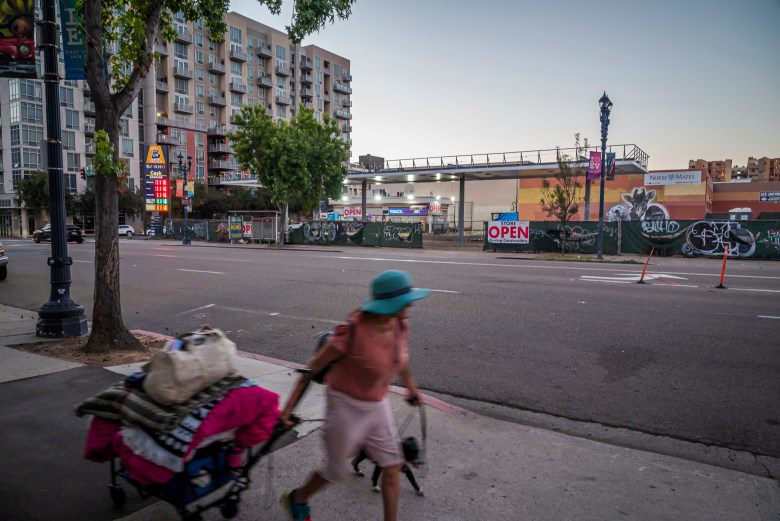
Before I moved to San Diego, everyone told me this was not a walkable city. But I’m French and used to getting around on foot, so I wasn’t worried about not having a car.
That changed when I started walking everywhere. I didn’t realize how dangerous it could be or how often I had to cross paths with people driving their cars.
In San Diego, the sidewalks have a lot of curb cuts. I didn’t know how many there were, especially clustered together in certain areas, until I started reporting on a developer of a proposed downtown gas station with seven driveways who lobbied the City Council to approve his project, defying the city’s pedestrian safety policies.
City engineering documents refer to driveways as curb cuts because they literally cut the curb and shave the sidewalk into a ramp to make it easier for cars to enter a city block. But cutting a curb also makes life harder for pedestrians. I realized during the hour-and-twenty-three-minute walk from my North Park apartment to the downtown Voice of San Diego offices that I would be constantly stopping on the sidewalk to look for crossing cars or maneuvering around these curb cuts.
The city of San Diego adopted a law in 1992, in the name of pedestrian safety, that strictly limited how wide, how many, and how close together curb cuts can be for new developments. But the new rules didn’t apply to properties built before 1992 (except in certain cases). That’s why on some blocks, there are more curb cuts than actual sidewalks.
Every time the sidewalk is cut, it’s an open invitation for a car to collide with my body. It’s clear who often wins. In 2014, the city set a goal of eliminating all traffic deaths and severe injuries by 2025. In 2025, more pedestrians died in collisions than the year the goal was set – 27 people died and 44 were severely injured that year.
Dodging cars is only one of the troubles I have with walking here. The urbanist Jeff Speck has a theory about this: that people will choose to walk only if the walk is useful, safe, comfortable, and interesting. My walk, every morning and every evening, often fails all four.
Most of my walk is entirely without shade. I wait, on average, 30 seconds to a minute at most blocks for permission to cross from the automated crosswalk.
The sidewalk itself is often broken by tree roots pushing up through the concrete, forming little tents of cement.
At one point, the sidewalk disappears altogether, and suddenly I am walking on a path built specifically for bicycles. In those cases, I often choose to use the sandy shoulder of the road, before being forced onto a trail.
For most of my hourlong walk, I am the only pedestrian, except for those who have made the sidewalk their home. My path is lined mostly by houses, interrupted here and there by low garden walls, blocks consumed entirely by parking lots, the occasional auto repair shop, and – every so often – a coffee shop or a 7-Eleven.
It wasn’t until I moved to San Diego that I understood how much walking is part of how you connect with a city. I miss passing people on the street or being able to sit down on a bench – that are virtually non-existent – spontaneously, for no reason at all, and watch whoever walks by. Or walking into a shop because something in the window caught my eye.
I miss being able to trust the sidewalk.

Safe sidewalks should be a priority for any large city. Curb cuts are obviously making the sidewalks in San Diego unsafe, which limits how many folks can walk to nearby businesses.
Not a single mention of the homeless drug addicts and poop that actually make walking in San Diego incredibly unpleasant. But yeah focus on the car cuts that’s the real thing making people avoid walking downtown
That was my thought. This is one of those YIMBY advocates disguised as a journalist.
Right. It is disgusting how such garbage can be published when everyone who lives here knows the homeless garbage people are the ones that make walking unsanitary, unpleasant and dangerous.
Right. It is disgusting how such trash can be published when everyone who lives here knows the homeless garbage people are the ones that are ruining this city.
The homeless are not killing and injuring people who are trying to get around on foot; nor are they depriving pedestrians of shade, or creating sections of the road with no sidewalk at all.
OK, you are definitely a Silicon Valley YIMBY shill.
You say you are French but complain about the sidewalks in San Diego? I had to laugh. In Paris the sidewalks were so small I was forced to walk in the street, and one time a motorcycle was heading towards me so I went on the sidewalk for safety. Big mistake. Apparently motorcycles are allowed to park on sidewalks and the moment I was on the sidewalk the motorcycle also went on it still heading towards me! I had to jump into the nearest shop to escape. I was wondering if the bike was going to follow me inside! At least it didn’t do that.
More apartments are being build, and people will be fighting for free parking spots. Then your walking will be more insightful and fun. Take pictures.
What is the most enjoyable city that you have regularly walked? San Diego can learn from comparing with other places like this writer has done. For me, walking in Washington DC has been most enjoyable.
As bad as your experience with sidewalks was, it is immeasurably worse for people relying on wheelchairs or mobility scooters. Sloping driveways are unstable surfaces. Same with sidewalks broken and tipped up by tree roots. Sidewalks sometimes end at a corner with no curb cut to get down to street level. Water often collects at the base of curb cuts at corners. Etc. Like you, I grew up in walkable European cities and am appalled at how little attention the walking (or rolling) experience receives in many US cities.
How come so many European YIMBYs showed up to comment on 8/19? Who is paying you folks?
Street crosswalks are some of the worst safety hazards. Drivers making turns are always trying to get around the pedestrians. Sometimes they drive right at you in the crosswalk. They seem to have no idea that pedestrians might be alarmed to see a vehicle heading for them, especially when it’s an oversized pickup truck. Sometimes I hop on a bus just to avoid walking across busy intersections.