

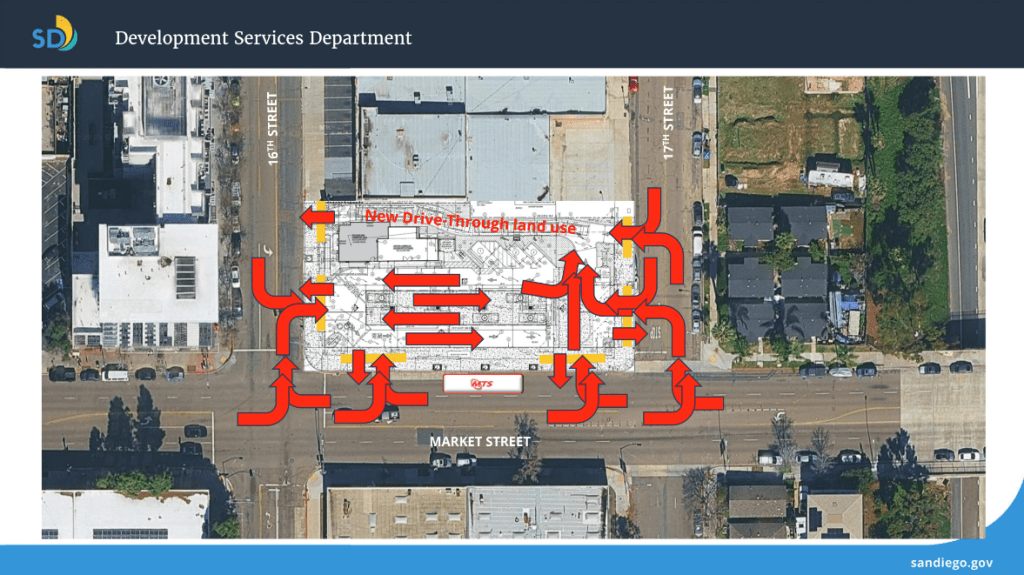
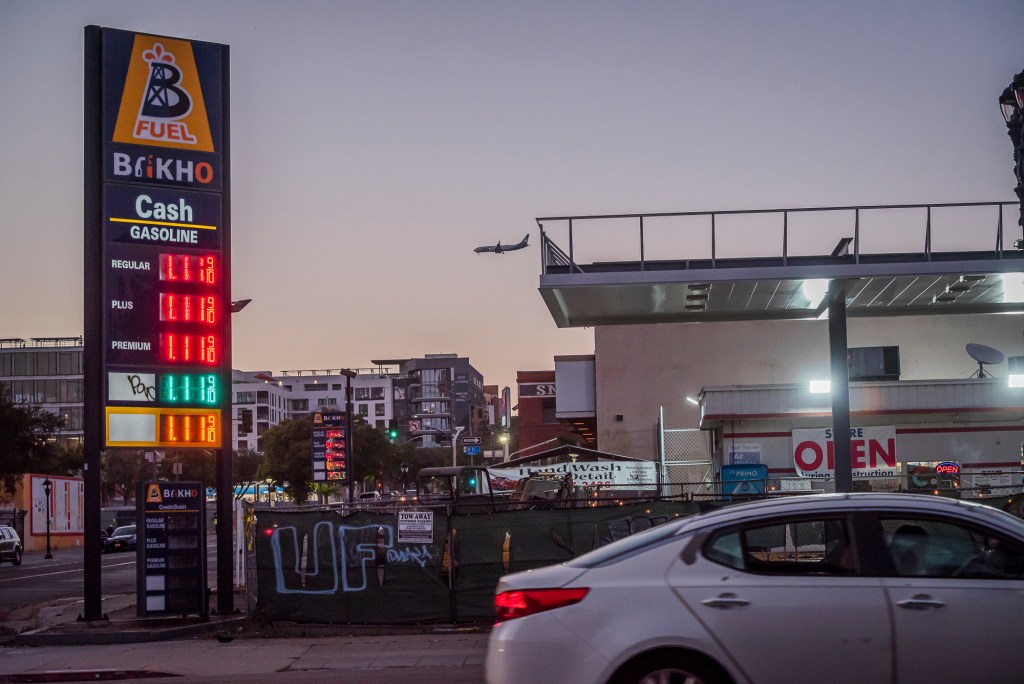
At 1606 Market St. in East Village, seven different driveways lead to the same gas station: three from Market Street, two from 16th Street and two from 17th. Pedestrians must pass a gauntlet of cars to walk the border of the property. The many driveways also aren’t ideal for the stream of passing cars, buses and cyclists in San Diego’s bustling city center.
The gas station complied with the car-centric zoning laws of the 1950s when it was built, but it had fallen well out of step with the city’s regulations by 2020 when Joseph Brikho applied to expand it. The Brikho family, prominent San Diego gas station and retail entrepreneurs, have been buying and fixing up old, run-down gas stations since the 2000s.
Owners that do big renovations, like the one Brikho proposed, are supposed to update their properties to comply with current law.
But Brikho wanted to keep the driveways, double the size of the convenience store and add a drive-through lane for food and beverages.
His own traffic consultant found the added traffic of the drive-through lane would put pedestrians, cyclists and drivers at greater risk of collision.
His plans clearly conflicted with the city’s new regulations and city staff members sent the project back to him multiple times asking for adjustments. They wanted him to get rid of four of the seven driveways, including all three on Market Street.
But Brikho did not accept city staff’s determinations. Instead, he and his brother spent $15,000 on lobbyists who petitioned the mayor and city councilmembers on their behalf.
“All we are trying to do is improve our site. We’ve been fighting for five years, we’ve spent hundreds of thousands of dollars with the city and with our consultants. We have tried to accommodate every request from the city,” Brikho said during a City Council meeting last July.
The Council ultimately approved the project in April 2026 – even though in its written decision it acknowledged the project didn’t align with its traffic safety goals and specifically a policy meant to eliminate traffic deaths downtown.
Only councilmembers Joe LaCava and Sean Elo-Rivera voted it down.
The deviations from city policy “run counter to priorities related to pedestrians’ safety, cyclists’ safety and our climate goals,” Elo-Rivera said at the time.
The Council has the authority to make regulatory exceptions for certain projects.
Jim Madaffer, a former city councilmember and one of the lobbyists hired by the Brikho family, said councilmembers made a common sense decision in the end.
“When you make a political decision, you have to weigh the alternative,” he said. “While the staff says that it’s not pristine and perfect according to a planning document, you have to have a common sense: it was previously conforming and the council made the decision and approved it.”
Old Design, New Downtown

The city has created a raft of new laws and regulations to make downtown more walkable, livable and public transit-oriented since the 1950s.
In 1992, a year before the city received national recognition from the American Automobile Association for its pedestrian safety efforts, the city added standards to limit driveways to avoid as much as possible the moments when a car and a pedestrian occupy the same space.
The city now fully bans new driveways along Market Street – which makes up the longest street-facing side of the gas station’s property and has three driveways.
In 2006, the City Council also rewrote downtown zoning rules through the Downtown Community Plan and the Centre City Planned District Ordinance. Under those rules, 1606 Market St. was rezoned for housing and employment uses, meaning a new gas station would not be allowed on the site today.
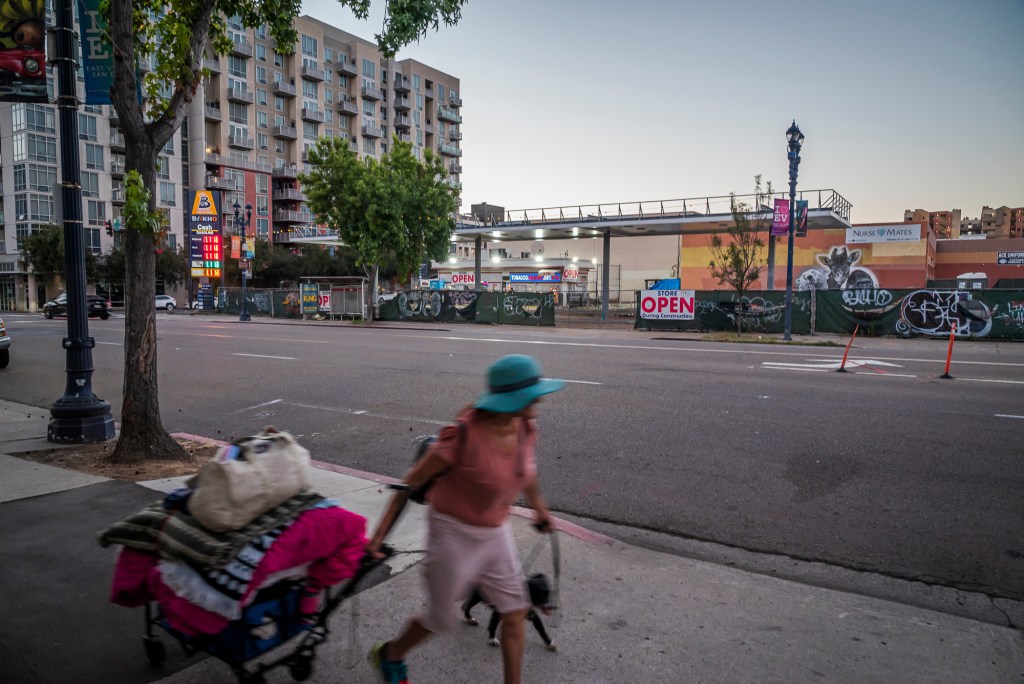
As downtown changed, the risk factors for collisions stacked up on Market Street. A bus stop, served by two MTS bus lines, is located between two driveways at the property and bikes share a lane directly with turning cars. A 12-story, 136-unit affordable housing complex sits right across from the gas station, adding extra foot traffic.
In 2015, driven by a rise in traffic deaths, the local nonprofit Circulate San Diego pushed the city to adopt Vision Zero, which made street safety a central priority for city planners and put new scrutiny on driveways that put people on foot or bike at risk from crossing car traffic.
The policy also committed to eliminate all traffic deaths by 2025. More than a decade later, the city is woefully behind on meeting its goal. In fact, more pedestrians are dying now than when the city set the goal.
An intersection two blocks away made Circulate San Diego’s 2025 Fatal 15 list of the city’s most dangerous crossings.
A Previously Conforming Site
City staff sent the proposal back to Brikho at least three times between 2022 and 2024, according to documents obtained by Voice of San Diego through Public Records Act request. Each time staff cited the same unresolved driveway problems.
Brikho never came close to meeting the staff’s requests.
The driveways violated the city’s code in myriad ways.
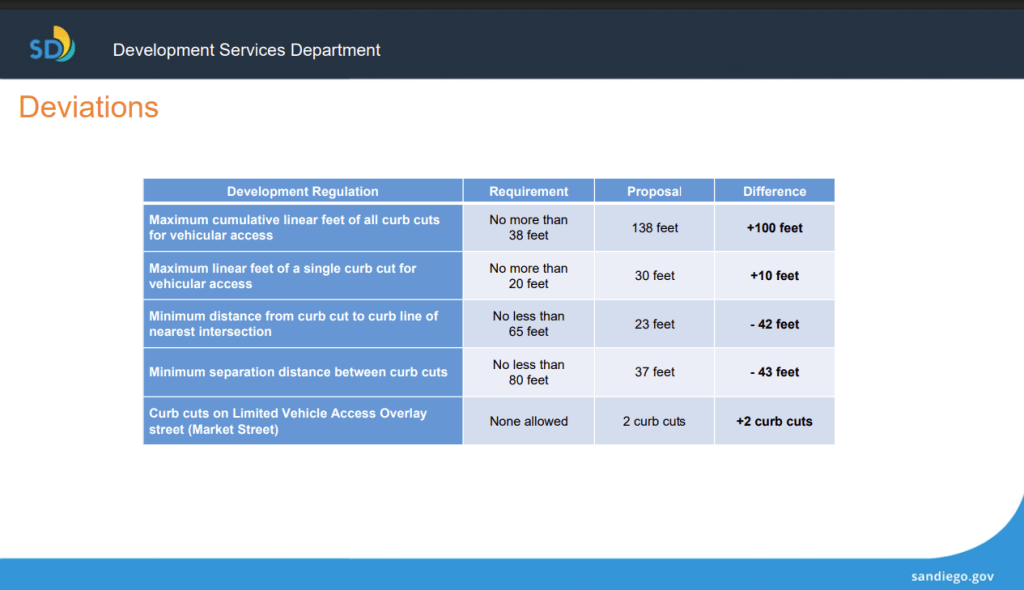
Driveways can only take up 38 feet of sidewalk space, for instance, but Brikho’s took up 138 feet. The driveways were also too close to intersections. Some sit just 23 feet away from an intersection, even though city code requires 65 feet of distance. They’re packed too close together, too; some are only 37 feet apart, even though city code requires 80 feet of separation.
Not to mention the fact that driveways aren’t allowed at all on Market Street under the new regulations.
In November 2023, the Downtown Community Planning Council – a group of elected volunteers who review proposals and make recommendations to the city – denied the project, in a 7 – 4 vote. The planning group gave two reasons: the project runs counter to the city’s Climate Action Plan by generating more vehicle traffic, and it works against the city’s Vision Zero goals by increasing the risk of traffic collisions.
Gary Hewitt, current chair of the Downtown Community Planning Council, explained the reasoning.
“That site is zoned so you could build something pretty substantial. A lot of people live downtown,” he said. “Yes, there was an existing building and it was previously conforming, but now the whole area has been zoned [differently] for a reason.”
By February 2025, city staff offered Brikho three options to bring the driveways into compliance, but he took none of them.
Instead, he appealed to get his project directly before the City Council.
Then the Brikho brothers hired two lobbying firms to press their case, including one run by a former San Diego city councilmember.
Jim Madaffer, who served on the Council from 2000 to 2008, contacted council offices and Mayor Todd Gloria himself on behalf of Joseph Brikho’s company.
Madaffer’s wife Robin Madaffer also runs a law firm and lobbying group. Joseph’s brother, Adeeb “Eddy” Brikho, and his company hired Robin Madaffer’s firm to represent him as a lobbyist and attorney. Records show that Robin Madaffer’s firm first reached city planning staff in the spring of 2025, then expanded its outreach by summer to council staff in all nine districts, plus the Mayor’s Office. Extensive lobbying continued into the fall and early 2026.
Voice reported last year that National City Planning Commission denied Eddy Brikho a permit for a gas station and drive-through of his own, a fight that led to lawsuits alleging he’d paid the mayor’s executive assistant for favorable treatment; the project was abandoned, but the lawsuit is still ongoing.
Paid lobbying is a common practice at City Hall. The city requires lobbyists to register and disclose their clients and contacts, and the records are public.
“This case was never about choosing between this project and a hypothetical gas station built to today’s standards. It was about determining how best to improve a long-established, previously conforming property while respecting legal rights that have existed for decades,” said Robin Madaffer.
In July 2025, Brikho’s appeal came before the Council. City staff suggested the Council deny it because of the driveways.
Five people at the meeting spoke in favor of the project. They said that the gas station was very old and overdue for renovations and that updating it would help boost the neighborhood’s vitality. Madaffer’s firm also presented councilmembers with a petition, signed by 153 people, supporting the project.
The Council granted the appeal, 8 – 1, with LaCava casting the lone no vote, and directed staff to work with Brikho to move the project forward.
Staff put aside their many concerns about driveways. Brikho hired a consultant to study how the drive-through lane’s added traffic would affect conflicts between vehicles and pedestrians.
For city staff to approve the project, the drive-through lane and new design would have to not lead to a “substantial” increase in conflict.
The report, obtained by Voice through a records request, found the design would increase vehicle-pedestrian conflicts by 25 percent and vehicle-on-vehicle conflicts by 22 percent, mostly due to the drive-through – and that was if Brikho eliminated one of the three driveways on Market Street. Conflicts would increase even more significantly if Brikho kept all three driveways, the report found.
But for the consultant it wasn’t significant cause for concern. The consultant concluded the design “would not result in a substantial increase in hazards.”
Hewitt, chair of the planning group, said the city doesn’t define what qualifies as a “substantial increase.”
“The determination is a judgment call by the consultant,” Hewitt said.
Staff, who ultimately answer to the mayor, accepted the consultant’s argument.
In April 2026, staff sent the project back to the City Council — this time recommending approval — despite the fact the proposal was unchanged from the one they had rejected the previous July.


The final version of the project cut the number of driveways from seven to six, getting rid of the middle one on Market Street. Two driveways were also changed so cars could only go one way instead of two. Brikho also agreed to move the bus stop slightly further away from the nearest driveway and improve the surrounding public area at his own expense. The project also added the drive-through lane, which ran from east to west, from 17th Street to 16th Street.
The City Council approved the plan, 7 to 2. The official Council decision acknowledges multiple times that the deviations are “not consistent with the goals and policies of the [Downtown Community Plan] to prioritize pedestrian safety and comfort over automobiles in Downtown development.”
LaCava and Elo-Rivera voted no.
“I won’t be supporting this because it’s consistent with the position that I’ve taken on adding drive-throughs to locations where we’re going with pedestrians and given what the downtown community plan is trying to do in that area,” said LaCava.
Hewitt thinks the city made a mistake.
“The city kind of doubled down on the use of the parcel that was not already really well used,” he said. “It’s a gas station, not a housing project. … The Council basically did this kind of strange thing — they could have put their foot down, say you can sell, build housing, or comply. But no, they said let’s go out of our way and let you do that.”
That’s deep San Diego state people. On water, land, energy… this is a good piece to get some info on the record on machinations.
I live four blocks away. The driveways are not an impediment to anything, the neighbors are happy to see the place fixed up, and the real problem is the homeless population.
This publication just has it in for the Brikho clan.
This is an amazing article with an incredible piece of history. As this issue has happened in national city two years ago, it could’ve destroyed a community because of the Brikhos.
OK, disclose who is paying you to take potshots at the Brikho clan.
All of the links to documents in this story prompt me to login to Microsoft, then after I do, it say I can’t view the docs.