
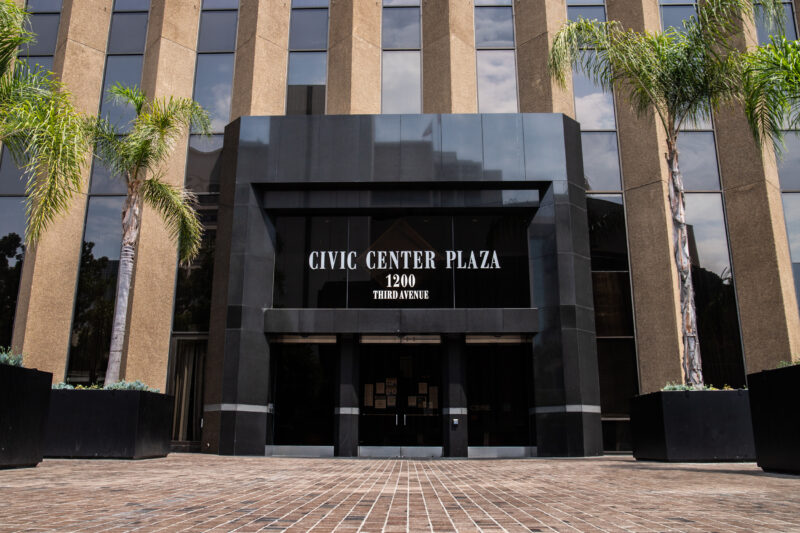
The long-ailing Civic Center redevelopment plan seems to have hit another snag – if you can believe it. At least one leader from an agency floated as a key collaborator just isn’t that into the plan.
In the years since the much-ballyhooed proposal first came to the fore, the project has encountered a seemingly endless stream of roadblocks. A dearth of interest from private developers was an inauspicious start, but Mayor Todd Glora’s abandoning of the effort amid a massive city deficit seemed to be the final nail in the coffin. Then came the Prebys Foundation, which breathed new life into the whole thing.
Last month, a Union-Tribune article seemed to point to an even clearer way forward.
Here’s an excerpt from the piece:
“In the next few months, San Diego’s Prebys Foundation and the Downtown San Diego Partnership will formally ask the city to create a joint powers authority, or JPA, with the San Diego Community College District and the San Diego Unified School District to facilitate redevelopment of the Civic Center.”
A JPA, for short, would allow the partnering entities to do everything from buying and selling land associated with the redevelopment to issuing bonds and launching construction projects. The proposal would grant the JPA some oversight over the entire Civic Center area, including Golden Hall, City Hall, the Civic Theater, the City Operations Building and scandal-ridden 101 Ash.
For some, the creation of the agency seemed like one answer to intractable questions surrounding the long-stalled proposal. There’s just one problem – one of the most influential leaders at San Diego Unified said they haven’t heard much about the plan.
“The idea that we would participate in a joint power authority is something that got suggested in a UT article – that was the first I’d heard about the concept,” longtime San Diego Unified board member Richard Barrera told me. “There have really been no conversations that have allowed the board or the superintendent in any formal way to consider this.”
The lack of communication hasn’t been reserved to San Diego Unified officials. In the days after Mayor Todd Gloria’s State of the City announcement that officials were negotiating with the San Diego Community College District on a redevelopment of Golden Hall, I spoke with the district’s Chancellor Greg Smith. He was extremely excited about the project but said the district had floated the proposal to city officials months earlier. They only got their first indication of something concrete when staff contacted them in the days before Gloria’s speech.
The San Diego Unified view: That one of the major players in this proposed JPA hasn’t heard much of it is a pretty big problem. But there may be an even bigger one. Barrera doesn’t think there’s an upside in it for the district.
“When it comes to what we would get out of being part of a partnership that includes governance from the city, I just don’t see it,” Barrera said.
Don’t get him wrong, like many civic-minded San Diegans, he is enchanted by the prospect of a revitalized arts district smack-dab in the heart of the city. He’s even taken with the prospect of relocating the high school portion of the district’s aging School of Creative and Performing Arts downtown.
“In the best of all worlds there would be a burgeoning arts district that’s created and our school sits in the middle of that – that’s an exciting vision,” Barrera said.
Conversations about the school’s relocation have popped up again and again over the years, leading to the delay, in some people’s telling, of much-needed fixes to critical infrastructure. Earlier this year, I wrote about the repeated promises district officials made in bond measures over the years that have largely gone unfulfilled, leaving the school grappling with occasional flooding.
There are a couple big problems with San Diego Unified’s getting roped into a JPA, in Barrera’s view. First is that the district would need to own the land any proposed school sits on, meaning the city would need to convey it to the district. A JPA could allow for that. But more importantly, the district can only use its bond funds to build schools. It wouldn’t be able to chip in to the grander vision of an arts utopia where the city’s aging administrative headquarters now sit.
He also thinks the district can’t rely on the other authorities to fund the construction of a new school; that’s why leaders built in funds for the construction of a new SCPA into the bond measure that will be before voters in November.
“If a JPA is something that’s helpful to the larger redevelopment of the arts district, all power to them,” Barrera said. “I would start with a skepticism that the school district gets anything out of that.”
San Dieguito Wants UC’s to Bring Back SAT Requirements
It may be old hat to say Covid upended education, but it really is true. Many of the lessons learned were incomplete. Even more have been forgotten.
One of the most lasting changes has been colleges’ turn away from standardized exams like the SAT or the ACT. That was done for a pretty simple reason – it was damn hard to take SAT tests when the world shut down. But now, years later, big institutions and systems still don’t require standardized test scores for admission. The University of California system is one of them.
Standardized tests have long been controversial. Many educators and folks on the progressive side of the ideological spectrum have argued that they further marginalized already marginalized groups and pointed to outright racist origin stories. If you’re a real Voice of San diego reader you know that it is true that standardized test scores are heavily dependent on kids’ backgrounds and income levels. But some studies have found that dropping standardized tests can exacerbate existing diversity issues on college campuses.
In any case, this change has led to a whole lot of heartburn from various corners of educational and political ideologies. A heavily publicized report from UCSD showing students’ math skills have plummeted offered potent fuel to the claim that colleges were accepting less prepared students than they used to.
All of this is why a story from a couple of weeks ago caught my eye. The board of San Dieguito Union High School District passed a resolution calling for University of California colleges to reinstate SAT requirements for admission.
One local parent who happens to be a UCSD professor had a pretty interesting public comment: “Removing the SAT does not remove competition or demographic advantages; it just redirects the arms race. Students, parents and schools respond to whatever admissions rewards. Take away test scores and the effort shifts to more AP courses, more extracurriculars and squeezing every possible tenth of a point out of GPA. The remaining signals become more inflated and less informative,” Kyle Handley said.
Related: Last week a UC Berkeley professor published an op-ed arguing for the UC system to reinstate SAT requirements for admission. The professor’s argument was similar to that at UCSD – that more and more students were entering the college without basic academic skills, like the ability to do middle school-level math. Like the UCSD report, the op-ed was spread widely.
Then an enterprising young reporter at The Daily Californian, the student news publication of UC Berkeley, ran the writing through an AI-checker that flagged 33 percent of it as likely AI writing. The professor, Zvezdelina Stankova, later admitted to using AI, but only to edit the work.
People who live in glass houses, etc., etc.
Start getting paid every month Thousands Dollars online.
💵 Earn $120+/hr | 🌍 grab it before it’s gone!”
TEB ON my name and read more,