

It’s been more than three years since a developer first proposed building a 259-unit, mixed-income housing project dubbed Seaside Ridge on an oceanside bluff in Del Mar.
And it’s been two years since the city of Del Mar and the Del Mar Fairgrounds started “exclusively” negotiating about possibly building a different affordable housing project on the Fairgrounds property with around 61 affordable units.
Time sure does fly when you’re trapped in a bureaucratic death spiral.
Those of you who have been following along probably heard that the Fairgrounds board ended those negotiations with the city of Del Mar last week. Some Fairgrounds board members said the project had gotten too complicated and it was no longer realistic.
The state’s housing department, or HCD, had given the city of Del Mar until November of this year to secure a lease agreement with the Fairgrounds for the project, and the exclusive agreement both agencies signed was set to expire in April 2027.
What’s more the agencies would have still had to tackle an annexation process to make the project work.
Since that decision, the team behind Seaside Ridge and Del Mar leaders have both chimed in. The Seaside Ridge developers are making it clear that their project is no longer optional.
Seaside Ridge Says ‘My Turn’
Now that the proposed Fairgrounds project is dead, Del Mar must identify where it can meet its state-mandated affordable housing goals.
Enter the city’s dreaded backup plan: Seaside Ridge.
City officials have repeatedly rejected the proposed project on Del Mar’s North Bluff, claiming the application is incomplete, fails to meet the location’s zoning standards, and is unnecessary given other affordable housing units the city had in the pipeline. The two sides are currently locked in a legal battle over those rejections – and the pipeline just dried up.
Under Del Mar’s state-approved housing plan, the state required the city to designate backup sites if the Fairgrounds deal fell through. The main backup location happens to be the exact North Bluff site Seaside Ridge is ready to build on. On Monday, an attorney for Seaside Ridge and the owner of the land Carol Lazier sent a letter to city officials with a clear message: It’s time to launch Plan B.
In her letter, attorney Brooke Miller included a section of Del Mar’s state-approved housing plan, known as the 6th Cycle Housing Element. Under that plan, the city committed to rezoning vacant land at North Bluff and South Stratford for higher-density residential development if it could not secure a lease agreement for the Fairgrounds site.
She also referenced a letter that state housing officials sent the city of Del Mar in January of this year:
“HCD reminds the city that [rezoning of North Bluff and South Stratford] is required should [the Fairgrounds project’s] binding agreement be suspended or terminated or should development of the Fairgrounds Affordable Housing project be rendered infeasible within the 6th cycle planning period by additional delays or extensions of key milestones.”
Finally, Miller writes that city officials seem to be trying to dodge the mandate altogether. She writes that Del Mar has quietly started implementing a lower-density zoning alternative for the North Bluff site (called “RM-North Zone”) for the state’s 7th planning cycle.
Carol Lazier Doubles Down
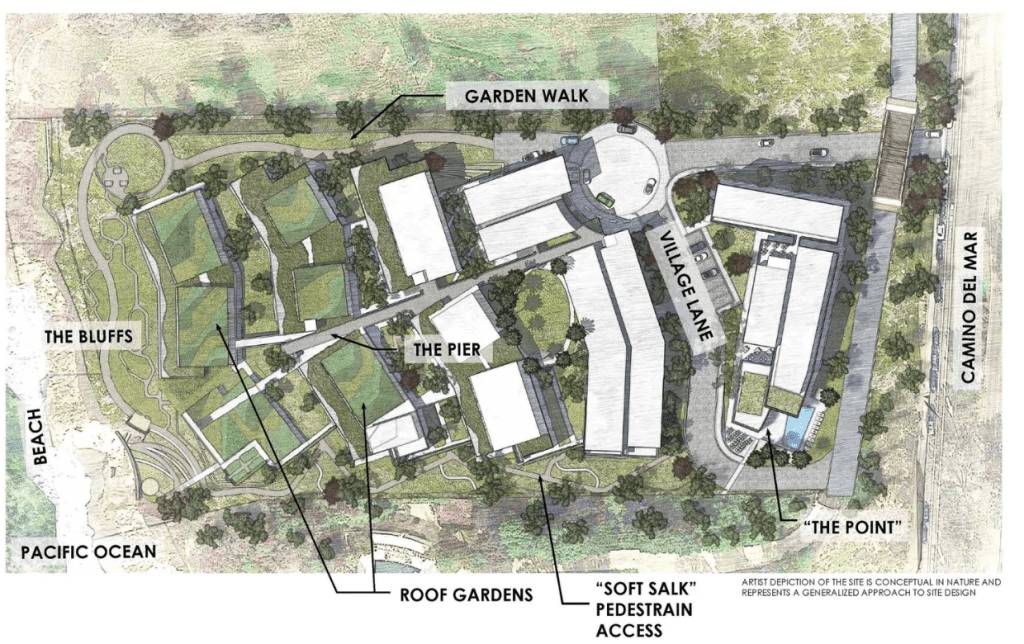
The owner of the North Bluff property and developer of Seaside Ridge Carol Lazier also sent a letter to the city of Del Mar on Monday urging the city to fall in line.
“This is no longer a question of whether the city should pursue the Fairgrounds strategy. Nor is this simply a question of what Del Mar might want to do in its next Housing Element as suggested with the discussions considering a new ‘RM-North Zone’ for the 7th Cycle,” Lazier wrote. “The city has already received clear direction from HCD and state officials on what must happen after termination of the Fairgrounds agreement.”
Or else, Lazier continued, Del Mar will face legal and financial consequences from the state, as well as continued litigation.
Del Mar Wants Another Chance at the Fairgrounds
Meanwhile, Del Mar is still stuck on what could have been.
Del Mar Mayor Tracy Martinez sent a letter to the Fairgrounds board last Friday urging them to reconsider their decision at their next meeting on Sept. 15.
She reminded the board about Gov. Gavin Newsom’s mandate to make way for affordable housing. The Fairgrounds board manages what is technically called the 22nd District Agricultural Association. It’s a state agency made up of board members appointed directly by the governor without confirmation from the senate.
“The governor has made it expressly clear that affordable housing is the most important issue facing California,” Martinez wrote in the letter. “Therefore, it is confounding that the 22nd DAA … would squander its best opportunity to rise to the governor’s challenge and build a significant and regionally important number of affordable units on state property.”
She also criticized the board’s decision as a “waste of public resources,” saying the DAA spent hundreds of thousands of dollars in state grant funds that Del Mar had obtained to study the proposed project and then “prematurely reject” it.
And finally, Martinez wrote that there was misinformation shared by Fairgrounds staff and board members at the Aug. 18 board meeting. She pointed to an error in a timeline document that the board referenced, which apparently misdated the start of affordable housing talks between the city and the Fairgrounds.
She claimed that board member Ted Miyahara, who made the final motion to terminate the agreement, was also inaccurate in some of the ways he described the annexation process.
In Other News
- Oceanside has created a special working group of city officials to review flood-response procedures and clear storm drains, creeks and the San Luis Rey River to get ready for El Niño. (Union-Tribune)
- Vista’s 70-year-old Bobier Elementary School has reopened after a $100 million rebuild. (Coast News)
- Stone Brewing, which was purchased by Sapporo USA in 2022, is closing its Escondido location after 20 years and expects to lay off around 220 employees. (Coast News)
In California, we get closer and closer to centralized planning at the state level. The result will probably be like China–overbuilding or building the wrong type of housing in places where there is not demand.
There seems to be no recognition that the housing “crisis” in California is largely due to incomes not keeping up. The “supply” argument is partially true, but not the primary driver. From the San Francisco Federal reserve:
https://www.frbsf.org/research-and-insights/publications/economic-letter/2026/02/housing-affordability-and-housing-demand/
Population and incomes have a greater effect on prices than housing supply. But that’s not what people want to hear.
In desirable places like San Diego, buyers are competing against well educated, high income couples. Take out immigration, and California and San Diego are losing people. Just ask yourself, with a declining population and birth rates below replacement, where are these renters and buyers going to come from? The developers won’t care once they’ve made their money.
This Del Mar complex will have no problem filling up with high income people because it is near the ocean. Places like city Heights, Kensington and other “transit desirable” places will end up with a bunch of high-rise units that are partially filled.
At some point, I hope the voters will revolt and we will see a citizens initiative to take back planning.