
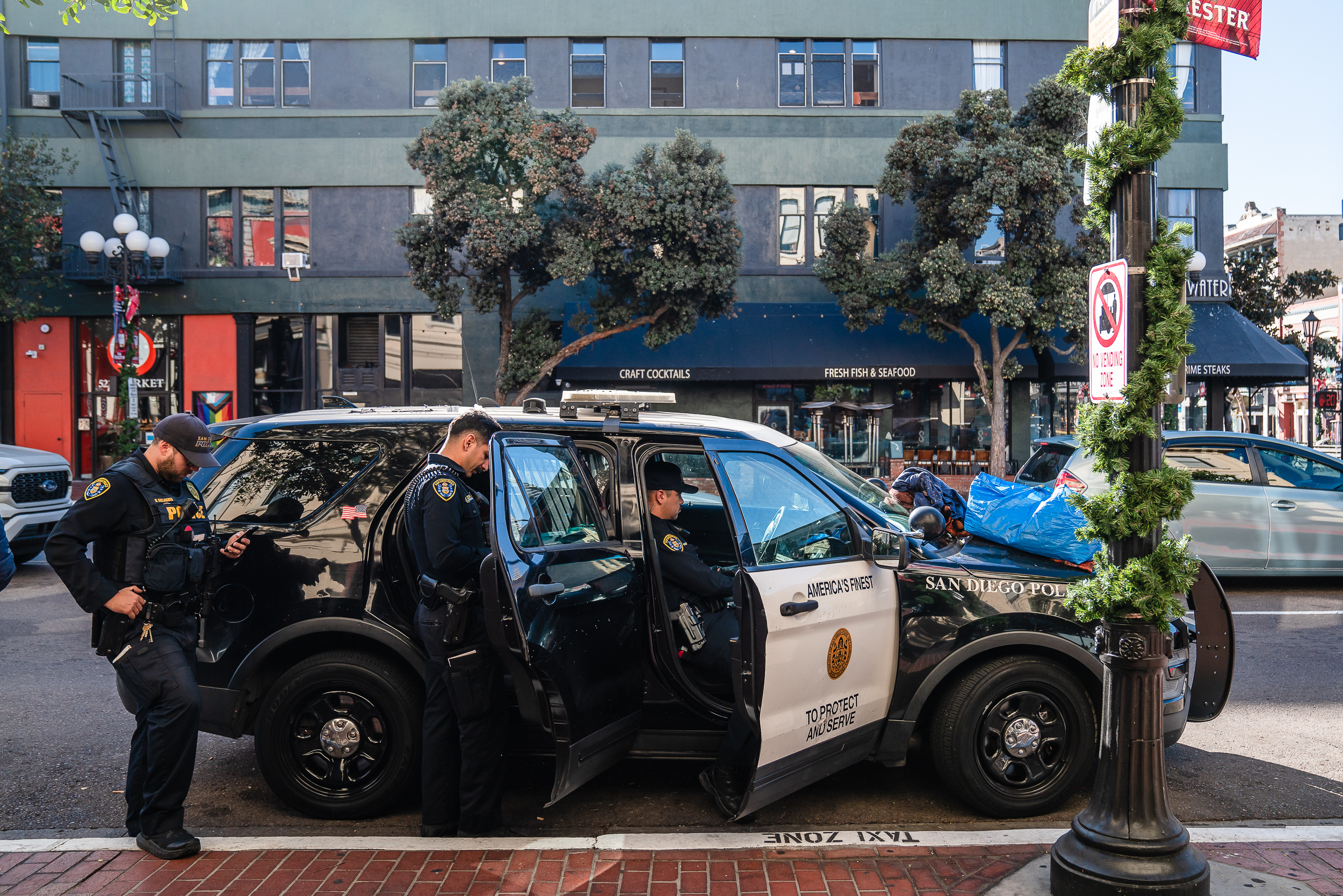
Earlier this year, the San Diego Police Department made headlines for a policy that prohibited officers from using artificial intelligence to produce police reports. Now, the department is opening the door to do just that.
A request for information issued by the department on July 31 describes the department looking for a program “that utilizes AI technology to assist officers and investigators in writing police reports.”
“The goal of this initiative is to enhance efficiency in report writing, thereby allowing officers to respond more quickly to calls for service,” the request for information reads.
The request for information notes that the program must allow users to maintain control over the “content and structure of their reports.” It also notes that it is not a request for proposals and is being issued “solely for information gathering and planning purposes.” The document estimates the contract value to be somewhere between $500,000 and $3 million.
In an email, SDPD spokesperson Ashley Nicholes emphasized that the department is just in an “exploration phase” during which they are working to learn what’s out there and what best practices for such technology is. Should they choose to pursue AI-assisted police report programs, they would conduct outreach to elected officials and community members, she said.
“SDPD is constantly looking at ways to maximize efficiency throughout the department, particularly given current staffing shortages of front line officers. With the emergence of AI technology, this may be an option to reduce time spent on certain tasks to put officers back in the field responding to additional calls for service faster,” Nicholes wrote.
The request comes less than a year after the department instituted a policy that, at first, seemed wholly contradictory. In December, the department forbade officers from using AI platforms to generate reports.
“The Department does not authorize the use of any generative Artificial Intelligence programs to author a police report,” read the memo, first reported by CBS 8.
The policy change came shortly before Senate Bill 524 went into effect. The law required police departments statewide to begin to develop policies regulating AI use. It also required that departments disclose if AI was used to write reports and hold on to any body-cam footage and audio to allow for future audits.
But the San Diego Police Department’s policy came with a huge asterisk: it only prohibited officers’ use of non-department-approved AI platforms. So, what may have seemed like a blanket ban was really just a time-out, assuming the department officially approved an AI platform.
Khalid Alexander is a professor at San Diego City College and the founder and president of Pillars of the Community, an organization dedicated to supporting San Diegans impacted by law enforcement. To him, the prospect seems all bad.
“It’s just one more example of them trying to take any kind of humanity away from policing,” Alexander said.
But it goes deeper than that for him. He not only worries about whether systems stuffed full of information about people on the worst days of their lives are actually secure, he also worries about over-reliance on the technology.
As an instructor, he constantly sees students relying on AI to complete coursework. What it produces is work rife with errors, hallucinations and nonsense. He said he imagines a typically flawed system used in a law enforcement context will have even worse repercussions.
“The problem isn’t just that they’ll use it, it’s the assumption that the technology is less biased and more correct than human beings,” Alexander said.
A handful of local law enforcement agencies have already leaned into AI. Both the Chula Vista Police Department and the San Diego County Sheriff’s Office utilize AI programs that transcribe residents’ non-emergency calls and route them to the appropriate place in a bid to free up dispatchers to take more emergency calls.
Chula Vista, which has wholly embraced such technologies, also utilizes AI to write police reports.
“We’re estimating usually three to five hours per shift spent on report writing,” Chula Vista Police Department Chief Roxana Kennedy told CBS8 in November. “If that means that officer is going to get back out on the street quicker, it’s super important.”
Still, law enforcement’s usage of AI has long sparked controversy. Many of those concerns have centered on the often-troubling biases programmed into AI platforms. But as AI platforms have become more integrated into everyday life, other worries have emerged, like whether the tendency of AI platforms to flatter and confirm the priors of their users can negatively impact police investigations.
Already, there are scores of examples of AI platforms bungling police-related tasks, leading to real-life consequences for innocent individuals, particularly when it comes to reliance on facial recognition software.
All of these concerns have been sent into overdrive by increasing pushback against AI-enabled surveillance cameras like Flock, of which San Diego has a robust network. Last year, one local man spent nearly a month behind bars after being arrested for a crime he didn’t commit thanks to a misidentification from a Flock camera
The use of AI to create police reports has been panned by some opponents and experts. Studies have found that AI can produce writing that is better, at least technically, but may not actually save officers time.
One recent study found that AI-generated police reports were “rated substantively and significantly worse on accuracy,” according to Ian Adams, a former police officer and criminology professor who ran the study.
“For a document whose downstream readers are prosecutors deciding to charge, defense attorneys probing for inconsistencies, and judges and juries reconstructing events months later, accuracy is the threshold condition,” meaning it is a minimum requirement, Adams wrote in a post on LinkedIn.
The platform used in that study was created by Axon, a company that creates all sorts of technology for police departments. In fact, the body-worn cameras used by San Diego police officers are made by the company, allowing for easy integration and even automatic uploads should the department opt to contract with the corporation. It also includes safety elements, like a feature that requires human input in all written reports and even manually inserts nonsense phrases to ensure reports have been reviewed by officers.
Andrew Ferguson is a law professor at George Washington University who specializes in police surveillance and the impacts of the integration of AI into policing. In a 2025 law review article on AI-produced police reports, he wrote “the danger for the criminal legal system is the digital poisoning of the facts in criminal trials by algorithmically altering the narrative.”
Still, Ferguson doesn’t view himself as an out-and-out critic. The current reality of human-produced police reports is far from optimal. After all, humans produce errors as well. But he does count himself as a skeptic.
“Because most of the history of police technologies has usually been one of adoption, ‘Oops, we created a problem,’ scandal, news report and then walking it back,” Ferguson said.
To him, there’s no question that AI will only become more integrated into policing. It’s already happening quicker than we realize. But officials and the public needed to understand there are inherent dangers in “moving a very human job to a less human mechanism.”
“The question is what human aspect are you losing, and what do you do to make sure that there aren’t real errors or problems in the technology?” Ferguson said. “The thing that I find the most frustrating is that we never seem to ask these hard questions before we roll out the technology. If we were really asking the questions beforehand, we might have avoided some of the more obvious errors before using tax dollars to pay for this stuff.”