

San Diego County leaders and advocates responded with dismay over the past year to President Donald Trump’s repeated efforts to upend U.S. homelessness policy.
In a series of executive orders and budget moves, Trump has sought to undo Housing First, a widely adopted approach to homelessness that seeks to provide people with immediate housing without preconditions.
Instead, the administration seeks to elevate what it describes as treatment-first programs that require homeless people to resolve addiction and mental health problems before receiving housing.
Local pushback to the administration’s efforts has included the city of San Diego joining a multistate lawsuit against restrictions on federal housing grant funds.
But not every part of the county has joined the resistance.
In San Diego’s predominantly Latino border region, the debate between Housing First and treatment-first approaches appears mostly over. And Housing First appears to have lost.
No city in the region has gone so far as to reject Housing First publicly, or, like cities such as Encinitas and El Cajon, reject grant funds that include Housing First provisions.
But leaders in the region have made their preferences known via policy choices.
Led by Chula Vista, South County’s largest city, the region’s homeless services now focus primarily on clearing encampments, providing temporary shelter, expanding affordable housing and steering homeless people toward treatment programs to resolve addiction and mental health problems.
The kind of permanent supportive housing called for by Housing First is a small component of each city’s efforts.
National City sets aside 24 supportive units for veterans transitioning out of homelessness in a larger affordable housing project. Imperial Beach likewise set aside 25 units in a senior housing project for older adults exiting homelessness. Chula Vista is building or helping to fund a few dozen permanent housing units.
The main focus of each city’s efforts, however, is temporary shelters that either require or strongly encourage residents to engage with treatment and other programs that help people transition to independent living.
The centerpiece of National City’s homelessness response is a faith-based shelter that encourages sobriety and refers clients to residential treatment and other support programs. The shelter is operated by the San Diego Rescue Mission, a faith-based nonprofit that operates a countywide network of shelters and treatment programs.
The shelter recently was the site of a press conference at which U.S. Health and Human Services Secretary Robert F. Kennedy, Jr. unveiled a new Trump administration “Best Practices Toolkit” for homelessness policy that promotes treatment and other non-Housing First approaches.
Rescue Mission CEO Donnie Dee stood beside Kennedy at the press conference and spoke about his shelter’s strategy.
Chula Vista operates its own shelter, contracting with a Los Angeles faith-based non-profit called City Net to run a 62-bed tiny home complex that requires residents to work toward resolving whatever issues caused their homelessness.
Chula Vista Mayor John McCann recently described the shelter as “high barrier, so you’ve got to be clean.”
Earlier this year, Imperial Beach entered into a two-year agreement with Chula Vista that effectively yokes the two city’s homelessness efforts. The agreement enables Imperial Beach to use beds in Chula Vista’s shelter and tap into the city’s rental assistance program.
Even in San Diego’s City Council District 8, the portion of the city that includes Barrio Logan, San Ysidro and other neighborhoods south of downtown, leaders are voicing skepticism about Housing First.
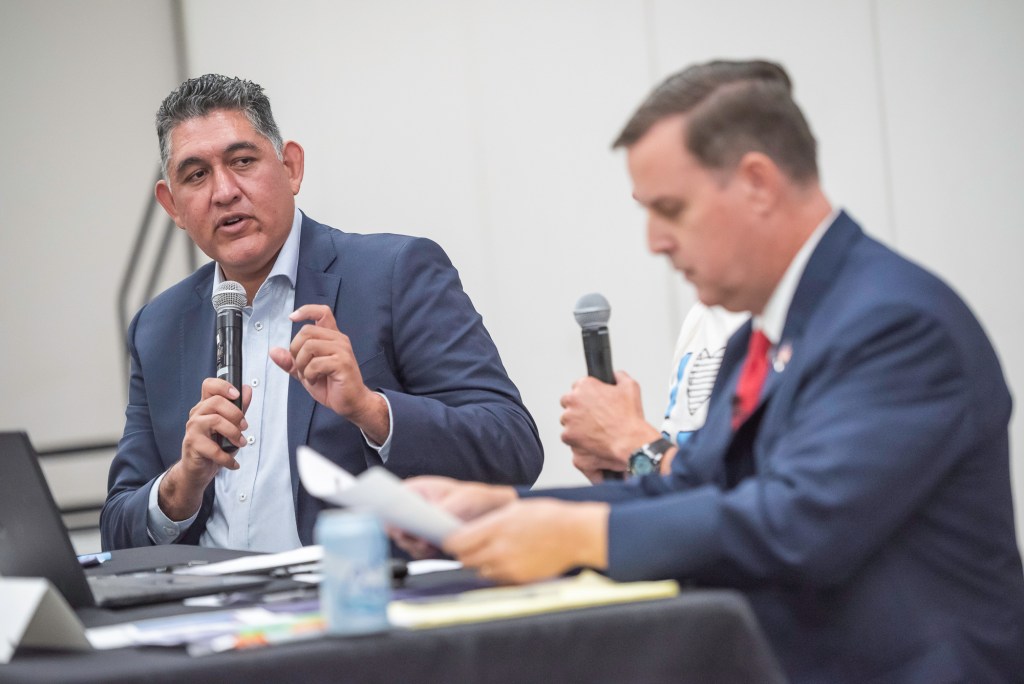
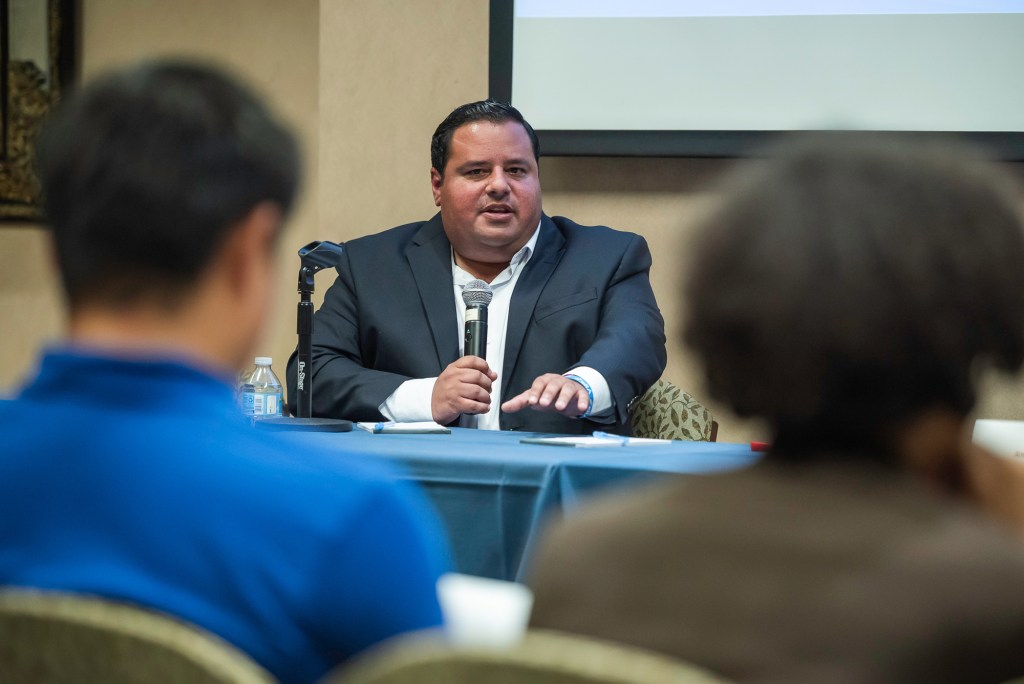
Asked at Voice of San Diego’s recent Politifest public affairs forum whether he supports Housing First, San Ysidro School District Trustee and District 8 City Council candidate Antonio Martinez said he does not – at least not always.
“We need to tackle other issues before housing,” Martinez said. “Drug addiction, mental illness, families that are living in their car…We have to look at each case separately, because housing helps some but not all.”
Martinez’s rival in the race, District 8 Chief of Staff Gerardo Ramirez, said he neither supports nor opposes Housing First because he said policy labels matter less to him than whether programs effectively help people transition off the streets.
“Focusing on…the data and results, that’s what works,” he said.
Ramirez said he thinks the city needs to do a better job providing more high-quality drug and mental health treatment – and compelling people in some cases to accept treatment if they refuse.
“We have to approach this with tough love…and compassion,” he said. “If we don’t do more and hold [people] accountable, we are never going to solve this issue.”
In a recent debate between Chula Vista mayoral candidates, McCann, a Republican seeking re-election, said his city’s approach, which he described as one of San Diego County’s strictest, is working.
“We were very innovative because we wanted to create a bridge shelter,” he said. “And we were very successful at that…This year, the number of homeless individuals went down by 25 percent, one of the highest decreases in homelessness in the entire county.”
The most recent regionwide count of San Diego County’s homeless population shows the number of unsheltered homeless people in Chula Vista declined by roughly 25 percent last year. By comparison, the city of San Diego’s unsheltered population declined by 7 percent. Countywide, the decline was 11 percent.
McCann’s Democratic rival in the mayoral race, Chula Vista Elementary School District Trustee Francisco Tamayo, mostly echoed McCann’s positive assessment of Chula Vista’s policy.
“Shelters are fine,” he said. “It’s a great idea and I can’t argue that one.”
Tamayo’s only proposed change, he said, would be adding more job-training and other forms of support to enable homeless people to become self-sufficient.
“What is the next step to move homeless people to be real productive citizens of our city, to contribute to our city?” he said.
The move away from Housing First comes as cities across the region face calls from residents to prioritize lowering costs for people who already have a home.
Studies also show Latinos have complex attitudes toward homelessness, with some feeling wary of government programs and others prioritizing family ties and multifamily households over seeking help via publicly funded supportive housing options.
South County candidates for mayor and city council this year, many of them Democrats, uniformly have staked their campaigns on pledges to lower housing costs, build more affordable units and increase home ownership opportunities.
None feature homelessness as a centerpiece of their campaign.
Among South County governments, the city of San Diego has done the most to enact Housing First policies. Mayor Todd Gloria recently touted the city’s approach in an update to the City Council.
“We have nearly doubled the resources available across our homelessness response system, including more than doubling permanent supportive housing,” Gloria said. “That approach is producing measurable progress, with unsheltered homelessness declining for two consecutive years and significant reductions among veterans and young people.”
Nevertheless, Martinez in District 8 said he thinks Housing First should not be the primary focus of city policy.
“For those individuals that are working two, three jobs but can’t make ends meet, I think housing is a perfect solution,” he said. “But I think that when it comes to homelessness in general, comprehensively, there’s no one solution that fits all. For a person that’s struggling with drug addiction, maybe helping them with their drug addiction first is the first solution before anything else.”
Research on the effectiveness of Housing First is mixed. Numerous studies show the policy increases homeless people’s housing stability and dramatically reduces their use of emergency services and run-ins with law enforcement.
Longer-term effects on communities as a whole are less clear. Cities such as Los Angeles, which have poured billions into building permanent supportive housing, have not seen a large reduction in homeless numbers.
McCann said what he described as his city’s more balanced approach is simply more effective.
In addition to its 62-bed shelter, Chula Vista offers rental support to residents struggling with housing costs, outreach referrals to domestic violence shelters and other programs – and a few permanent supportive housing options, including a converted motel that the city says will house 27 formerly homeless residents when it opens early next year.
Since opening in 2023, the city’s shelter has enrolled 210 clients and, last fiscal year, helped 39 of them transition to permanent or temporary housing, said Stacey Kurz, Chula Vista’s director of housing and homeless services.
The number of unsheltered homeless people in the city declined from 470 to 355 last year. The 25-percent drop was the largest in South County but not as large as drops in Encinitas and El Cajon. Other large cities, including Oceanside, Carlsbad and Vista, saw a rise in unsheltered homelessness.
The number of sheltered homeless people did rise in Chula Vista last year, from 144 to 340, But Kurz said that increase consisted almost entirely of 211 people temporarily placed in city hotels by a county program. The actual number of unsheltered people in the city, she said, was 129, a decrease from the previous year.
“We have a high barrier,” McCann said of Chula Vista’s shelter program. “[Our goal is to] be able to take care of issues and help the individual get back on their feet.”