
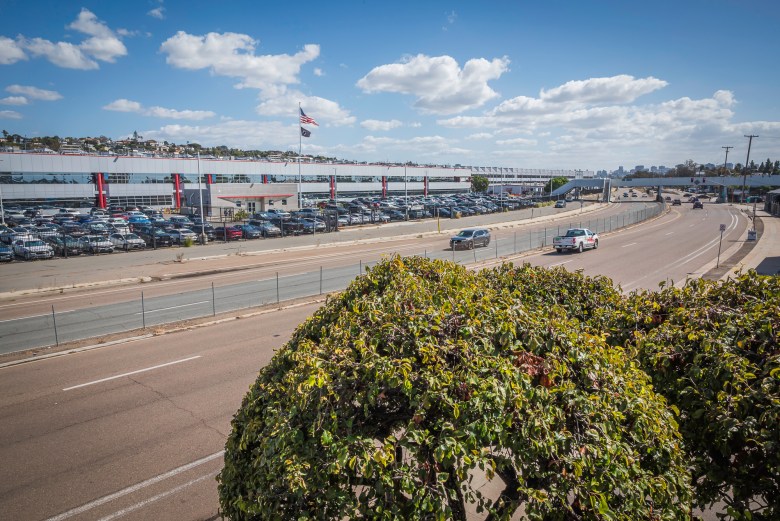
The San Diego City Council votes Tuesday on Mayor Todd Gloria’s proposed temporary ban on large data centers. The vote would put an emergency ordinance into place and pause for 45 days all pending applications for data centers, buying the city time (the City Council can renew the ban with consecutive votes for up to 20 months) to come up with regulations for how data centers might fit within city zoning.
Gloria’s team had apparently already been working on a temporary ban for weeks, we reported in the Politics Report. They’d been waiting for input from the city attorney’s office. Then earlier this month, I broke the news that Manchester Financial Group was exploring the possibility of building a 400-megawatt data center on the U.S. Navy property near the Midway District. That added a lot of pressure to get the proposed ban on the books.
Even if the ban passes, the city can’t really do much to stop a data center from being built at 4301 Pacific Highway. City councilmembers already acknowledged that.
“Because NAVWAR is federal land, the moratorium can’t stop that project,” reads a press release from Councilmember Sean Elo-Rivera’s office.
It turns out very little can stop data centers from popping up on federal property. A big reason for that is Donald Trump.
Trump has ordered the Secretary of Defense to proactively identify sites on military installations that could house data centers.
On July 23, 2025, he also signed Executive Order 14318, fast-tracking data centers larger than 100 megawatts through permitting processes under the Clean Air Act, the Clean Water Act and the Toxic Substances Control Act. Data centers that are funded with mostly private dollars would mostly be excluded from environmental review under the National Environmental Policy Act, or NEPA, as well. NEPA is a landmark environmental law passed in 1970 requiring federal agencies to assess environmental impacts before making major decisions on permits, land management and constructing highways or publicly owned facilities.
“This administration has watered down NEPA to where it’s pretty meaningless these days,” said Debbie Sivas, who teaches environmental law at Stanford University. “I don’t think people realize how much they’ve tried to neuter the laws because it’s going on in real time.”
She said the Trump Administration’s opinion on what kinds of projects are subject to NEPA is “extremely narrow.” Each federal agency was allowed to adopt their own way of regulating under NEPA and, to her surprise, their interim guidelines went into effect right away.
Manchester is currently negotiating with the Navy on what kind of redevelopment project might take place on the NAVWAR site. Manchester is supposed build the Navy a new command center and, in exchange, be allowed to redevelop the rest of the land. The final project will absolutely include some housing, Manchester officials have said, maybe as much as thousands of units. It also could include hotels, restaurants and other commercial uses.
The Navy started the NEPA process for the project back in 2020 and released a draft environmental impact statement in 2021. Such a step allows the public to comment on their proposed plans, for which the Navy received over 650 letters and 1,000 comments. Under NEPA, the government is supposed to respond to each one.
Sivas said when those sweeping changes to NEPA were announced, government officials said they wouldn’t apply retroactively to projects that were already in the middle of the process. That means, in theory, the old regulations should apply to the NAVWAR project.
Sergio Hernandez, a spokesperson on behalf of the U.S. Navy, told me the agency expects to publish a revised draft environmental impact statement in 2027.
A new Politico poll showed at least half of Americans oppose data centers being built within three miles of their home and Americans on both sides of the aisle are more likely to back candidates that oppose them. The topic has captured the public’s attention in political races and debates across the country as the Nov. 3 midterm elections draw nearer.
Hundreds of cities have placed bans on data centers and that’s partly why developers appear keen to turn to federal land to build them.
In January, the Department of Defense solicited competitive bids from developers interested in leasing land from the U.S. Army to develop commercial data centers at Fort Hood and Fort Bliss in Texas, Fort Bragg in California, and Dugway Proving Ground in Utah.
Sivas likened what’s going on with data center development to how the Trump Administration is building detention centers on federal land to house people migrating into the United States.
“They’re trying to get onto federal property to get a shield from local opposition,” Sivas said.
Around the Environment
- Rep. Scott Peters, a Democrat from San Diego, says a bill making its way through Congress would place the electricity costs of data centers onto developers. (Union-Tribune)
- I joined KPBS Roundtable to talk about data centers last Friday. Listen here.
- In other moratorium news, the city of Escondido extended its data center moratorium until August 2027.
- This San Diego airport in Kearny Mesa leads the nation in lead pollution. (inewsource)
- An Orange County woman sued San Diego Gas and Electric over the Norte Fire in San Clemente. (KPBS)
- Tammy Murga at KPBS interviewed the new curator for birds at the Natural History Museum. Here’s a profile I wrote on the former curator, who served 50 years at the museum.
- High tides pushed bay water onto the doorstep of at least one Mission Beach resident. The National Weather Service warns flooding could continue through Thursday afternoon. (ABC 10)