
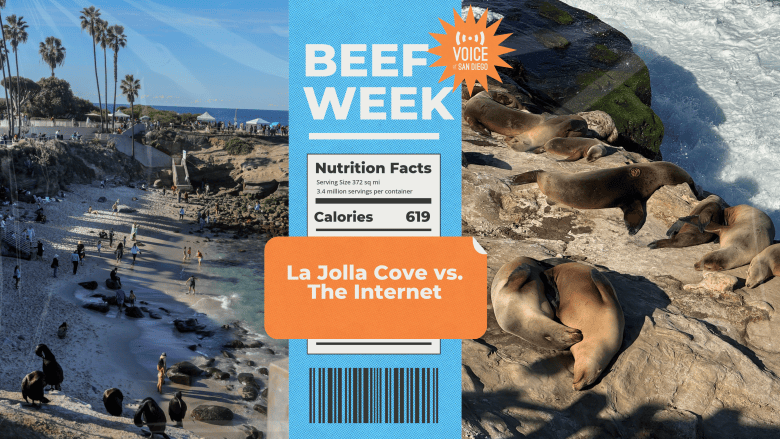
For the last 25 years, La Jolla’s preoccupation with pinnipeds – the family of flippered mammals that includes sea lions, seals and walruses – has been as reliable as the tides that erode its western edge.
Nearly every aspect of the animals’ presence on La Jolla’s mile-long strip of cliffside beaches, from the seals in Children’s Pool to the sea lions in La Jolla Cove, is subject to contention. Locals fight over when they arrived, why and “who” put them there (a popular theory suggests they were “dumped” in the cove by SeaWorld in the 90s). We know there are many more of them than there were a few decades ago, but the exact number remains mysterious, as does the mortality rate of their pups – a subject of great concern in conservationist circles. Scientific research on the local sea lion and seal populations is minimal.
More than anything, we cannot agree on what, if anything, to do about them.
In the past year, a steady stream of internet virality has inflamed this La Jolla Cove beef far beyond the edges of its tiny beach.
It began in February, when the cove was named the No. 1 beach in the nation on TripAdvisor’s “Best of the Best Beaches” list, further raising the profile of a destination that’s long been classified by locals as a tourist trap.
Then, at the peak of an exceptionally busy tourist season, a video of 18-year-old La Jolla resident Tyler Muehl kicking a sea lion just west of the cove went viral on social media. He has since pleaded guilty to harassing wildlife, a federal crime, and awaits sentencing.
Beef Week is a Voice of San Diego reporting series. This week our newsroom will bringing you stories about all the beef and battles in San Diego. Read more Beef Week stories here.
Four months have passed since that viral video, yet it remains a centerpiece of the conversation over what to do about La Jolla Cove. More than 76,000 people have signed a Change.org petition to close the cove permanently to humans, which was launched by Barrett Pall, a San Diego-based activist with 1.3 million Instagram followers who frequently posts about progressive causes.
The exact shape of the beef varies depending on who you ask. Some blame the tourists, others blame the sea lions. The city blames the federal government, while the conservation organizations blame the city. Meanwhile, Pall faults a vast network of monied interests, which he believes operates in the shadows to protect each other’s pocketbooks by keeping the cove open. While some wealthy La Jollans undoubtedly have a financial interest in maintaining tourism dollars, many others decry tourists for robbing their community of its quiet and charm.
“They just are not happy with how they feel the community has changed and I think it’s easier for them to blame the sea lions for that,” said Zach Cabading, a Scripps graduate who’s done research in the cove. “Like the sea lions have become the microcosm of the decay of La Jolla.”
We’ve seen a version of this before. For more than a decade, conservationists and beach access advocates fought over whether to close the nearby Children’s Pool due to its growing seal community. Their animosity manifested in a series of protests, physical altercations and lawsuits. As of today, three La Jolla beaches – Children’s Pool, Boomer Beach and Point La Jolla – are closed to non-swimmers for at least part of the year to protect the pinniped population.
The question of how to coexist with pinnipeds has historically involved swimmers, conservationists, La Jolla locals and a rotation of local leaders and politicians. But when I started making calls for this story, I was surprised when they all said the same thing: It’s time for the city to implement a partial closure.
A partial closure would likely mean limiting entry to one staircase by the lifeguard tower, and possibly maintaining a sign-in sheet for swimmers. This would prevent people from lingering on the beach, where most human-wildlife conflict happens, but keep the water open for swimming.
Even Council President Joe LaCava, who represents La Jolla on the San Diego City Council and has historically opposed the idea of reducing access to the cove, has come around to the idea of a partial closure.
The first elected official to suggest this approach was Matt O’Malley, who sits on the California Coastal Commission and is a former executive director of San Diego Coastkeeper.
“I’ve seen people punching the animals or putting their kids next to them for selfies, always getting way too close,” O’Malley said.
“I actually kind of boycotted the area for a while,” he added, saying his wife feared he’d get into trouble for passionately defending the sea lions.
Slowly, over the past few months, many stakeholders have ironed out their differences to rally behind a partial closure. The Sierra Club Seal Society says it supports a partial closure, and local nonprofit La Jolla Parks and Beaches recently pitched the idea of a partial closure during pupping season, which almost perfectly overlaps with the summer tourism rush.
But Pall the activist and his “Love Army” remain headstrong on a full, permanent closure.
“I think a partial closure is completely loaded with, again, more racism and classism,” Pall told me during an interview in mid-November. His videos have repeatedly made the point that scapegoating foreign tourists for wildlife harassment is racially motivated.
“How are you going to be able to enforce that in a way that is truly fair? To me, a (full) closure is easy to enforce.”
Tensions between swimmers, conservationists and others exploded at a La Jolla Town Council meeting in September. Researchers refuted a claim made by the Seal Society about mortality rates among sea lion pups at the La Jolla rookery, while swimmers mused about the cove’s spiritual and physical healing properties. Speakers yelled to “close the cove,” and some chastised Pall for his financial ties to Change.org, which sponsors his petition. He’s since expanded his network of sponsors to include DeleteMe, a service for scrubbing personal information off the internet.
“If you’re not getting paid for your work, you’re being exploited,” Pall said in response to criticism about his financial interests. “Do they want to exploit me the way that they’re exploiting the sea lions? I’m sure they would be fine with that.”
Lay of the Land (and Sea)
La Jolla Cove is a complex, multilayered ecosystem.
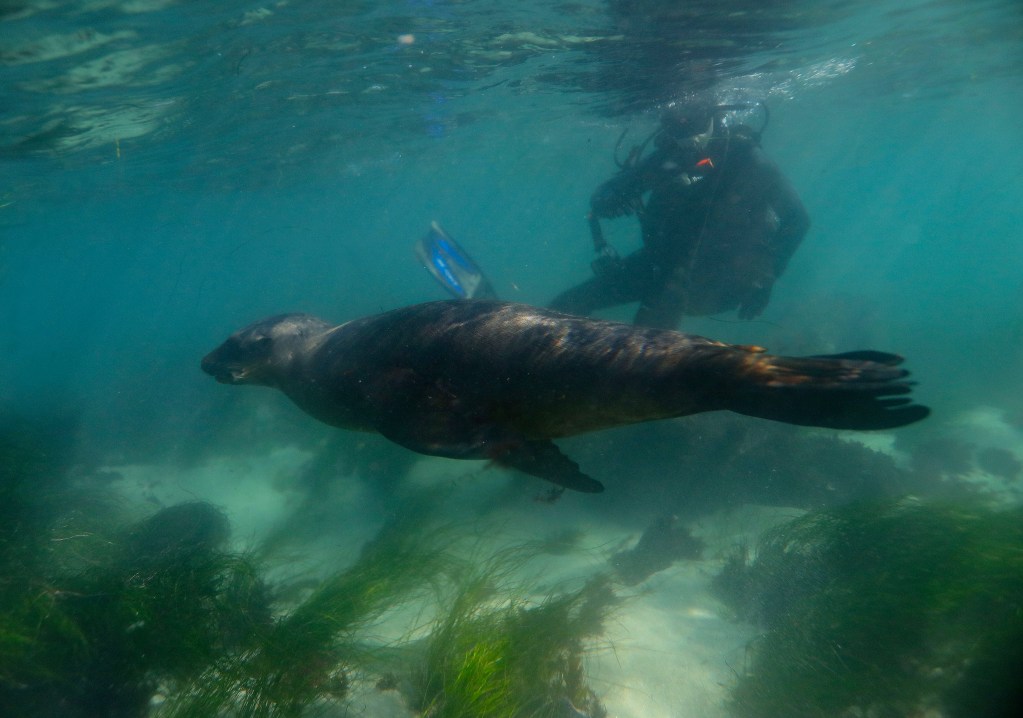
On its shallow seafloor, orange garibaldi flit through the seagrass, which moves to and fro with the cool currents, often revealing more life underneath it: horn sharks, lobsters, stingrays. Closer to the surface, baby sea lions juke out novice snorkelers as they adjust the tightness of their rented goggles.
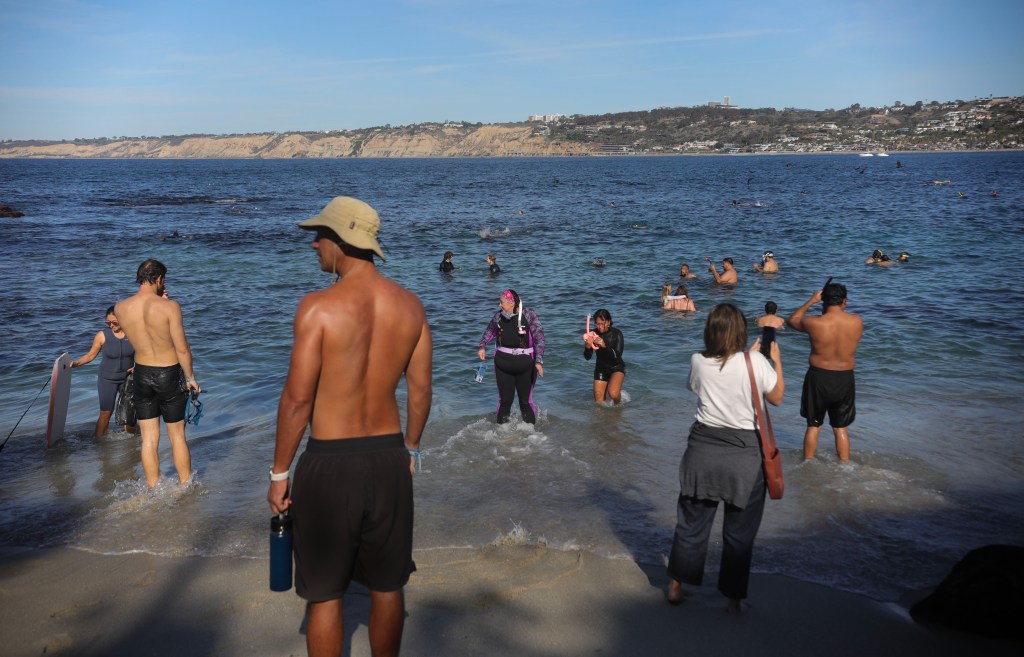
On the narrow sandy beach, humans laze about, some in wetsuits and others in brunch outfits, often mere feet away from the sea lions. Signs advise people to leave the animals alone, as do the lifeguards with their loudspeakers, often to no avail. On the street level, cars jostle for limited parking and pedestrians enjoy street meats that bear almost no resemblance to the AI-generated menus they were ordered from.
“I call this basically the free Sea World,” said Rocco, a vendor who regularly sells crystals and jewelry near the cove. “You get to park for free, you get to use the bathroom for free and you get to see the sea lions for free. And at a really, really number one beach in the world.”
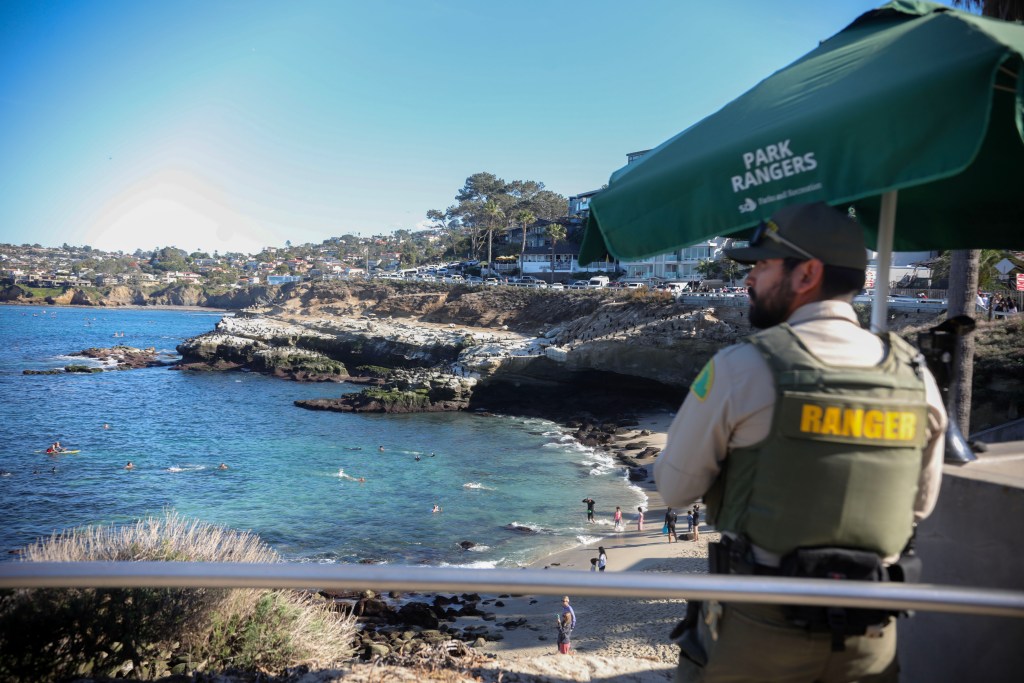
Less visible but nonetheless omnipresent is the layer cake of legal jurisdictions which govern the cove. From the city of San Diego, there are the lifeguards, who report to the fire department, and the park rangers, who report to Parks and Recreation. But sea lion harassment is technically a federal crime, illegal under the Marine Mammal Protection Act, meaning city workers can’t issue citations. They must come from federal rangers, of which there are only a handful along the entire west coast. Meanwhile, any attempts to mitigate the issue proactively by closing or limiting access to the cove would have to be approved by the California Coastal Commission, an infamously slow moving state agency.
Last December, the Coastal Commission approved a plan for greater enforcement and education at the cove in response to years of advocacy from the Seal Society and other conservation groups, and it was somewhat working. But gaps remain: city workers still can’t cite offenders, and once they clock out for the day, oversight is virtually nonexistent.
A joint letter penned in late October by Mayor Todd Gloria, Council President LaCava, Rep. Scott Peters and the Coastal Commission called upon the National Marine Fisheries Service (also known as NOAA Fisheries) to increase its enforcement presence and, crucially, give city workers the authority to enforce the Marine Mammal Protection Act. NOAA has acknowledged the letter but has yet to respond.
“Now, the spoiler is that we know that NOAA absolutely does not have the resources to do that,” LaCava said of the request for increased enforcement. “But we had that ask.”
If NOAA doesn’t deliver, LaCava said he hopes a partial closure could be in effect by June 2027, the start of pupping season.
This falls short of the demand made in Pall’s petition, for an important reason. A full closure would be legally tricky, if not straight-up illegal, under California’s constitution. Maintaining public beach access is one of the Coastal Commission’s core duties, but the city and state also have an obligation to curb animal harassment in accordance with federal law.
“With the Coastal Commission, there’s always a balancing act,” Commissioner O’Malley said. “The act itself says sometimes you have to balance things, but I have a hard time thinking that the Coastal Commission or the city would look for a full closure.”
History Repeats
It is worth remembering at this point that the city already navigated this issue with the Children’s Pool situation, and ultimately came to the same conclusion: a partial closure.
A duo of San Diego State researchers published a paper reflecting on the Children’s Pool debate in 2021, which concluded that the lack of early management of the seal issue led to an escalation of social conflict that made the issue increasingly difficult to resolve. It’s hard not to see the parallels.
“La Jolla Cove is becoming the same as Children’s Pool was back in the 2000s,” said Robyn Davidoff of the Seal Society. “Because the city is failing to implement tactics to keep people safe and away from the sea lions, the two groups are getting more polarized.”
LaCava and others contend that it was important to exhaust all options for mitigating the issue before proceeding with any kind of closure. But today’s battle, differently from the Children’s Pool situation, has been supercharged by a social media audience with little patience or interest in compromise.
“It does kind of create this third actor in the dynamics that’s beyond the people who are actually there on the beach and beyond the managers or any of the organizations who are advocating,” said Arielle Levine, a professor of geography at SDSU and co-author of the Children’s Pool study. “It becomes its own kind of beast that drives behavior.”
In lieu of a quick solution from the city, Pall’s videos have become increasingly conspiratorial, suggesting there’s a hidden network of friendships and financial ties between La Jolla community leaders, politicians and developers that has a vested interest in keeping the cove open.
“I don’t think they were ready for someone like me who came in and has white privilege and has a big platform and is not going to just go, ‘Oh, they’re Democrats. Great,’” Pall said.
It’s impossible to discern just how much of an impact Pall’s advocacy has had compared to other factors, but what is clear is that it’s more unpopular than ever to advocate for the cove to stay fully open. The needle has been permanently moved.
Pall said he will not stay quiet until violence against the sea lions ceases, regardless of the final solution.
“The story can be all of them versus me, but I represent a lot of people who haven’t had their voices heard because maybe they don’t have the same platform,” Pall said.
“I think a lot of these people in their everyday life probably agree with me on a lot,” he added. “I think a lot of them just don’t want to get uncomfortable in changing their own life, which is part of how we use our privilege to make change for everyone.”