
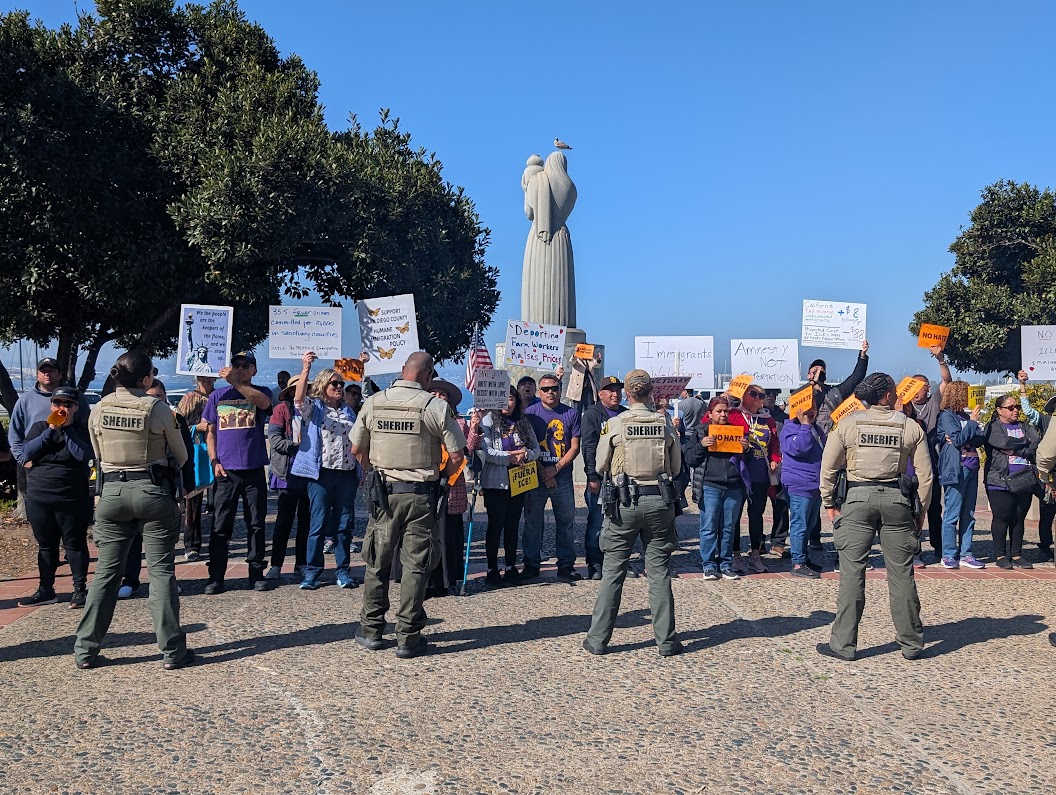
Late last year, anticipating a Trump administration immigration crackdown, San Diego County Supervisors enacted a new policy that sharply limits county cooperation with federal deportation efforts.
The law, controversial when it was adopted, now faces new opposition in Sacramento. Sen. Minority Leader Brian Jones recently proposed legislation that would outlaw what the county did.
Jones’ bill, SB 54, would require counties to adhere to California’s less strict sanctuary provisions, which gives local governments wider latitude to cooperate with federal authorities in cases involving immigrants convicted of serious crimes such as murder or rape.
SB 54 also would go one step further than current state law by requiring local governments to cooperate with federal authorities in such cases. The current policy gives local governments the option of cooperating but doesn’t require it.
Jones said San Diego County’s so-called “super-sanctuary” policy inspired his new legislation.
“Their reckless ordinance prohibited law enforcement from cooperating with immigration officials on illegal immigrants convicted of any crime, including the worst felonies,” Jones said, making “it easier for convicted illegal immigrant felons to return to San Diego streets and continue their crime sprees, regardless of how many felony convictions they have.”
Immigration advocates called Jones’ bill “a political stunt” that would align California with the Trump crackdown.
In other Capitol news: State Sen. Steve Padilla urged state lawmakers to adopt a so-called “AI Bill of Rights” to ensure that “AI systems respect human rights, promote fairness, transparency, accountability, and safeguard Californians’ well-being.”
Read the Full Sacramento Report here.
The New Front in Housing Battles: ADUs vs. HOAs
Over the past decade, California officials have done just about everything they can think of to expand the state’s housing supply.
They’ve forced cities and counties to plan for more density, stripped local governments of their ability to block housing projects, punished localities that don’t get with the program and even given individual homeowners the ability to turn their property into new housing by constructing accessory dwelling units, or ADUs, adjacent to their homes.
Increasingly, however, those aggressive legislative efforts are coming up against an implacable and all-too-familiar foe: The almighty homeowners’ association.
HOAs, as they’re known, are technically nonprofits but they act like mini-governments, enacting rules that limit what homeowners within the association’s boundaries can do on their properties. The aim is to control the look and feel of neighborhoods to preserve one of the sacrosanct pillars of California life: Property values.
HOAs, it turns out, don’t much like ADUs. And, increasingly, they are flexing their muscles and trying to shut such projects down.
In a fascinating story, CalMatters reporter Ben Christopher follows the saga of a homeowner in Carlsbad determined to convert his garage into an ADU, and the HOA that is equally determined to stop him.
The Mayor’s New Digs
Last week, Mayor Todd Gloria announced he was eliminating the position of chief operating officer.
Now, Gloria is taking over the responsibilities. Our editor Scott Lewis heard that the mayor is moving to the 9th floor. Lewis set out to learn how Gloria’s day-to-day will change.
“I spent some time talking this week with people who know how the city works. There was widespread surprise both that the mayor would want to oversee operations directly and that he thinks he can handle it,” Lewis writes.
Read more in the Politics Report.
VOSD Podcast: Our hosts unpack the mayor’s new responsibilities. They also explain the history of San Diego’s strong mayor system.
Listen to the full story here.
In Other News
- A rare positive update on San Diego County’s detox shortage: Interfaith Community Services expects to open 21 new beds on March 3 after sign off from the Escondido City Council. This means the county will soon have 100 contracted detox beds for Medi-Cal patients, up from the current tally of just 79 beds. Father Joe’s Villages hopes to add another 45 beds to that roster this spring at its East Village campus.
- San Diego City Councilmember Sean Elo-Rivera this week plans to introduce a proposal that would boost the minimum wage for workers at tourism-related businesses such as hotels and even centers to $25 an hour. The proposal has the backing of organized labor but is opposed by business leaders. (Union-Tribune)
- The San Diego City Council last week moved forward with a proposal to lower the speed limit to 20 miles per hour on certain business corridors in Pacific Beach, Mission Beach, Ocean Beach, Old Town, Hillcrest, North Park and City Heights. (KPBS)
- Encinitas residents are asking city officials to change the design of a traffic roundabout that they say recently has caused a disproportionate number of accidents. City officials disagree, pointing out that the majority of recent accidents at the site were caused by motorists driving under the influence. (KPBS)
The Morning Report was written by Jim Hinch and Andrea Lopez-Villafaña. It was edited by Andrea Lopez-Villafaña.